

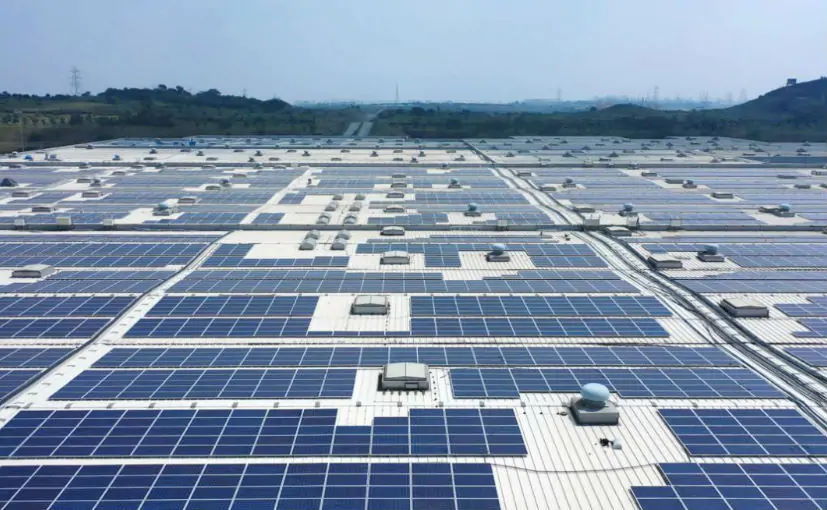
Researchers have analyzed how wind speed and direction affect the cooling of a rooftop PV installation with 10,806 panels. They say wind from behind was less effective due to the roof slope and the minimal gap between the panels and the roof, but wind from other directions could contribute to a cooling effect of up to 7 degrees Celsius.
Researchers from Turkey’s Bursa Uludağ University investigated the cooling effect of wind on rooftop PV installations. They measured temperature changes on a 57-hectare rooftop facility in the summer of 2023 and found that wind could have a cooling effect of up to 7 degrees Celsius, depending on direction and speed.
“It has been observed that a significant portion of studies in the literature focus on ground-mounted PV installations. However, this study examined rooftop PV installations, which are increasingly being used by many industrial facilities to reduce energy costs,” the group said. “The main difference between rooftop PV systems and ground-mounted applications is the roof geometry. Panels installed in sequence on busy rooftops are at a disadvantage compared to ground-mounted installations in terms of receiving cool winds.”
The solar site is located on top of a TOFAS automotive production facility in Bursa, Turkey. Bursa receives an average solar radiation intensity of 1,393 kWh/m² per year, and during the measurement period the wind blew predominantly from the northeast. The average wind speed from all directions was approximately 1 m/s, with the east experiencing the strongest winds with an average of 1.49 m/s.
On the roof there are 10,806 monocrystalline PERC half-cut PV panels, each rated at 545 W, contributing to a total rated power of approximately 5.9 MW. The panels are oriented 22° east of south, with a slope angle of 17.8° and a gap of 15 cm between the panels and the roof.
“The metered facility is in active use and the facility owner is collecting measurements from a single point. The measuring instruments include ambient temperature, irradiation and wind sensors. The PV temperature sensor is mounted under the panel,” the group said. “Wind measurement data is collected at one-minute intervals, while all other data is collected at 15-minute intervals.”
To account for wind speed effects, researchers combined and compared 50 events with similar irradiance, temperature and wind direction, but different wind speeds. They found that wind speeds below 0.5 meters per second (m/s) result in a limited cooling effect of 1 C to 3 C on solar panels, while speeds above 0.5 m/s increase the cooling effect to 3 C to 7 C.
Using back and side wind pairs, the research group was also able to analyze the effect of wind direction.
“The roof slope and minimal gap between the panels and the roof made winds from behind less effective as they could not penetrate the back of the PV panels,” the group said. “Sidewinds, on the other hand, had no trouble flowing over the panel surfaces, but lost their cooling effect as they flew past the long rows of panels.”
The researchers concluded that selecting locations with higher wind speeds is crucial during the design phase of a solar power plant. They noted the importance of properly configuring the installation to ensure wind can effectively reach all PV arrays. They added that optimizing the design phase can improve performance without incurring significant costs, especially as retrofitting an existing plant poses challenges and costs.
They presented their results in “Research into the cooling effect of wind on rooftop PV plants”, which was recently published in Case studies in thermal engineering.
This content is copyrighted and may not be reused. If you would like to collaborate with us and reuse some of our content, please contact: editors@pv-magazine.com.
