

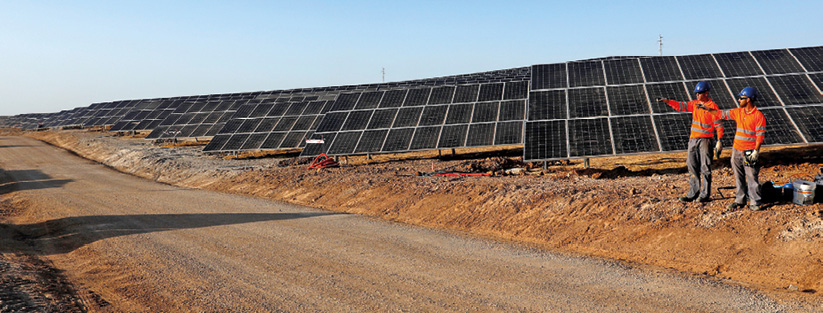
The Iberian Peninsula is emerging as a key test case for hybrid PV and battery storage, driven less by the inherent attractiveness of projects and more by the increasing pressure for standalone solar energy. As merchant exposure, price cannibalization, and curtailment risks increase, co-located battery energy storage systems (BESS) become a tool to stabilize revenues rather than unlock upside potential. In this context, aggregator contracts are moving towards more flexible, seller-driven structures. Everoze Partner Ana Bamonde explores this shift and what it means for the structuring, financing and operation of hybrid assets in Iberia.
Across Europe, PV-plus-battery storage projects are rapidly moving from concept to implementation, and Iberia is no exception. The accelerated deployment of solar energy, combined with increasing energy price volatility, a sharp increase in negative price hours in Spain and Portugal, and limited interconnection capacity, have created a strong case for co-location storage.
The standalone PV market has reached an impasse, with many turnkey projects struggling to secure financing and earlier-stage developments facing limited prospects as the risk to traders increases. These pressures have increased interest in co-location and modernization of BESS to optimize asset revenues and reduce wasted energy.
The regulatory frameworks for BESS are gradually being adapted. In Spain, recent decrees have sought to streamline hybridization permits, although access to grid permits remains a major bottleneck on the demand side. This is expected to decrease once Spain’s energy regulator, the CNMC, publishes its framework for flexible access to demand. In Portugal, hybridization rules have been established and recently streamlined through regulatory updates. While co-located BESS is permitted and grid charging is permitted subject to network approvals, certain support schemes (such as storage auctions) have imposed restrictions on charging, for example by requiring the majority of charging energy to come from renewable sources, which may limit operational flexibility.
In the absence of capacity markets or other stable, contracted revenue streams, hybrid projects in the Iberian Peninsula are necessarily anchored primarily on merchant revenues. Value creation is therefore centered on wholesale price arbitrage, intraday optimization, imbalance management and support services, requiring assets to continuously respond to market signals.
For the first co-located BESS assets that are now financially close, this means that optimization and aggregator agreements reflect a clear shift from rigid, bottom-line protected frameworks to lighter, vendor-driven profit sharing models. Profit-sharing arrangements allow assets to respond directly to market signals, with revenues linked to optimization performance rather than contractual guarantees. The critical importance of fully back-to-back guarantees is reduced and in some cases eliminated altogether. Instead, more attention is paid to assumptions around price volatility, optimization opportunities, shipping strategy and operational performance.
Financing and bankability
This newly acquired flexibility also allows projects to be completed financially based on draft optimization agreements only. In this rapidly evolving market environment, sponsors prefer to finalize commercial terms closer to operations, keeping their options open in case new revenue streams or regulatory mechanisms emerge. Rather than undermining bankability, this approach reflects a pragmatic response to current conditions, where flexibility and optimization for hybrid storage/PV assets are increasingly key value drivers.
Reality shows how wholesale price volatility encourages storage projects to function as an active optimization tool rather than a passive contracted asset. Contractual solutions that prioritize operational freedom are therefore better aligned with market fundamentals than rigid risk transfer mechanisms. Even if the underlying financing structures remain relatively simple, in the absence of long-term contracted revenue or capacity-based support, lenders and investors are increasingly assessing projects based on their technical and operational robustness rather than solely on predefined revenue certainty.
From a technical perspective, this places greater emphasis on the quality of revenue modeling assumptions and the credibility of the optimization strategy. Downside sensitivity to price volatility, curtailment and negative pricing is now treated as a central design consideration. As a result, technical due diligence extends beyond traditional energy yield assessments to include further assessment of storage logic, cycle assumptions, degradation expectations and the interfaces between the PV plant, BESS and the optimization platform.
In this way, aggregator and optimization agreements are now seen less as purely commercial tools and more as operational enablers. Rather than focusing on contractual guarantees, project stakeholders are increasingly seeking solace in alignment of incentives, clarity on control and dispatch responsibilities, transparency of performance reporting, and well-defined operational fallback arrangements. Where lighter contractual structures are adopted, technical safeguards and governance frameworks play a key role in mitigating execution risk.
Overall, this shift does not imply that Iberian hybrid projects are less bankable, but rather that bankability is demonstrated in a different way. Integrated assessments that link market behavior, asset performance and optimization capabilities to a coherent, defensible project story are needed most.
Defined by flexibility
Hybridization is a central response to market reality. Continued price volatility and declining PV prices, increasing constraints, limited interconnection capacity and the absence of capacity-based rewards have shifted value creation from contractual certainty to operational flexibility.
What sets Iberia apart is not just the lack of capacity markets, but also the way developers, investors and lenders adapt to that lack. Rather than replicating established European templates, the market is converging towards vendor-led models that reward optimization opportunities, informed risk-taking and robust operational strategies. While regulatory evolution may provide additional revenue stability over time, flexibility will remain the cornerstone of hybrid asset value in the region.
About the author
Ana Bamonde has been working in the renewable energy sector since 2014 and has gained experience across a range of technologies and markets. Over the years she has contributed to projects in multiple countries, mainly in Europe but also in South America and Africa, with a focus on solar energy and energy storage and exposure to the full project lifecycle. At Everoze, after two years in the UK office, Bamonde co-led the opening of the Madrid office in 2019. Since then, she has focused on market development, due diligence and operational advisory services in the Iberian Peninsula and other European markets. In addition to her techno-commercial consultancy work in the field of solar energy and storage, Bamonde represents the shareholding of Everoze on the board of directors of Skyray SAS.
The post Flexibility as an asset first appeared on pv magazine Global.
