

A research group has proposed a new method to control rates of increase in electricity networks. The control optimization is based on weather, load and production forecast data. The scientists simulated the operation of the proposed technique and achieved a reduction in the ramp rate of up to 76.2%.
A research team led by Japan’s Osaka University has proposed a new ramp rate control method using PV module cooling.
The ramp rate refers to the rate at which the output of a PV system changes due to environmental conditions over a given time. Controlling this can improve grid stability.
The traditional methods of controlling short-term fluctuations use battery energy storage system (BESS), controllable fuel power generation and load dumping. “The proposed method has low system costs and low environmental impact because it does not require a gas turbine or a large capacity battery,” the group explains. “In addition, the energy saved during output power fluctuations is not dumped, but effectively used in the PV cooling unit.”
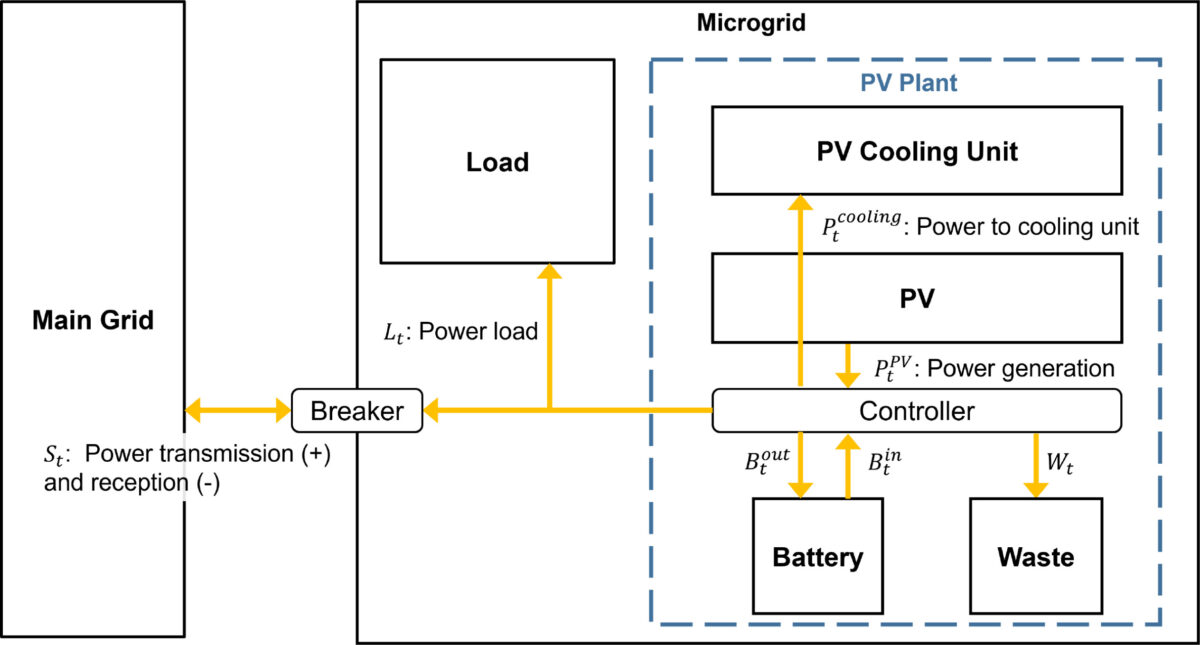
The core of the system is a control method that uses power demand, weather information and PV generation forecasts from the relevant microgrid as input. This optimization problem is formulated mathematically and optimal results can be obtained by a mathematical solver that can be run online, using platforms such as the Raspberry Pi.
The traffic controller then decides to initiate one of four possible situations.
In situation 1, the PV power corresponds to the demand, without significant fluctuations in the output and without cooling being activated. In situation 2, the PV power exceeds demand and the cooling unit is activated, preventing power surges to the grid as the modules produce more energy.
In situation 3, when a sudden increase in energy is needed due to a sudden drop in solar radiation or a sharp increase in demand, the cooling unit is turned off or its activity is reduced, and the power is sent to the electricity grid. In situation 4, the panel temperature gradually increases by stopping the cooling unit and the power boost is terminated.
To check the validity of the proposed method, the group tested it in a simulation. That includes a microgrid model in Oldenburg, Germany; a PV system consisting of 5,000 panels that together produce a maximum power of 1 MW; a cooling unit with a varying coefficient of performance (COP); and a small battery with charging capacity, which is used to support the system.
The new system was compared to a system that BESS used in the fall, winter, spring and summer. For each season there was a measuring period of 15 minutes in the morning, afternoon and evening.
“The effectiveness of our method was validated by simulation against real-world data, which showed an average and maximum ramp rate reduction of 43.5% and 76.2%, respectively, compared to traditional battery storage solutions,” said the team. “These improvements were achieved in particular with a cooling unit with a coefficient of performance of less than ten and a minimum battery capacity of 20 kWh, highlighting the efficiency of the method and its potential to significantly reduce system costs and environmental impact compared with traditional control strategies. ”
The results also showed that a traditional system would need a 100 kWh battery to show the same average and maximum ramp rate as the new method with a 20 kWh battery. “In other words, the proposed method reduced the required battery capacity by almost 80%,” the team concluded.
The method and its demonstration were presented in “Improving grid stability in PV systems: a new method for ramp rate control using PV cooling technology”, published in Applied energy. The research was conducted by scientists from Japan’s Osaka University, as well as the Belgian research and development organization Interuniversity Microelectronics Center (imec) and the Catholic University of Leuven (KU Leuven).
This content is copyrighted and may not be reused. If you would like to collaborate with us and reuse some of our content, please contact: editors@pv-magazine.com.
