

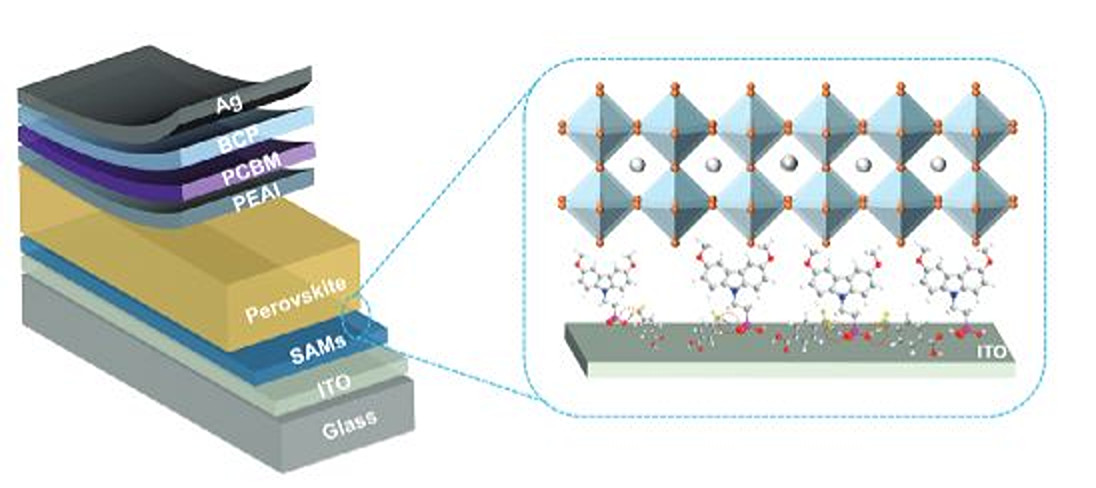
A research team in China improved the efficiency and stability of an inverted perovskite cell using a co-assembled approach to incorporate self-assembling monolayers into the hole transport layer.
A group of researchers from China Hangzhou Dianzi University has developed an inverted perovskite solar cell based on a hole transport layer (HTL) with a self-assembling monolayer (SAM) aimed at passivating defects and increasing efficiency.
Inverted perovskite cells have a device structure known as “pin”, where hole-selective contact p is at the bottom of the intrinsic perovskite layer i with electron transport layer n at the top. Conventional halide perovskite cells have the same structure, but in reverse: a ‘nip’ arrangement. With nip architecture, the solar cell is illuminated via the electron transport layer (ETL) side; in the pin structure it is illuminated by the HTL surface.
“With the introduction of SAM, the photoelectric conversion efficiency of inverted perovskite solar cells is significantly improved as HTL material, but clusters will be formed when SAM exceeds a certain concentration in solution,” said the study’s corresponding author Yue Zhang. pv magazine. “These cluster phenomena lead to a weak bond between the phosphate anchoring group at the bottom of SAM and indium tin oxide (ITO), which greatly affects the coverage of SAM on ITO substrate, resulting in loss of carrier extraction efficiency.”
The scientists have adopted a “co-assembled SAM (Co-SAM) strategy”, consisting of selecting additive material to be mixed with a common SAM based on a layer of MeO-2PACz, also known as [2-(3,6-Dimethoxy-9H-carbazol-9-yl)ethyl]phosphonic acid. This strategy was chosen to achieve optimal SAM coverage.
The academics designed the cell with a substrate made of glass and indium tin oxide (ITO), the MeO-2PACz layer, the perovskite absorber, a layer based on phenethylammonium iodide (PEAI), an ETL based on phenyl-C61-butyric acid methyl ester (PCBM)a bathocuproin (BCP) buffer layer and a silver (Ag) metal contact.
The group examined the perovskite crystals using scanning electron microscopy (SEM), X-ray diffraction (XRD), and photoluminescence (PL), and found that the grain size of the perovskite treated with Co-SAM increased to a certain extent, suppressing the hole phenomenon of the buried interface and making the cross-sectional grain arrangement more vertical. “These results can be attributed to improved SAM coverage,” said Zhang.
“We then measured the cell Kelvin probe force microscopy (KPFM) and femtosecond (fs) transient absorption (TA) measurements and observed that the contact potential difference (CPD) of the films decreased after Co-SAM treatment, indicating that the increase in work function was beneficial for better energy level tuning, thus increasing the carrier transport rate,” added he added.
Tested under standard lighting conditions, the cell achieved an energy conversion efficiency of 23.31%, an open-circuit voltage of 1.18 V, a short-circuit current of 23.63 A and a fill factor of 83.21%. In comparison, a benchmark device developed without the Co-SAM strategy achieved an efficiency of only 21.34%.
“And with the maximum power point tracking, the efficiency can be maintained at almost 90% under the lighting conditions of 500 hours,” said Zhang.
The study introduced the new solar cell design “Reconstruction of hole transport layer via co-self-assembled molecules for high-performance inverted perovskite solar cells”, which was recently published in the scientific journal Nano Micro Small. “This study underlines the potential of Co-SAM for addressing challenges associated with SAM-based HTLs while achieving high device performance and stability,” the scientists concluded.
This content is copyrighted and may not be reused. If you would like to collaborate with us and reuse some of our content, please contact: editors@pv-magazine.com.
