

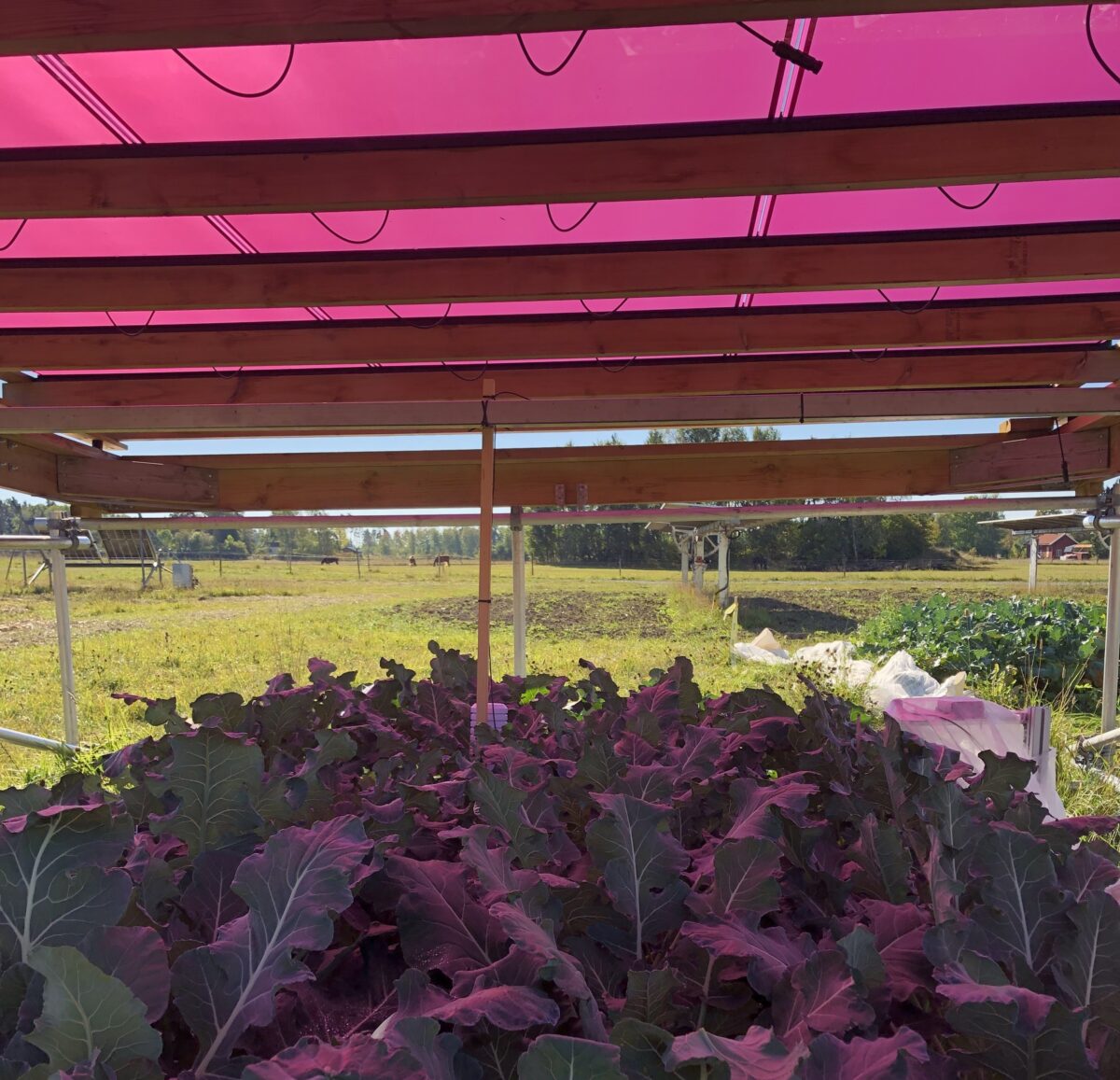
Scientists in Sweden have conducted an extensive study of all wavelength-selective PV technologies for agricultural voltaic installations. They proposed creating standards for reporting on the performance of these technologies.
Researchers from the in Sweden have provided a comprehensive overview of all wavelength-selective PV systems for applications in the agricultural voltaics sector.
“Traditional opaque silicon panels often provide excessive shade that limits light availability for most shade-intolerant crops. Yet plants do not need the full spectrum of sunlight to grow, but only the area where they are photosynthetically active. In some cases, full spectrum may even hinder their development,” said the study’s lead author, Silvia Ma Lu pv magazine. “This opens the door for wavelength-selective solar photovoltaic (WSPV) technologies. WSPV systems are designed to transmit light at the wavelengths most favorable for photosynthesis, while reflecting or absorbing less essential wavelengths to generate electricity.”
Wavelength selectivity in agricultural voltaics can be achieved in several ways, including tailoring photoactive layers, using semi-transparent colored coatings, integrating mirrors and lenses, or designing spectrally selective luminophores. “There is evidence that these methods can effectively share sunlight between energy generation and crop production, although full evaluations of the impacts on crops and energy remain limited,” Ma Lu added. “We provide a set of recommended performance metrics aligned with WSPV technologies in agricultural applications, along with guidelines for standardized experimental procedures and reporting to promote consistent and reliable research practices in the field.”
In the study “Wavelength-selective solar photovoltaic systems to improve the spectral sharing of sunlight in agricultural voltaics”, published in Joulethe research team explained that plants selectively absorb blue and red light, with favorable spectral bands of 430-480 nm and 630-680 nm, respectively. Since crop production is a top priority in agriculture, the WSPV system must be designed to transmit or redirect the corresponding spectral solar band to the crop, with the remaining spectrum used for energy generation.
The article provides a comprehensive overview of solutions aimed at achieving wavelength selectivity in agricultural voltaic systems, presents a classification of WSPV technologies and discusses their current status, challenges and future directions for effective implementation in agricultural voltaic systems.
The classification of the WSPV systems was based on where and how the spectral selectivity occurs. “In thin-film WSPV, the active layer, or, in the case of ultrathin nanoabsorbers, the back contact is responsible for absorbing the wavelengths not desirable for the plants,” the group specified. “Spatially segmented PV with selectively colored layer WSPV achieves spectral selection by adding a colored layer to conventional c-Si or thin-film PV modules. Spectral selection in CPVs is achieved using dichroic mirrors or lenses. LSCs rely on luminescent materials (organic dye or quantum dot) that absorb the unwanted wavelengths and re-emit them to the embedded PV cells, thus not relying on simple reflection or refraction.”
The group also proposed creating standards for reporting on the performance of WSPV technologies.
“In addition to assessing current WSPV technologies, our work aims to inspire future developments by outlining the efficiency limits for different solar cell types under spectral sharing conditions, especially when shared with crop production,” said Ma Lu.
This content is copyrighted and may not be reused. If you would like to collaborate with us and reuse some of our content, please contact: editors@pv-magazine.com.
