

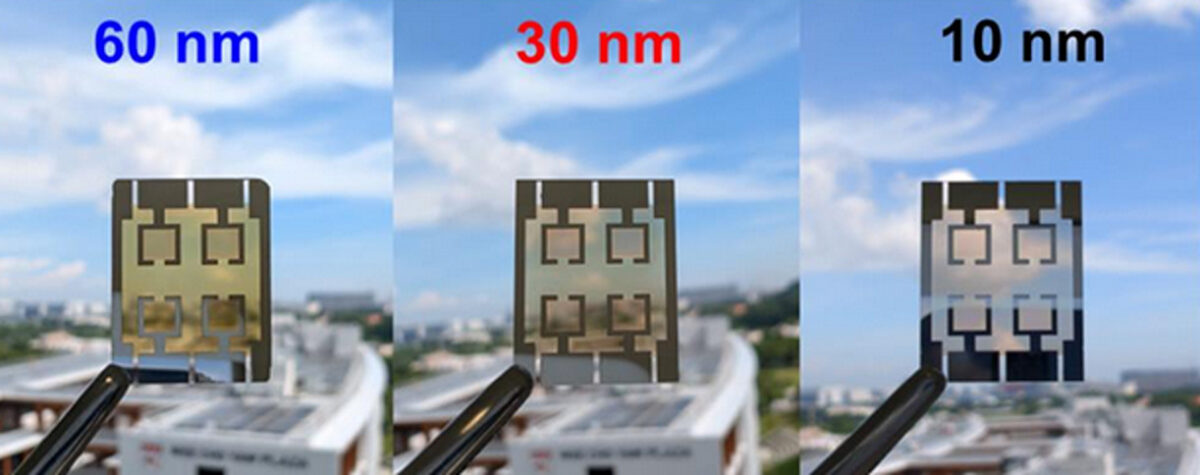
Researchers in Singapore have developed fully vacuum-processed ultra-thin perovskite solar cells with absorber layers as thin as 10 nm, achieving high transparency and stable efficiency up to 12%. These cells balance optical transparency and electrical performance, providing scalable, design-flexible solar photovoltaics suitable for seamless integration into buildings.
Researchers at Nanyang Technological University (NTU) in Singapore have developed ultra-thin perovskite solar cells with absorber layers as thin as just tens of nanometers.
The research work addresses a key challenge in the development of transparent solar photovoltaics: balancing optical transparency with electrical performance without sacrificing scalability or manufacturability, while minimizing instrument safety.
“We are pushing perovskite solar cells to the ultimate thickness limit, demonstrating fully vacuum-processed devices with absorbers down to around 10 nm compared to the conventional 500-700 nm range, making them efficient as well as aesthetically beautiful and translucent,” NTU researcher Annalisa Bruno said. pv magazine. “This represents a step toward scalable, design-flexible photovoltaic systems suitable for seamless integration into buildings.”
For their experiments, the scientists used planar methylammonium lead iodide (MAPbI3) perovskite films grown on a Spiro-TTB hold transport layer (HTL) and a self-assembled monolayer (SAM). The film thickness was varied from 10 to 700 nm, with optical studies showing bandgap widening on ultrathin scales due to quantum confinement.
X-ray diffraction (XRD) showed that the composition and crystal orientation of the film change with thickness, improving charge flow in pin devices. Field emission scanning electron microscopy (FESEM) and atomic force microscopy (AFM) confirmed that the films are smooth, uniform and stable even at a thickness of only 10 nm.
The perovskite cell design consisted of a substrate made of glass and indium tin oxide (ITO), the Spiro-TTB HTL, the perovskite absorber, a buckminsterfullerene (C60) electron transport layer (ETL), A bathocuproin (BCP) buffer layer and a silver (Ag) metal contact.
Tested under standard lighting conditions, the cells built with 10nm, 30nm and 60nm absorbers achieved energy conversion efficiency of 7%, 11% and 12% respectively, and they maintained their performance even under low illumination.
Additionally, the 30nm and 60nm devices showed the highest reported light utilization efficiency (LUE) for ultrathin devices, indicating a favorable balance between transparency and performance. In contrast, the 10 nm cell showed reduced open-circuit voltage and some hysteresis, indicating the need for processing optimization.
“The 60 nm thick cell achieved an average visible transparency of approximately 41% with a power conversion efficiency of almost 8%, with a LUE of 3.13. These values of LUE, with further optical engineering, have the potential to achieve LUE values above 5%,” said lead researcher Luke White. “All devices showed nearly color-neutral transparency, with a color rendering index of 79.7, indicating compatibility with architectural requirements.”
The cell design was presented in “Ultra-thin, fully vacuum-processed perovskite solar cells with absorbers up to 10 nm”, published in ACS Energy Letters.
“Our findings are particularly relevant to the built environment, which represents a significant portion of global energy demand,” says Bruno. “Technologies that enable buildings to generate electricity without changing their appearance are expected to play a central role in the expansion of distributed renewable energy sources. Perovskite materials are particularly promising in this context, thanks to their tunable optical properties, compatibility with low-temperature processing and potential for large-area production.”
This content is copyrighted and may not be reused. If you would like to collaborate with us and reuse some of our content, please contact: editors@pv-magazine.com.
