

Fraunhofer ISE researchers have investigated whether PV panels installed above orchards can affect the reception of signals from the Global Navigation Satellite System (GNSS) and in turn affect the accuracy of advanced autonomous tools. They noticed a disruption and suggested some alternatives.
A team of researchers led by Germany’s Fraunhofer Institute for Solar Energy Systems (Fraunhofer ISE) has investigated the impact of above-ground agrivoltaic systems on the signal from global navigation satellite systems (GNSS) below. GNSS signals are used for precision agriculture capabilities such as planting, seeding, irrigation, fertilization and harvesting.
“Disruptions to GNSS signals can significantly reduce the effectiveness of these technologies,” the team explains. “As agrivoltaic systems are increasingly deployed in agricultural environments, it is critical to understand their potential impact on GNSS signal performance and develop strategies to mitigate any adverse effects.”
To test the effect of an agrivoltaic installation on these signals, researchers conducted a study of an above-ground setup in Kressbronn am Bodensee, Germany and compared these results with those from a nearby conventional orchard. Pip fruit grew at both test locations, with the agrivoltaic orchard having semi-transparent, double-glazed PV modules above the crops. In the southern zone the panels had a power of 260 W, providing a light transparency of 40% and a total power of approximately 147 kW, while in the northern zone the panels had a power of 170 W, with 51% light. transparency and an estimated capacity of 95 kW.
“The data was collected using a GNSS receiver, specifically a smartphone model Poco X4 Pro 5G, which supported multi-constellation GNSS logging. The smartphone was equipped with the open-source GPSTest application, which recorded GNSS data,” the team explained. “The device was hand-held at a height of 1.5 m from the ground and moved through both the agricultural voltaic and conventional orchard zones, as well as along the roads within the study area, to ensure consistent data collection on the spatial extent of each zone.”
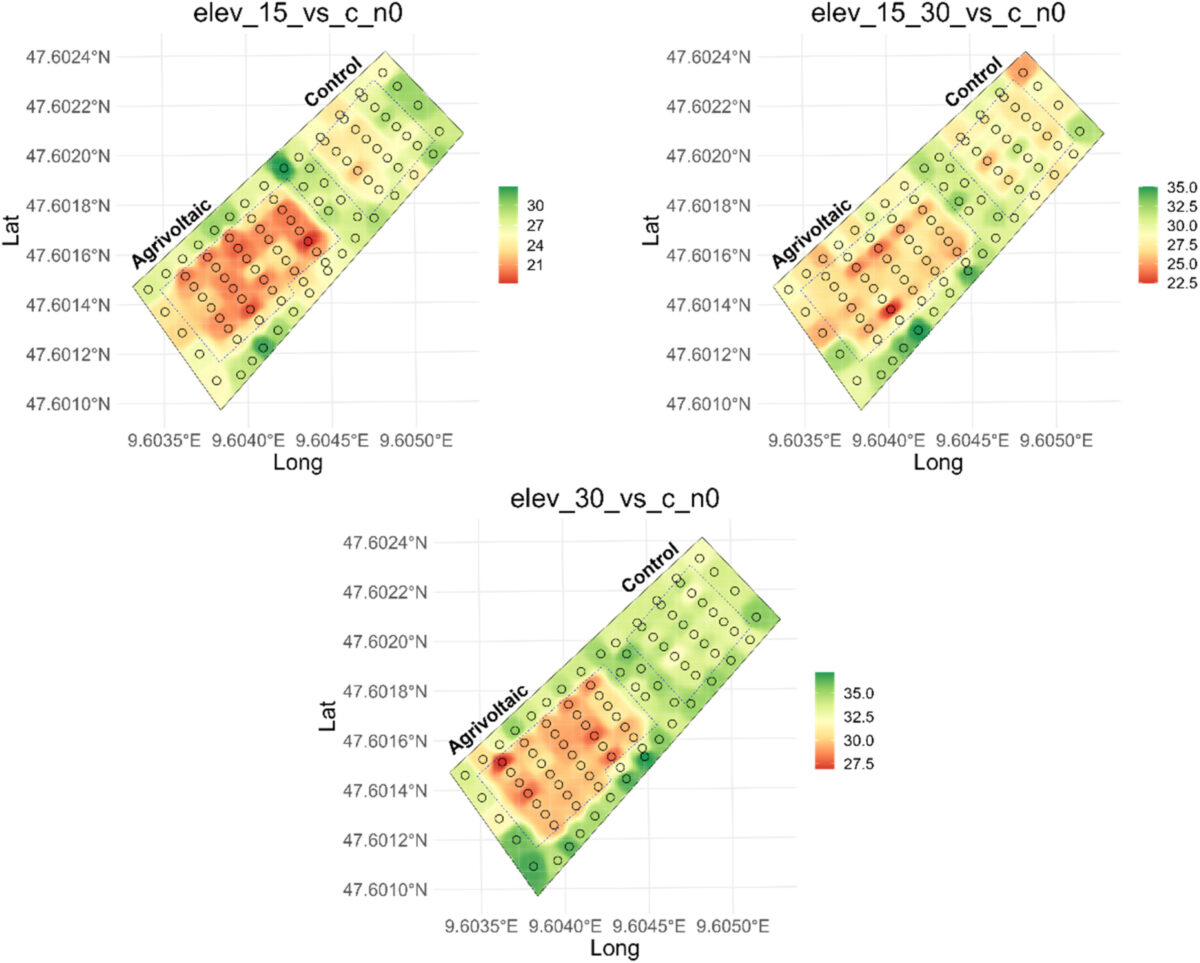
The tests showed that the average carrier-to-noise density ratio (C/N₀) decreased from 30.62 dB-Hz in the conventional orchard to 26.92 dB-Hz in the agrivoltaic system. C/N₀ measures the strength and quality of a satellite signal and according to the literature, 24 dB-Hz is a recommended threshold value. Despite the lower signal quality, the average number of satellites with C/N₀ above 24 dB-Hz remained over 22 in both areas.
“The main challenge of agricultural voltaic systems is the reduction of signal strength rather than the geometry of the satellites’ visibility,” the scientists noted. “Lower values of horizontal dilution of precision (HDOP) and vertical dilution of precision (VDOP) are generally associated with better positioning accuracy, and in the agrivoltaic field the values of position dilution of precision (PDOP) were 0.82, HDOP 0.52 and VDOP 0.62. observed, which are considered excellent for precision tasks.”
The measurements also showed that the agrivoltaic system had a horizontal accuracy (EHAcc) of 5.30 m and a vertical accuracy (EVACc) of 3.10 m, while the control plot had 3.8 m and 2.5 m respectively . The U/A flag ratio was slightly higher in the agrivoltaic system (0.71) than in the control orchard (0.7). This metric describes the proportion of satellites actively used in position calculation (U flag) over the total number of satellites available with almanac data (A flag). Simply put, it shows how many of the satellites visible to a GNSS device are useful.
The results are presented in “Assessment of the impact of above-ground agricultural voltaic systems on GNSS signal performance for precision agriculture”, published in Smart agricultural technology. The research was carried out by scientists from the German Fraunhofer Institute for Solar Energy Systems ISE, the University of Freiburg and the Spanish National Research Council (CSIC).
“The study highlights the importance of addressing signal interference to avoid hindering the integration of drones, robots and other advanced technologies into agrivoltaic management and suggests alternative solutions, such as real-time kinematic (RTK) correction or simultaneous localization and mapping (SLAM) techniques to improve performance,” the scientists concluded. “These findings are critical as the adoption of agrivoltaic systems increases, requiring a balance between solar energy production and the operational needs of precision agriculture.”
This content is copyrighted and may not be reused. If you would like to collaborate with us and reuse some of our content, please contact: editors@pv-magazine.com.
