Scientists in the UK have simulated how a 1 GW off-grid agrivoltaic facility could be used to power hydrogen-powered electric vehicles in Australia, California, China, Nigeria and Spain. Their techno-economic analysis showed that the proposed combination could deliver a levelized hydrogen price ranging from $3.90/kg to $8.13/kg.
Researchers from the University of Exeter in the UK have simulated 1 GW agrivoltaic hydrogen generation in Australia, California, China, Nigeria and Spain and found that tomatoes could be the most suitable crop to grow under solar panels.
“Producing hydrogen with agrivoltaic energy would be technically and economically feasible, even below the 1 GW threshold,” said the study’s lead author, Aritra Gosh. pv magazine. “This scale was not used due to economies of scale, although the proposed combination could benefit from this. We selected this capacity to provide a clear and understandable benchmark for industry and government stakeholders, allowing comparisons with other large-scale renewable energy projects. Smaller scales or grid-connected projects may also be feasible.”
In the study “Analysis of a large-scale (1GW) off-grid agrivoltaic solar park for a hydrogen-powered fuel cell electric vehicle (HFCEV) charging station”, published in Energy conversion and managementGosh and his colleagues explained that the selected five locations are expected to have a high demand for hydrogen tanks. They mainly chose areas close to cities and main roads to avoid additional costs for hydrogen transport.
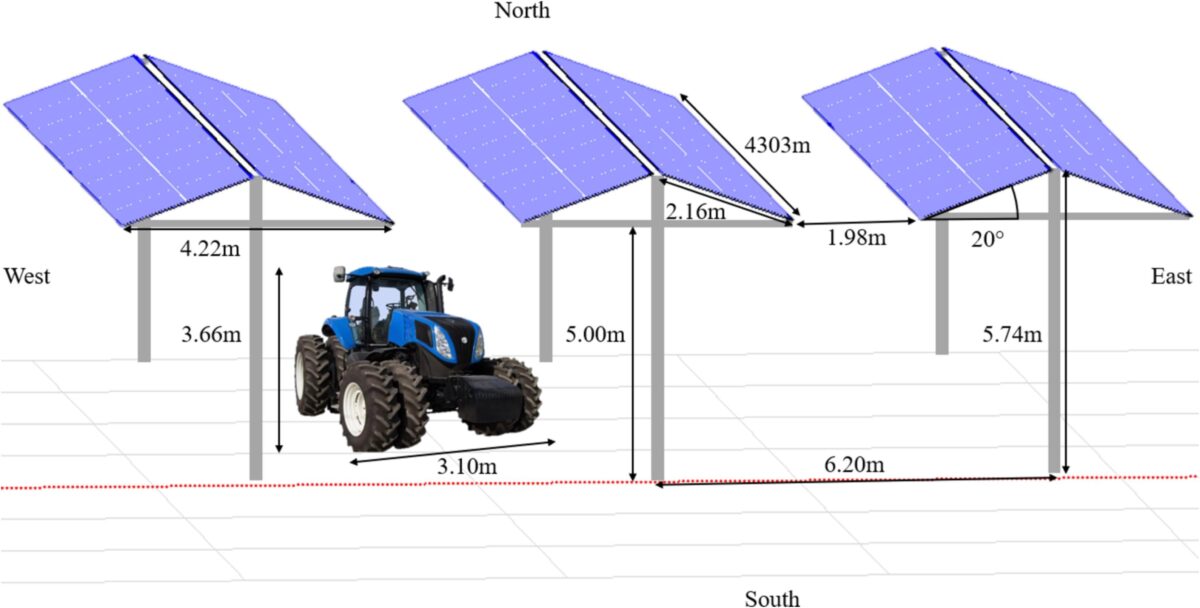
The proposed project configuration includes a 1 GW off-grid agrivoltaic facility, 300 proton exchange membrane (PEM) electrolyzers, converter systems, compressors and storage systems to fuel cell electric vehicles (FCEVs). The hydrogen refueling system consists of high-pressure storage tanks, a hydrogen filling station and automotive demand.
Image: University of Exeter, Energy Conversion and Management, Common License CC BY 4.0
It was assumed that the agrivoltaic array would use 2,272,752 bifacial monocrystalline solar panels with a power of 440 W each and 200 inverters with a rated power of 500 kW each. It was assumed that the panels were deployed at a tilt angle of 20 degrees and covered an area of 5,095,083 m2.2. “In addition to the agrivoltaic PV system, a ground-mounted solar PV system has been designed and simulated in PVsyst to facilitate the calculation of the land equivalent ratio (LER) of each site location,” the scientists said. LER is a method used to measure land use efficiency for the simultaneous production of crops and electricity.
Their techno-economic analysis considered 125 site configurations and took into account net present value (NPV), internal rate of return (IRR), total profit, simple payback period, capex, opex and levelized cost of hydrogen (LCOH). This reportedly showed that the proposed combination could deliver a levelized hydrogen price ranging from GBP 3.06 ($3.90)/kg in Nigeria to GBP 6.38 ($8.13)/kg in Spain. It also showed that the Nigerian site had the highest number of HPV refills at 3.75 million per year, while the Spanish site was found to have the lowest at 3.11 million per year.
The analysis also found that tomatoes would be the best crop to grow under the panels, with agricultural yield losses estimated at between 9.40% and 36.94%. “Our analysis looked at tomato production because it was suitable for the soil types of each of the locations analyzed,” said Gosh. “Tomato plants are not the most shade tolerant crop that can be grown in an agrivoltaic system and therefore highly shade tolerant crops can result in less reduced crop yields or even higher crop yields under certain climatic conditions, where the PV array provides microclimate benefits such as shade against too much radiation and heat, and increased humidity.”
According to Gosh, the study’s findings show that combining off-grid agrivoltaic energy with hydrogen generation is a viable model to improve land use while generating additional income. “The benefits of land restoration and additional income from electricity generation should compensate for reduced crop yields,” he stressed. “The key findings indicate that all locations are suitable for agrivoltaic applications.”
This content is copyrighted and may not be reused. If you would like to collaborate with us and reuse some of our content, please contact: editors@pv-magazine.com.
Popular content