
Close Menu
  • News
  • Industry
  • Solar Panels
  • Commercial
  • Residential
  • Finance
  • Technology
  • Carbon Credit
  • More
    • Policy
    • Energy Storage
    • Utility
    • Cummunity
What's Hot

Dutch solar owners asked to switch off during peak periods to ease the distribution crisis

June 7, 2026

The hydrogen flow: Toyota demonstrates its racing prototype on liquid hydrogen

June 7, 2026

Era of electrification exposing Australia’s weakest link

June 6, 2026
Facebook X (Twitter) Instagram
Solar Energy News
Sunday, June 7
  • News
  • Industry
  • Solar Panels
  • Commercial
  • Residential
  • Finance
  • Technology
  • Carbon Credit
  • More
    • Policy
    • Energy Storage
    • Utility
    • Cummunity
Solar Energy News
Home - Technology - American engineers develop ChatGPT algorithm to design solar cells – SPE
Technology

American engineers develop ChatGPT algorithm to design solar cells – SPE

solarenergyBy solarenergyJuly 25, 2024No Comments3 Mins Read
Facebook Twitter Pinterest LinkedIn Tumblr Email
Share
Facebook Twitter LinkedIn Pinterest Email

OptoGPT is a new algorithm that uses the computer architecture underlying ChatGPT. The makers say it will allow researchers and engineers to design optical multilayer film structures for a wide range of applications, including solar cells.

July 25, 2024 Patrick Jowett

Engineers at the University of Michigan have developed a new algorithm that can design optical multilayer film structures for applications including solar cells.

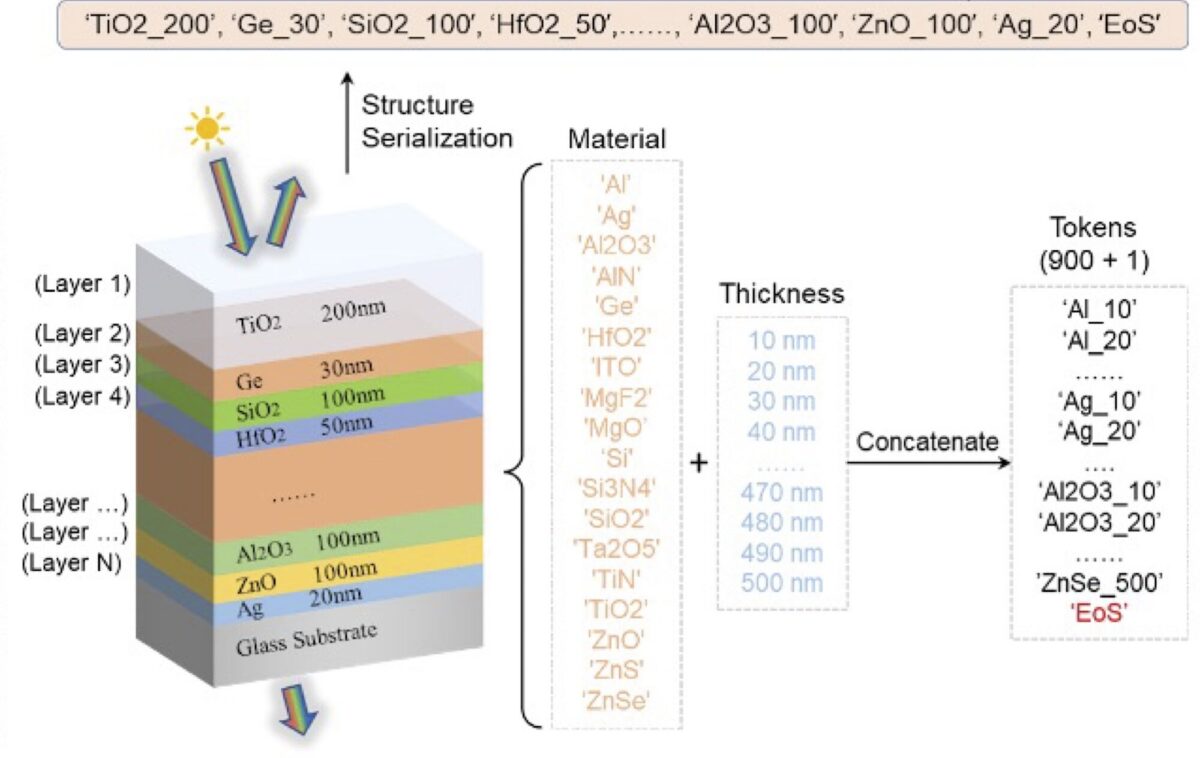
OptoGPT (Opto Generative Pretrained Transformer) uses the computer architecture underlying ChatGPT to work backwards from the desired optical properties to the material structure it can provide.

The algorithm produces designs for multilayer film structures, consisting of stacked thin layers of different materials, reportedly within 0.1 second. Well-designed multilayer structures can maximize light absorption in a solar cell, and can also optimize design in other manufacturers of optical components, such as telescopes. According to the makers, OptoGPT designs contain an average of six fewer layers than previous models. This means that the designs are easier to manufacture.

“Designing these structures typically requires extensive training and expertise, because identifying the best combination of materials and the thickness of each layer is not an easy task,” said L. Jay Guo, professor of electrical and computer engineering at the University of Michigan. The model works by treating materials of a certain thickness as words and encoding the corresponding optical properties as input. It looks for correlations between these ‘words’ and predicts that the next word will create a ‘sentence’ that achieves the desired property. “In a sense, we have created artificial sentences to fit the existing model structure,” says Guo.

See also  Cybersecurity guidelines for smart inverters – SPE

Guo is the corresponding author of “OptoGPT: a basic model for inverse design in optical multilayer thin-film structures”, a research article recently published in Optoelectronic advances.

The article says that OptoGPT can “effectively deal with the non-trivial inverse design problem in multi-layer structures… Combined with many proposed techniques, our model can unify the inverse design under different types of input targets under different incidence angles/polarizations, be versatile for different types of structures, and facilitate the fabrication process by providing diversity and flexibility.

The researchers acknowledged that although they used a large-scale dataset with 10 million samples for training, the dataset “covers only a small portion of the extensive and complex design space associated with optical multilayer thin-film structures.”

They said that due to the limitations in the training dataset, OptoGPT may not identify designs that fall outside the sampled design space.

“Close collaboration between multiple research groups is needed to obtain a better model for a more general and better photonic inverse design that extends to more complicated structures,” the researchers concluded.

This content is copyrighted and may not be reused. If you would like to collaborate with us and reuse some of our content, please contact: editors@pv-magazine.com.

Popular content

Source link

algorithm American cells ChatGPT design develop engineers solar SPE
Share. Facebook Twitter Pinterest LinkedIn Tumblr Email
solarenergy
  • Website

Related Posts

Dutch solar owners asked to switch off during peak periods to ease the distribution crisis

June 7, 2026

Letter from China’s PV Industry: Arctech wins 2.1 GW solar deal

June 5, 2026

ComEd starts a new energy pilot with a solar rebate on the roof of a brewery

June 5, 2026
Leave A Reply Cancel Reply

Don't Miss
Solar Industry

Premier Energies commissions a 5.6 GW solar module plant in India

By solarenergyApril 1, 20260

Premier Energies Ltd has commenced pilot production at its 5.6 GW solar panel manufacturing facility…

Idematec inks Tracker Supply Agreement for 2.1-GW Texas Solar Project Pipeline

May 6, 2025

Advances in semi-transparent solar cell technology drive future energy solutions for buildings

October 29, 2025

CTC launches ‘High-Capacity’ Air-Water Heat Pomp-PV Magazine International

August 25, 2025
Stay In Touch
  • Facebook
  • Twitter
  • Pinterest
  • Instagram
  • YouTube
  • Vimeo
Our Picks

Dutch solar owners asked to switch off during peak periods to ease the distribution crisis

June 7, 2026

The hydrogen flow: Toyota demonstrates its racing prototype on liquid hydrogen

June 7, 2026

Era of electrification exposing Australia’s weakest link

June 6, 2026

‘Come out from behind your screen, our industry is ultimately about people’

June 6, 2026
Our Picks

Dutch solar owners asked to switch off during peak periods to ease the distribution crisis

June 7, 2026

The hydrogen flow: Toyota demonstrates its racing prototype on liquid hydrogen

June 7, 2026

Era of electrification exposing Australia’s weakest link

June 6, 2026
About
About

Stay updated with the latest in solar energy. Discover innovations, trends, policies, and market insights driving the future of sustainable power worldwide.

Subscribe to Updates

Get the latest creative news and updates about Solar industry directly in your inbox!

Facebook X (Twitter) Instagram Pinterest
  • Contact
  • Privacy Policy
  • Terms & Conditions
© 2026 Tsolarenergynews.co - All rights reserved.

Type above and press Enter to search. Press Esc to cancel.