

New research from China shows that using rigid connectors instead of polyester cables in floating photovoltaic installations can help reduce the relative movement of floats and simplify the layout of the connection system.
Researchers from China’s Harbin Engineering University have investigated the use of rigid single-rod connectors in floating PV installations and found that these connectors offer a range of advantages over polyester cables.
The research group performed several numerical simulations on different sizes of floating PV systems, different rod lengths and different degrees of freedom of movement. “Currently, many FPV floats are connected using polyester ropes,” it explains. “As the field of application for photovoltaics increases, so does the number of polyester cables and the complexity of their arrangement, which can lead to potential problems. Compared to polyester cables, steel structural connectors offer advantages such as simplifying installation. Therefore, applying steel structural connectors to connect photovoltaic floats is a promising approach.”
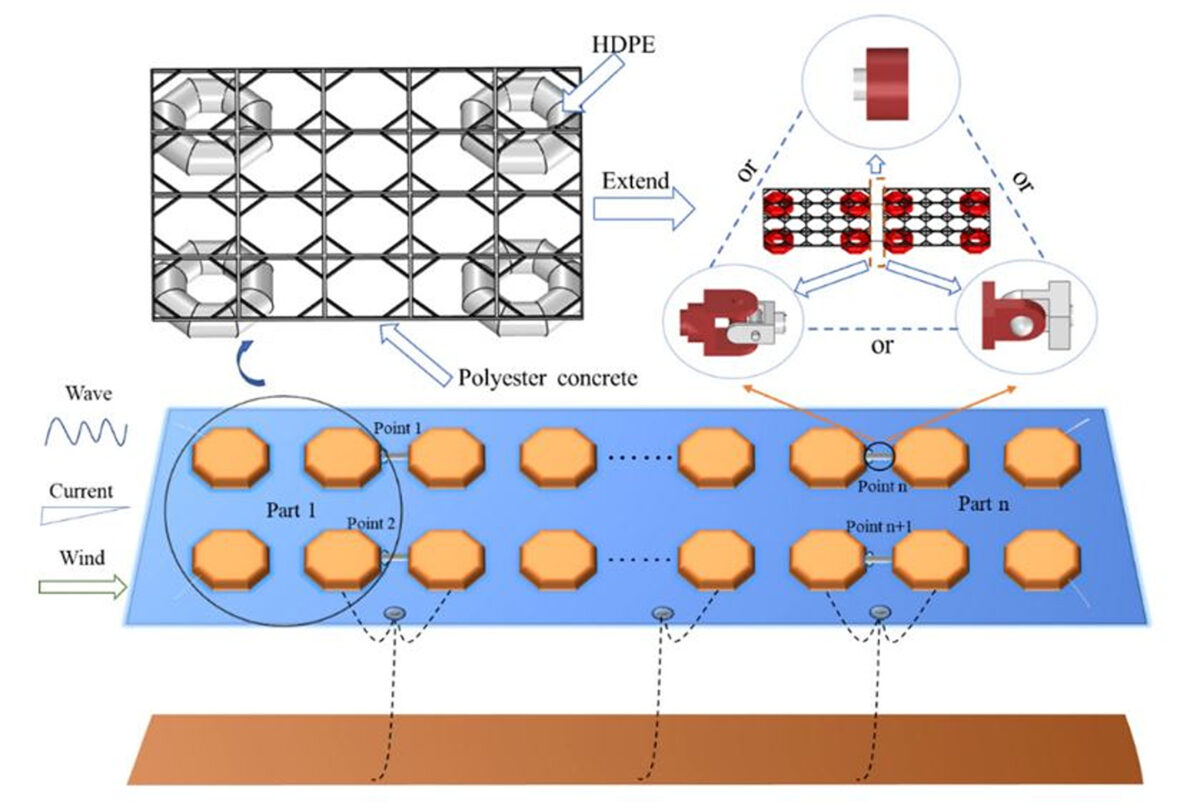
In their simulation, the scientists assumed that the floating system would be deployed in waters with a depth of 12.68 meters. Each PV platform is supported by four small octagonal floats, made of high-density polyethylene (HDPE) and having an outer diameter of 2.8 m and an inner diameter of 1.2 m. A six-line mooring system is also used.
The floats are connected with rigid connectors of 1.2 m, namely purely rigid connectors, hinged connectors and cardan connectors. While purely rigid connectors do not release any degree of freedom, hinged connectors allow relative rotation. Cardan connectors allow rotation on two axes, reducing vertical and lateral bending moments, but are susceptible to self-locking effects under wave action. Each type of connector was tested in two, four or eight PV setups. The case of a two-panel system was further explored, with additional connector lengths of 0.5 m and 1.9 m.
“Through validation, it has been proven that three-dimensional potential flow theory can be well applied to the motion of floating solar photovoltaics,” the academics said. “In the rigid connections between the floats, various connections are simulated by imposing restrictions. The connection used in the article is a single-pin connector. Therefore, restrictions are imposed on both sides. In numerical simulation, the connections of connectors are simplified into constraints, and different shapes of connectors are simulated by releasing degrees of freedom in different directions.”
The simulation results showed that purely rigid connectors experience significant longitudinal bending moments and vertical loads. On the other hand, releasing degrees of freedom leads to a corresponding reduction in bending moments and loads. The cardan connectors experience 4.86 times smaller longitudinal moments compared to purely rigid connectors under specific conditions.
“It is important to emphasize that the self-locking effect in cardan connectors reintroduces stiffness, creating additional bending moments,” the researchers pointed out. “This suggests that connectors without released degrees of freedom are unsuitable for harsh offshore environments. To prevent self-locking, the gimbal connectors should be used separately in areas with less wind and wave conditions.”
Concluding their article, the scientists explained that as the number of floats increases, the load on the connectors gradually increases and the chance of green water on deck also increases. “The maximum loads on the connectors in eight-float and four-float configurations are significantly greater than those in the two-float arrangement, with the maximum load point shifting toward the center as the floating configuration expands,” they stated. “This finding indicates that the middle portion of the multi-floating system is particularly vulnerable.”
The results are presented in “Hydrodynamic analysis of a floating photovoltaic system confined by rigid connectors”, published in Scientific reports. The research team consisted of scientists from the Chinese offshore specialist Yantai CIMC Raffles.
This content is copyrighted and may not be reused. If you would like to collaborate with us and reuse some of our content, please contact: editors@pv-magazine.com.
