

Scientists from the European Commission’s Joint Research Center tested two single-junction perovskite modules outdoors for a year and reported generally stable performance, supported by a new light-infused preconditioning method to improve measurement reliability. While one module deteriorated significantly, the other maintained relatively stable efficiency with seasonal variations, highlighting the need for longer-term outdoor studies.
A group of scientists from the European Commission’s Joint Research Center (JRC) tested the performance of two single-junction perovskite solar panels over a period of one year and concluded that the tests produced ‘stable results’.
“We believe the test has yielded a promising result for perovskite solar panels,” said lead researcher Hanna Ellis pv magazine. “We must be aware that all new technologies present challenges when initially implemented. To adequately assess perovskite technology, more independent studies of the performance of commercial outdoor modules are needed.”
“We have attempted to address two issues in this paper; the challenge of demonstrating that we can perform repeatable and reliable characterization of perovskite modules, and the ability of the perovskite module to continue to perform at this level in real-world conditions. We believe that the initial characterization is the most important outcome for the commercialization of this technology, while its longer-term stability is promising,” she continued.
The research team developed a new preconditioning methodology for electrical characterization. A light-transmitting approach similar to conventional technologies was used, which has been shown to be suitable for commercial perovskite modules.
In the study “Exterior measurements of perovskite modules”, published in Progress in photovoltaicsthe researchers explained that the Light Soaking Effect (LSE) is the main cause affecting the thermal stability of perovskite solar cells and modules. This effect can impact cell efficiency, short-circuit current and open-circuit voltage under constant illumination, when cell performance evolves over time as illumination activates several slow physical and chemical processes in the device.
“The LSE phenomenon limits the reliability of the measured and modeled power of the perovskite solar cells, and therefore the research field is investigating mechanisms and strategies to understand and mitigate the LSE,” the academics emphasized.
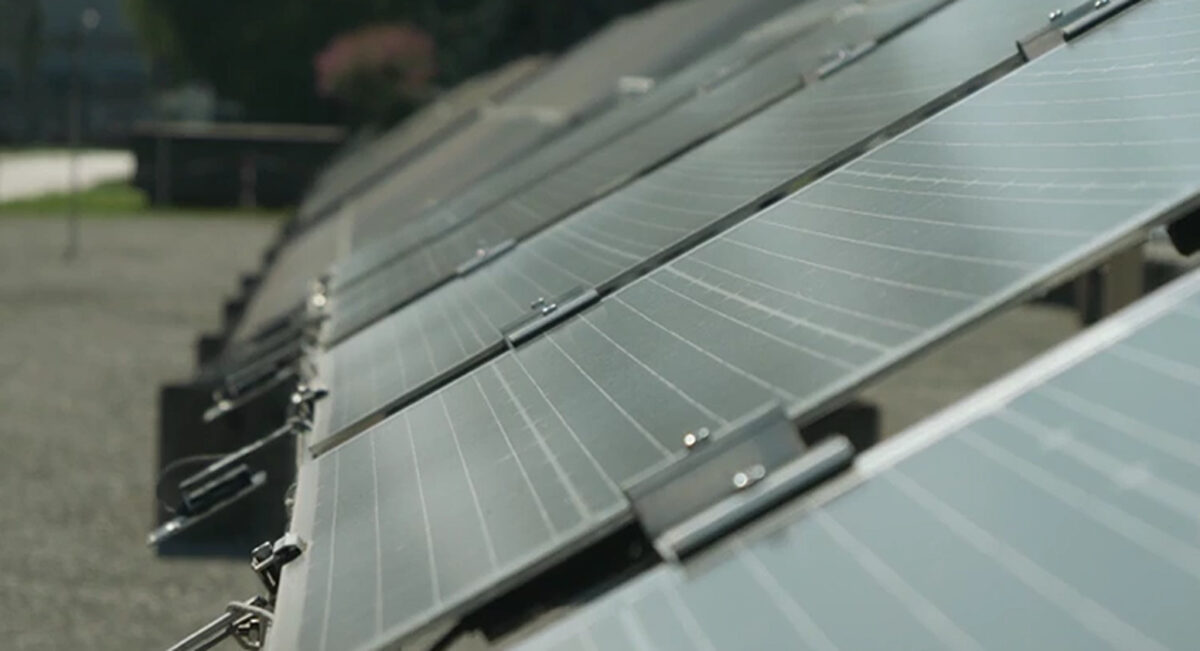
Tests were conducted on two south-facing 0.7164 m² glass-glass perovskite modules in the outdoor environment at the European Solar Test Installation (ESTI) in Ispra, northern Italy, over a one-year period from June 2024 to June 2025. The panels were deployed on fixed structures with a tilt angle of 45° and were designated YZ517 and YZ518. In addition, a third reference module, the YZ519, was used during the measurement protocol research
Before being installed outdoors in natural sunlight, the modules were characterized indoors under simulated lighting. For the outdoor measurements, the group used an ESTI sensor, an anemometer, temperature sensors, a pyranometer and conventional monitoring instruments.
The testing showed that the YZ518 module deteriorated significantly, with efficiency dropping below 7% in May 2025 compared to the original internal value. In contrast, the YZ517 remains more stable and maintains efficiency values around 12-13% in May 2025, after peaking above 15% in June-July 2024. In addition, the YZ517 was found to exhibit a pronounced seasonal variation, with efficiency decreasing in winter and recovering in spring, but generally showing “stable” performance and was therefore selected for further analysis as a function of irradiance, temperature and time of day.
This analysis showed that during warm summer periods, after a number of sunny days, the YZ517 panel achieved higher efficiency values in the morning at lower temperatures than in the afternoon with comparable irradiation. However, seasonal effects were present: on sunny days in November and December after cloudy periods, deviations in efficiency performance as a function of irradiation occurred, and afternoon and morning values were comparable at similar irradiance.
“We believe that one year of outdoor use is an important milestone, but further research and longer-term exposure are needed to improve our understanding and further validate the technology,” Ellis concluded, explaining that further research is needed to fully understand the influence of irradiation, temperature and seasonal weather conditions on the performance of perovskite solar cells.
This content is copyrighted and may not be reused. If you would like to collaborate with us and reuse some of our content, please contact: editors@pv-magazine.com.
