

Researchers from Belgium and the University of Cyprus conducted outdoor stability tests with solar-powered perovskite mini-modules, providing two years of stability performance data. The tests showed that the performance loss of the modules during the burn-in period of perovskites varied between 7% and 8% per month.
Researchers from Belgian research center imec and the University of Cyprus have announced that they have completed outdoor stability testing of solar perovskite mini-modules, which will provide stability data over two years.
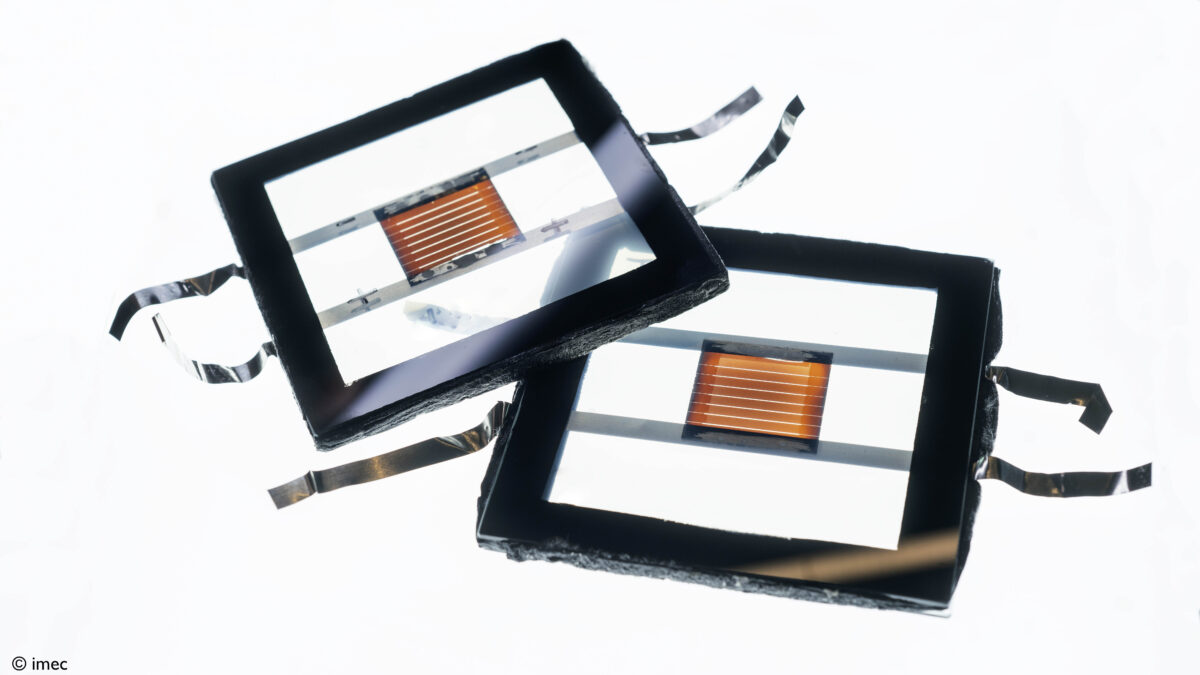
The research team tested 4 cm2 metal halide perovskite mini-modules, developed at imec/EnergyVille at the University of Hasselt in Belgium, under real-world conditions in Nicosia, Cyprus, and found that the panel offers “remarkable” retention of energy conversion efficiency after one year.
“The most durable mini module retained 78% of its initial efficiency after one year. The performance loss during the burn-in period of perovskites was found to be approximately 7% – 8% per month for the perovskite configurations tested,” the researchers said. They also recorded daily degradation and recovery data, which was monitored across all perovskite configurations tested.
“The results have also been disseminated and discussed at conferences and with our partners in various projects, spanning both academia and industry. There is great interest because the datasets are among the most extensive currently available for outdoor testing of perovskite modules,” says Tom Aernouts, R&D Manager at imec/UHasselt/EnergyVille. pv magazine.
Outdoor trials are steps toward commercializing perovskite technologies in utility-scale and residential PV applications because they reveal how environmental conditions, such as varying light, temperature and weather, affect cell performance. “Despite this, only a handful of research groups have investigated the performance of perovskite PV in open air, with a focus on small cells rather than modules,” the researchers said.
Further field trials are underway in various climate zones in Brussels, Madrid, Spain, Freiburg, Germany and the US state of New Mexico, rainy, temperate and arid regions respectively.
“We have also introduced a number of new perovskite module architectures for some of these tests, and we will continue to do so, including in new locations,” says Arnouts, referring to Colorado, the Middle East, North Africa and East Asia.
The perovskite mini-modules used in the study had a pin-device architecture, according to the researchers. The cells are built with indium tin oxide (ITO) coated glass substrates, sputtered nickel(II) oxide (NiOx) hole transport layer (HTL), perovskite layer, electron transport layer (ETL) and another ITO layer. The perovskite composition for the study was FA0.8Cs0.2Pb(I0.94Br0.06)3. The ETL composition was varied, either lithium fluoride (LiF), buckminsterfullerene (C60) and a bathocuproine (BCP) buffer layer, or the LiF/C60/LiF composition.
The field measurements, which “focussed on the evolution of key electrical parameters,” were obtained using a variety of electrical equipment from commercial suppliers and a weather station, including a single current-voltage source meter multiplexed to take consecutive measurements of the tested devices. In addition, LabVIEW software is designed to record the current-voltage (IV) curves every 10-15 minutes.
The collected data allowed the scientists to develop a data-driven predictive model to predict power time series using the eXtreme Gradient Boosting (XGBoost) regression technique. They noted that it could “accurately” predict the power output of the test set with a normalized root mean squared error (nRMSE) of 6.76%, meaning it demonstrated “a strong correlation between actual and predicted power.”
The most challenging aspect of the research, according to Aernouts, was the reproducibility of the sample manufacturing process, which he said is “crucial for the relevance” of outdoor testing.
“That’s why we first developed a highly reproducible baseline for module processing, including strong encapsulation. This also meant that long lifespan for entire modules was prioritized over the one-off efficiency of a single cell on a small footprint, Aernouts said. Another challenging aspect was that test sites must adapt their setups for perovskite cell technology.
The research work is described in “Diurnal changes and machine learning analysis of perovskite modules based on two years of outdoor monitoring”, in ACS Energy Letters.
This content is copyrighted and may not be reused. If you would like to collaborate with us and reuse some of our content, please contact: editors@pv-magazine.com.
