

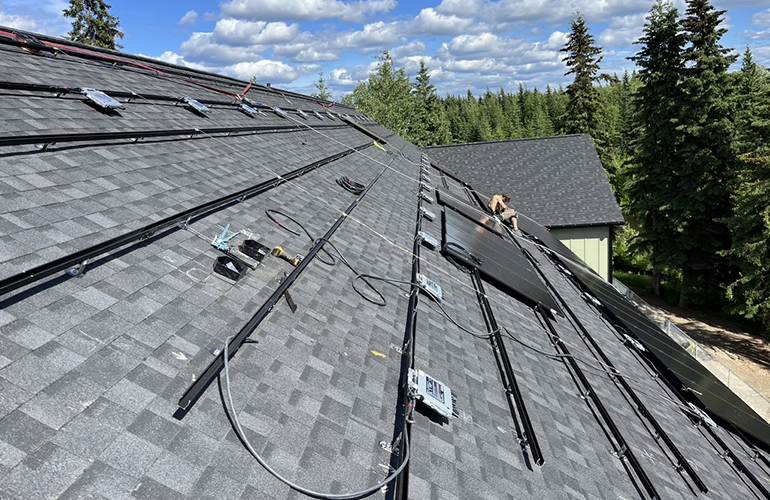
 While microinverters have a clear place in the residential solar ecosystem, commercial projects are usually synonymous with string inverters. But microinverter manufacturers still see a clear place for them in the C&I market, whether it’s satisfying rapid shutdown and optimization requirements or stepping in to handle unique site conditions.
Manufacturers like Northern Electric Power (NEP), Enphase and APsystems all believe their microinverters can work well for many smaller commercial projects that are seeking long-term cost savings and higher uptime.
Specialized C&I micros
Although it’s possible to install residential microinverters in three-phase commercial applications using combiner panels, a few companies have created inverters specifically for the C&I market.
APsystems has offered C&I microinverters since 2014, with its latest iteration being the four-module QT2. It features three-phase plug-and-play design and incorporates phase monitoring and balancing to save time on commercial projects.
Enphase decided to launch a U.S.-made microinverter in 2023 exclusively for the commercial market to simplify both installation and domestic content credit qualification. The company noticed some of its installers were using residential microinverters on commercial projects just because they had them in stock and were already trained to install them.
“We saw the uptake without even trying, essentially, where installers viewed a spot for microinverters in commercial. And then we dug into that more and more,” said Trey Ramsey, senior director of Enphase’s C&I business. “Those same installers inevitably would meander into commercial, simply because those residential homeowners had commercial properties and they wanted a similar solution.”
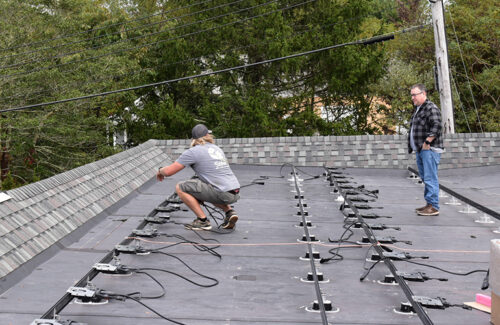
A commercial installation using Enphase inverters.
The single-module IQ8P-3P commercial microinverter is still a single-phase inverter, but it balances the necessary branch circuits between the inverter and the cable without the need for an additional combiner panel. To tailor the offering to the commercial market, Enphase also added new features to its app to help fleet owners better visualize and display their systems, including an improved kiosk feature for production display in businesses like coffee shops or bank branches.
Ramsey said customers choosing commercial microinverters are looking for granular monitoring to help identify issues and decide when a truck roll makes sense for just a few unproductive panels. He’s also seen microinverters save the day when insurance companies or regulatory entities push back on allowing high DC power on rooftops, like in traditional string inverter arrays.
“That definitely resonates particularly well with numerous segments within commercial; so, schools, gas stations, fire stations, a lot of retail. There’s been some obviously negative occurrences in the industry that have put a spotlight on that risk,” Ramsey said.
Jesse Elliott, president of residential and commercial installation and consultancy firm JEBL Engineering & Construction, has chosen microinverters for projects with uncommon electrical service amps. Most recently, he went with NEP BDM-2000 microinverters for a church with 240-A high-leg delta electrical service in central California. To use a string inverter for this site, he would’ve had to install an additional costly transformer.
“A lot of commercial systems are for a native 480-A [service] and so it works fine for most string inverters to be used. In those cases when you have a commercial system that is a 240-A, that’s a different beast,” Elliott said.
Microinverters could also be a good solution for commercial sites with lots of shading from large rooftop HVAC units, low weight restrictions or insufficient space to mount a larger string inverter, Elliott said. When given the option to add more panels or go with a heavy string inverter, it might be best to choose microinverters and more panels.
Cost competition
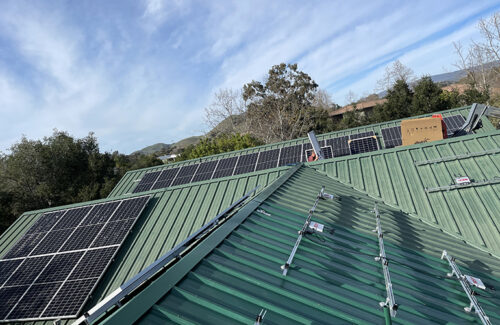
A small commercial installation using NEP microinverters.
Outfitting a project with numerous microinverters instead of a few string inverters has always been more expensive, but that conversation has started to change with recent code and policy happenings.
While the new UL 3741 PV Hazard Control System listing can sometimes eliminate the need for module-level rapid shutdown devices paired with string inverters, some AHJs have not yet adopted it and are still requiring rapid shutdown. NEP is pushing its single-phase, four-module microinverters for the commercial market as a more cost-effective option to satisfy rapid shutdown requirements with fewer failure points than systems that use a string inverter + rapid shutdown/optimizer combination.
“There’s a tipping point here occurring now where the cost of the quads can get under the [cost of] string plus rapid shutdown,” said Ed Heacox, co-founder of NEP. “And with that, you get a couple things. You get very granular power conversion, very granular MPPT with the quads that you don’t get with the string inverters.”
APsystems said its QT2 four-module microinverters are a good choice for projects under 250 kW for those same reasons. These microinverters can pass the fire safety requirements and also give C&I customers more peace of mind, said Jason Higginson, senior director of marketing at APsystems.
“A microinverter system offers a redundancy where each PV module can operate independently, and if one goes out, the rest can perform normally. If you scale an array large enough, string inverter systems can then offer a similar benefit, so if one string goes out, the rest aren’t affected,” he said. “Ultimately, the decision often comes down to project-specific factors like roof configuration, shading and the site owner’s performance and financial goals.”
Longer warranties for microinverters — usually 25 years vs. 10 to 15 for string inverters — can also give the little guys a leg up. Project owners invested in the long-term rate of return for a project could be interested in the higher output and lack of replacement spending on microinverter options.
A commercial system using APsystems microinverters.
“You’re not dealing with budgeting for string inverter replacements anywhere from years eight to 12,” Ramsey said. “The biggest deltas that cause models not to work out in commercial — and really any project, utility scale too — is going to be, you miss on your planned and unplanned maintenance costs. And then secondarily, it’s going to be, is there any significant downtime due to those failures?”
For Enphase and its U.S.-made inverters, there’s the added IRA domestic content bonus that makes the product even more cost-competitive, whether looking at the short- or long-term. Its C&I inverters can help companies reach the threshold to get another 10% added to their tax credits.
“With domestic content, the benefit here is that it actually even undercuts the ‘higher cost’ argument to some degree,” Ramsey said. “We’re seeing a lot of folks looking to buy the ‘safe harbor,’ because, of course, the threshold is going up next year, so it’s definitely a boom, but putting that to the side, it’s a great tailwind for us.”
Microinverters are a solid solution for smaller C&I projects that won’t work optimally with string solutions or whose owners are invested in the full lifespan of the array. As more inverter-makers continue to contemplate U.S. manufacturing, the cost savings can make them even more competitive with the string inverter crowd.
