Scientists measured the performance of PV modules under high pollution conditions in Saudi Arabia and identified the most suitable tilt angles to improve power generation. They also found that rain intensity, dust, sandstorms and cloud cover play a key role.
A research group consisting of scientists from Saudi Arabia and the United Kingdom conducted a year-long experiment to analyze the impact of dust and tilt angle on PV performance in a desert environment and found that rain intensity, dust, sandstorms and cloud cover play a key role in the performance of solar panels.
“Jeddah is one of the most polluted areas in the world, namely the Middle East and North Africa (MENA) and Central Asia,” the group explains. “The city is characterized by a desert environment with high temperatures, low precipitation, drought and winds that cause dust and sand storms.”
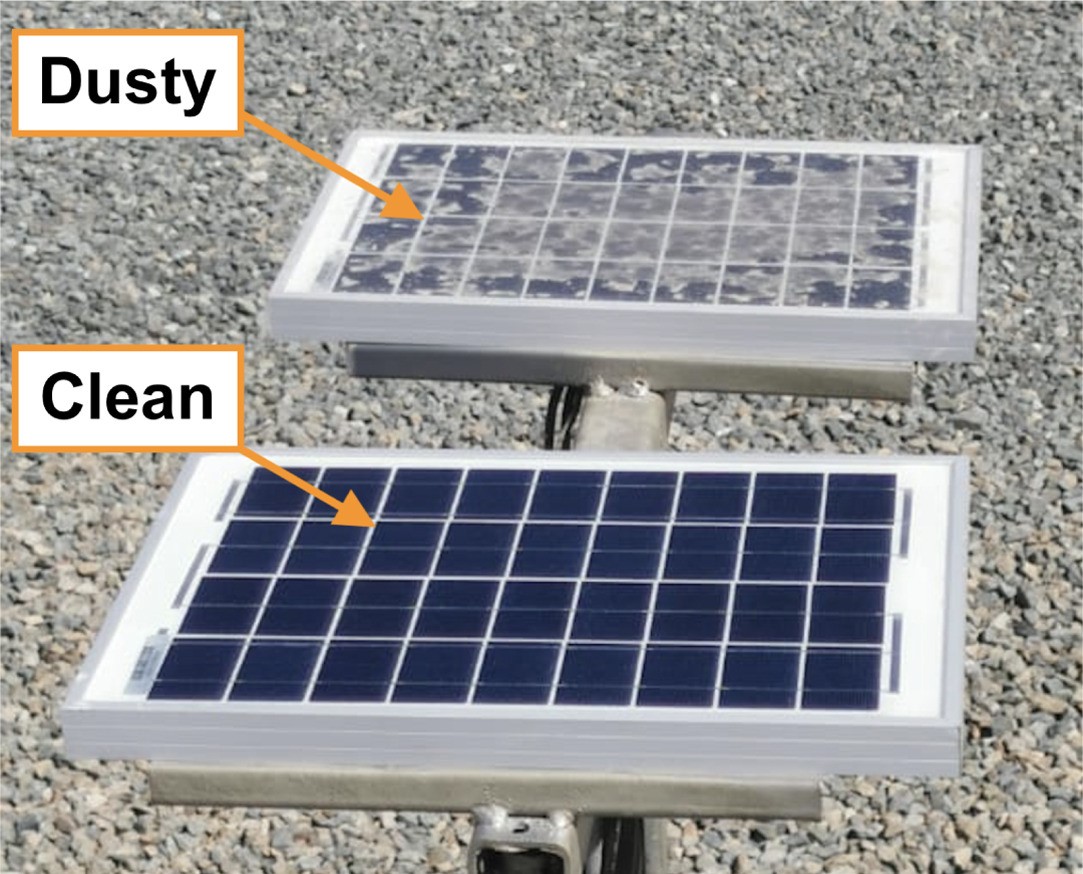
The experimental setup included seven pairs of PV modules installed in Jeddah City at angles of 0◦, 15◦, 25◦, 45◦, 60◦, 75◦, and 90◦. One panel of each pair was cleaned daily, while the other collected dust throughout the year.
During the 12-month test period, the performance of the PV module was monitored and recorded on a minute-by-minute basis. In addition, an air quality monitoring system measured airborne particulate matter (PM), allowing the correlation between dust events and performance variations. For a more in-depth analysis, the team also highlighted periods of light rain, dust storms, heavy rain, prolonged dust accumulation and cloudy days.
The PV panels were based on polycrystalline cells and each had a nominal power of 10 W. All panels faced south on 150 cm poles. The cleaned panels were placed at a height of 80 cm, the dusty panels above. A distance of 120 cm was maintained between each pair of tilted panels. The 90◦ angle modules encountered technical problems, which resulted in their partial removal from the analysis.
Image: Taif University, Solar Energy, CC BY 4.0
“The findings showed that dust accumulation significantly reduces power, with a reduction of up to 80.4% observed after 183 days without rain for a module at an angle of 0◦,” the group said. “Rain helped significantly in cleaning the PV modules by naturally removing dirt build-up, especially at steeper angles. However, lower rain intensities (<1 mm/day) increased dust build-up and adhesion, causing cementation on the module at an angle of 0◦.”

Image: Taif University, Solar Energy, CC BY 4.0
According to the results, the 25◦ was able to maintain the best results with dust all year round, with an average output of 4.76 W. That represents a normalized power of 0.73 over the 12-month period. 0◦, 15◦, 45◦, 60◦, 75◦ and 90◦ could produce 0.5, 0.61, 0.65. 0.48, 0.37 and 0.23 respectively. The 25◦ also maintained the lead in the dry period, with an average power of 4.28 W. On the other hand, the 45◦ panels delivered the best performance in the rainy period, with an average power of 6.05 W.
“The study highlighted the critical role of environmental factors, such as rain intensity, dust, sandstorms and cloud cover, on PV module performance,” the team concluded. “By identifying the optimal tilt and understanding environmental patterns, this research has provided valuable guidance for improving the efficiency and longevity of solar panel installations in desert environments.”
The results are presented in “Impact of dust and tilt angle on photovoltaic performance in a desert environmentt”, published in Solar energy. Scientists from Saudi Arabia’s Taif University, King Abdulaziz and Britain’s University of Southampton conducted the research.
This content is copyrighted and may not be reused. If you would like to collaborate with us and reuse some of our content, please contact: editors@pv-magazine.com.
Popular content