

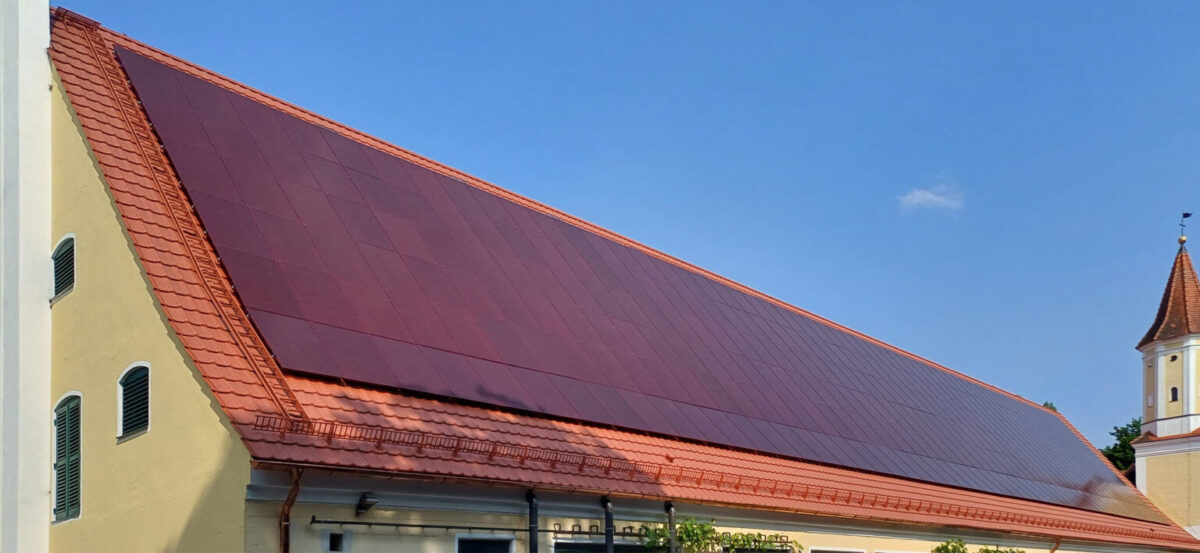
A castle in Bavaria, Germany, has installed a brick PV system using colored solar modules from Futurasun in Italy. The project was made possible by a recent amendment on the Monument Protection Act of Bavaria, making solar energy on heritage buildings possible.
A PV system with stone red solar modules is installed on the listed Blumenthal Kasteel in Bavaria, Germany.
The 120 KW system is so far the largest of its kind in Bavaria, according to the Italian module manufacturer Futurasun, which supplied its red-colored FU370m Silk Nova Red Panels for the project in Aichach.
German installer Elektro Schnepf GBR installed the panels at 640 m² from the roof of the castle. The inverters were supplied by the German manufacturer SMA and the mounting system came from Schletter.
A recent amendment to the Bavarian Monument Protection Act and the use of color -matched modules made the installation possible, according to the companies involved. Previously, installing a PV system on the protected roof was not permitted. With the brick -red modules, the system combines “unobtrusive” in the historical structure and received approval under rules for heritage protection.
About 60% of the generated electricity is consumed on the spot. The former Fugger Castle now works like a hotel with a restaurant and a cheese dairy.
“With our Silk Nova color technology we show that solar modules do not have to be black exclusively,” said Ricarda Gutsch, country manager Germany at Futurasun.
The PV system also fits in with the extensive ecological concept of the castle. The heating system runs on wood chips, a private service for sharing cars is available and rainwater is partially used for irrigation.
“With the RED PV system we not only lower our electricity costs, but we also prove that historical conservation and climate protection can go hand in hand,” said Joachim Back, the Castle Director. “Blumenthal Castle sees itself as a model project for a livable, public welfare -oriented future.”
Ask about PV -Magazine The investment amount and the project timeline were left unanswered.
A recent study by the University of Freiburg and the Fraunhofer Institute for Solar Energy Systems showed that color deviation of solar modules on roofs or facades can improve the social acceptance of buildings-integrated photovoltaic (BIPV).
“An important finding of the study is that the social acceptance of PV systems depends on the type of construction and visual impression,” said Angela Zhou, the main author of the study. “These two factors weigh much heavier than personal variables such as personal values, political attitudes or environmental problems.”
This content is protected by copyright and may not be reused. If you want to work with us and reuse part of our content, please contact: editors@pv-magazine.com.
