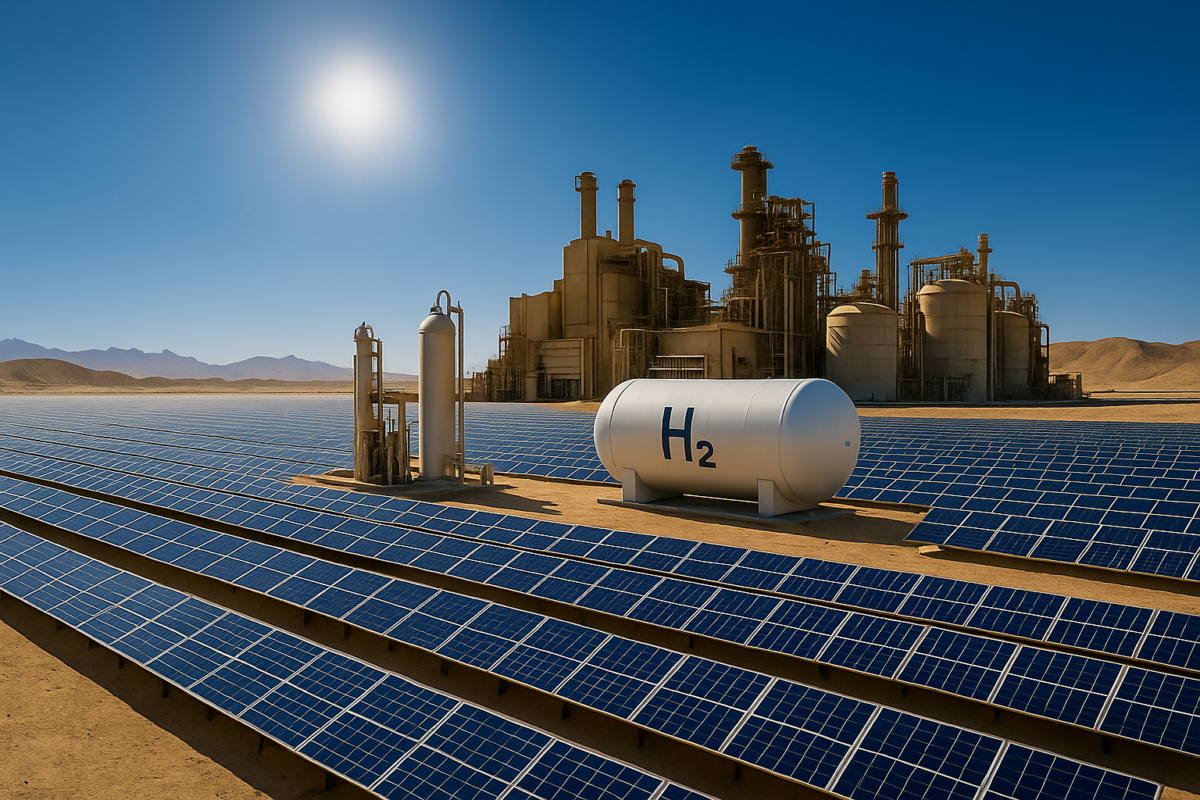
The industry sector is the most challenging, due to high energy and raw material demand, large and continuous production factories, difficult to follow process emissions and infrastructure challenges. In the public discourse, hydrogen is prominently discussed for industry, but its role can be overestimated. Solar PV If the least source of costs of electricity, the electrification from the industry can bring to the next level.
Electrons versus molecules in industry: important insights from a comparative study
A public debate similar to the transport (battery of electric vehicles versus fuel cell electric vehicles) and heat sector (heat pumps versus hydrogen boilers) can soon stand up for energy-intensive industries. Although direct electrification is clearly superior to warmth and transport, the image is more complicated for industry. A new study by Lut University & RLS-Graduate School Defends existing stories about large hydrogen quantities and emphasizes the possibilities of direct electrification. With the help of multi-criteria decision analysis as a methodological framework, with five different weighting strategies, the study compares direct electrification and hydrogen technologies for four industrial segments, including e-amammonia and e-methanol. The general results show that hydrogen is technically easier to implement, but suffers from high energy costs, limited process flexibility, possibly lower efficiency and higher country effects than the alternative based on electrons. Still under lab-scale development, but promising are the electrocatalysis routes for ammonia and methanol production that avoid high temperatures, high pressure and energy losses during the production of green hydrogen as an intermediate step and synthesize the end products directly from water and vocational or carbon dioxide, respectively.
Image: Lut University & RLS-Graduate School
The larger whole: mapping the landscape of industrial solutions
The series of technologies is huge and some are promising than others. An earlier study Identified 28 technologies in all energy-intensive industries considered. Iron and steel is the sector with the highest emissions and the demand for energy, but also the best investigated, with a growing amount of studies.
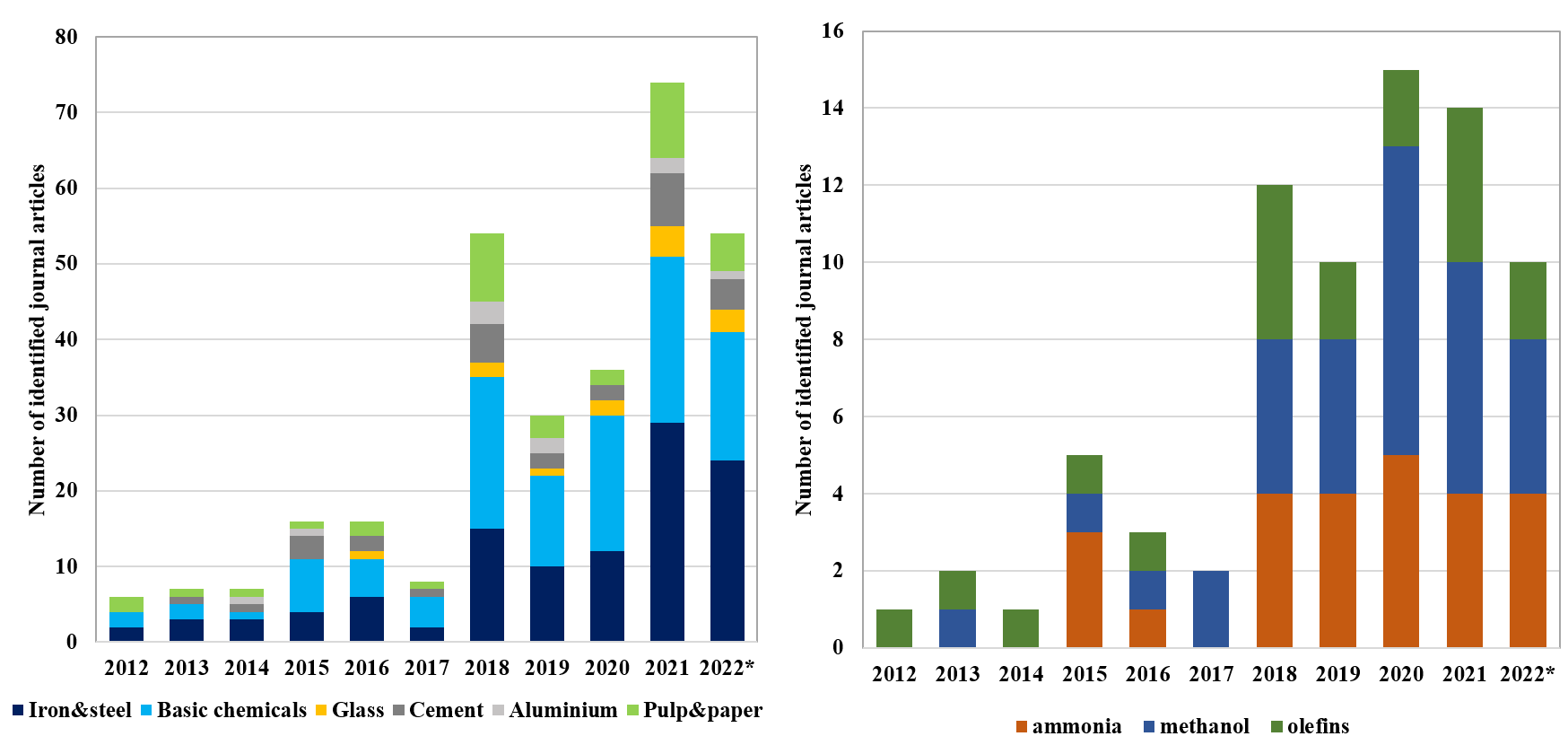
Image: Lut University & RLS-Graduate School
Development of research articles published on industry -defossilization of 2012 – 2022. Source: Lut University & RLS-Graduate School
The world is currently waiting for the first direct hydrogen direct reduction plants in Sweden (Stegra) and Germany (ThyssenKrupp) to start the production of large-scale green steel. Direct electrification, however, is a significant option for every industrial segment: the most prominent for low and medium temperature heat supply via heat pumps and electrical boilers in all industries or by easily replacing fossils with renewable electricity for already electrified processes (such as aluminum melts). In addition, direct electrification can be implemented in technically advanced approaches such as plasma-broken heating in rotating cement ovens, fully electrical glass melting with immersed electrodes or new electrolysis or electrocatalysis allocation for steel and chemical production respectively. The most important thing is that the study has shown that most industries can benefit from an increased use of already available technologies for secondary production and recycling to electrify processes, increase efficiency and reduce the pressure on the availability of material.
Make electrification routes for primary samples
Researchers expect that steel recycling will play an increasingly prominent role with the help of electric arc ovens. Primary steel production with the help of reduced iron ore, ie pig/sponge iron, is still needed for high -quality production. Apart from the route of the hydrogen direct reduction route, the direct electrolysis of iron ore via electricity can be a chance for direct electrification of the production of sponsor. Last Lut University Research indicated that, based on technical maturity in 2040, steel production via electrowning can be the least costs of samples for an electricity price of € 16 ($ 18.7)/MWH, easily feasible by Solar PV and CO2 emission costs of € 30/TCO2.
Anticipating hydrogen direct reduction of the short term, companies have made investments to produce sponsor in regions with abundant renewable energy sources, in particular Zonne -PV, together with iron ore deposits to supply electric arc ovens in regions with limited land usual or less abundant energy sources. Such projects are currently underway in Namibia, Algeria and Mauritania to produce green iron that can be used in European electric arc ovens. New supply chains Can then appear with sponge iron is a strongly traded raw material due to the considerable share of hydrogen production costs in the total steel costs. Technical development of electrowning can enable higher shares of self -supply in the supply chain with samples, because the total steel production costs would be less sensitive to electricity prices.
Global supply chains for chemical raw material -based hydrogen
For chemical production, hydrogen -based raw materials from E-monia And e-methanol are usually considered the most important platform chemicals to produce electric chemical products. Indeed, Transitional investigation of the chemical industry has estimated that more than 33 PWH electricity may be needed to lack the production of chemical raw material. Given the high electricity requirements for producing hydrogen before chemical synthesis, cheap solar PV can be the key to producing economically viable raw materials. An analogue of making samples, a significant trade of electricity-based methanol and ammonia entry can occur, with research into a Power-to-plastic supply chain From Chile and Morocco to European countries that determine that raw materials imports to comparable plastic production costs for importing final plastics. For regions with large chemical industries, such a supply chain strategy can be feasible to maintain chemical production capacities, because electrocatalytic routes may only be available in 2045. e-fuels and e-chemical trade Research indicates a strong and rising competitiveness for Sunbelt -countries.
Modeling of energy system for industrial needs in 100% renewable energy systems
More models with an energy system include industry as a supplement to the modeling of energy systems in 100% renewable energy systems Research and to represent all energy and raw material demand for creating full demand and supply insights, while all energy industry covers System flexibility. Existing studies with a complete representation of energy industry, such as for Finland” Kazakhstan” Americaand the United States and CanadaClearly indicates a high PV share on solar energy with industrial demand driven by three important factors: cheap electricity, seasonal resources complementarity in particular with wind energy, and flexibility benefits in the shorter term with batteries and in the longer term with hydrogen-based requirements. Industrial solar-X characteristics can be found for America and the United States and Canada.
Solar-to-x as an industrial strategy
In most regions in the world, Solar PV is already the least cost source of electricityWith excellent availability of resources that open new industrial opportunities for countries in the Sun Belt region. Although large investments in new factories will be needed, the already low and still falling costs of solar PV and batteries will open the door for large-scale industrial production, with directly electrified processes, or by using green E-Hydrogen as a transitional option. These countries, often based in Global South, can become exporters From green bulk e-chemicals (ammonia, methanol, ethylene) or other intermediate or end products such as e-steel or e-aluminum. Countries in the Global South also benefit from reduced seasonal, which makes continuous production possible by a synergistic interplay of large and small-scale batteries and solar PV. Although the transition from the global industry is still at an early stage, the promising technical opportunities for green industrial production and cheap electricity are ideal conditions for a solar energy-based industrial jump-one that enables emerging economies to position themselves as important players in a lack of worldwide Supply Chain.
Authors: Philipp Diesing, Gabriel Lopez, Dominik Keiner and Christian Breyer
This article is part of a monthly column of Lut University.
Research into Lut University includes various analyzes with regard to electricity, heat, transport, industry, desalination and negative CO2 Emission options. Power-to-X research is a nuclear subject at the university, integrated into the focus areas of Planetary sources, business and society, digital revolution and energy transition. Solar energy plays a key role in all research aspects.
The views and opinions expressed in this article are the author, and do not necessarily reflect it by PV -Magazine.
This content is protected by copyright and may not be reused. If you want to work with us and reuse part of our content, please contact: editors@pv-magazine.com.
Popular content