

In a new weekly update for pv magazineOPIS, a Dow Jones company, provides a brief overview of the major price trends in the global PV industry.
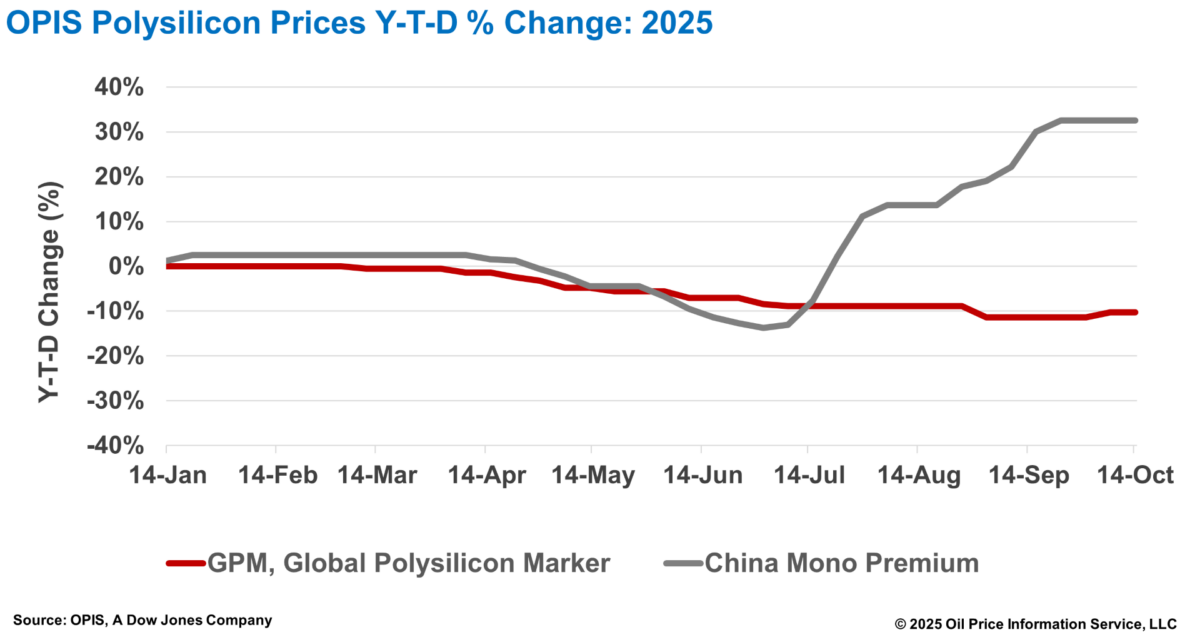
The China Mono Premium – OPIS’ rating for mono-grade polysilicon used in the production of n-type ingots – remained unchanged week over week at CNY52,200 ($7.32)/kg, or CNY0.110/W, according to the OPIS Global Solar Markets Report released on October 14.
The price is now up 53.6% from the year-to-date low of CNY33.975/kg on July 1.
Recent policy signals from China indicate renewed progress on the long-discussed plan to consolidate the polysilicon industry. According to market information, a platform company jointly established by several major polysilicon producers tasked with acquiring and restructuring excess capacity is nearing formal registration.
Participating companies are expected to complete the signing and payment procedures soon. Market sources generally agreed that while the plan has made progress, its pace and scale are still pending official confirmation.
Sources noted that reaching consensus among multiple stakeholders and completing the signing and payment process within a short time frame would be a major achievement, exceeding market expectations.
Meanwhile, others pointed out that the plan has been in development for some time, and that it reflects authorities’ determination to tackle overcapacity and return the solar industry to sustainable growth.
The Global Polysilicon Marker (GPM) – the OPIS benchmark for polysilicon produced outside China – was valued this week at $18,267/kg, or $0.038/W, unchanged week-on-week.
Industry insiders broadly agree that the most influential factor shaping the outlook for the global polysilicon market is the ongoing U.S. national security investigation into polysilicon and its derivatives under Section 232.
Sources believe that the potential risks associated with this research have directly stimulated demand for US-made polysilicon, which is currently seen as the only product completely free from policy-related uncertainties when entering the US market. One source noted an increase in inquiries for domestically produced polysilicon and its lower-quality products.
Another trade source echoed this sentiment, emphasizing that strict US Customs traceability requirements have given solar products made with US raw materials a clear advantage in entering the domestic market. Compared to the complex traceability documentation required for other solar products, products using American polysilicon can sometimes pass customs with only a certificate of origin, the source said.
Given these developments, market participants generally expect the global polysilicon market to see greater price differentials between different origins in the long term, even if such differentiation does not occur immediately.
However, one market observer pointed out that this outcome largely depends on the rigor and final results of the Section 232 investigation. The Observer explained that a significant amount of cells and modules continue to enter the US market from regions such as Africa, by ‘purifying’ their manufacturing origins.
If the US were to further tighten control over the origins of the supply chain, domestic polysilicon prices could rise to around $30/kg in the long term, the observer added.
In contrast, there is great uncertainty surrounding a new polysilicon project that is almost operational in the Middle East. A market source noted that products from this new facility could be seen as an expansion of Chinese capacity and thus could face barriers to entering the US market.
Nevertheless, as solar production capacity increases in India, Turkey and the Middle East, new customer bases and market opportunities are expected to emerge in these regions, the source said.
OPIS, a Dow Jones company, provides energy prices, news, data and analysis on gasoline, diesel, jet fuel, LPG/NGL, coal, metals and chemicals, as well as renewable fuels and environmentally friendly feedstocks. It acquired assets with pricing data from Singapore Solar Exchange in 2022 and now publishes the OPIS APAC Solar Weekly Report.
The views and opinions expressed in this article are those of the author and do not necessarily reflect those of the author pv magazine.
This content is copyrighted and may not be reused. If you would like to collaborate with us and reuse some of our content, please contact: editors@pv-magazine.com.
