

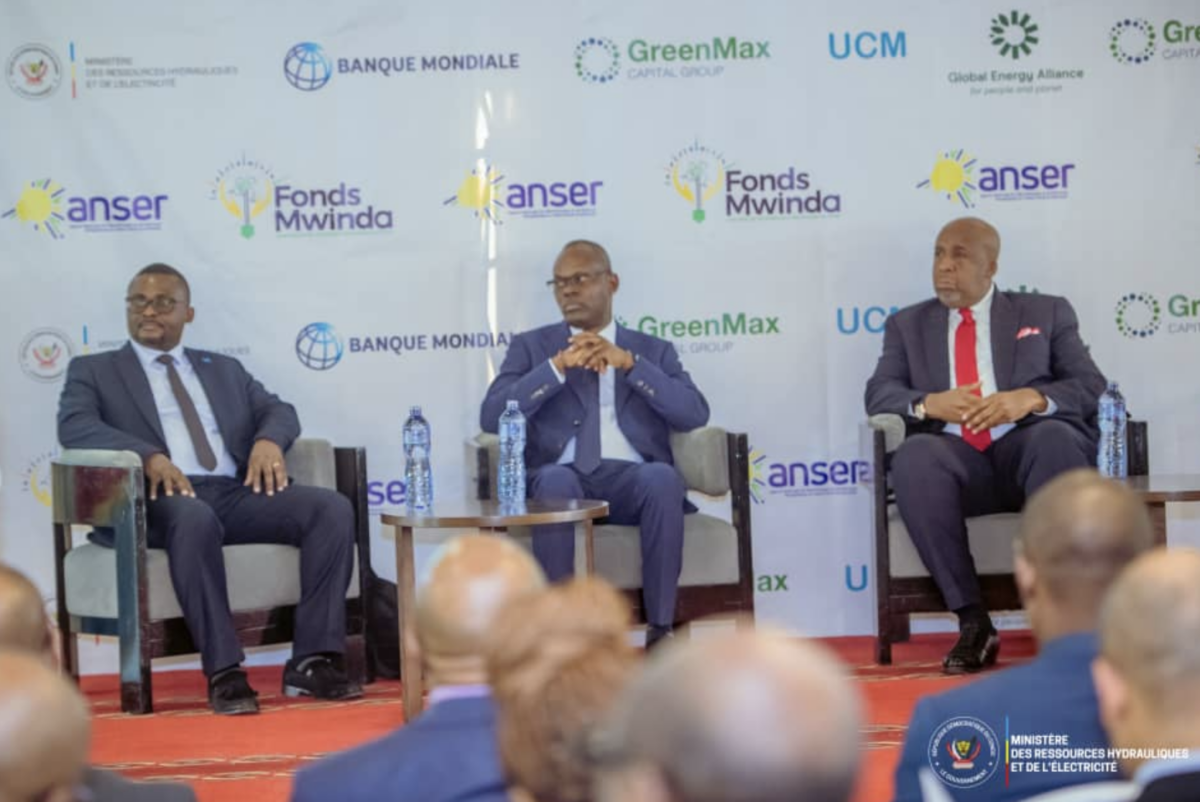
The Mwinda Fund aims to distribute $500 million in grants for mini-grids, solar energy systems and clean cooking solutions in DR Congo by 2030. It is already supported by $65 million in financing from the World Bank and $7 million from the Global Energy Alliance for People and Planet.
The DR Congo‘s Ministry of Water Resources and Electricity and the country’s National Rural Electrification Agency (ANSER) have opened a fund that will provide subsidies for home solar systems, mini-grids and clean cooking solutions in the country.
The Mwinda Fund is part of the government’s Access, Governance and Reforms Project for the Electricity and Water Sectors (AGREE) project, which aims to increase access to both grid and off-grid energy in DR Congo.
The fund aims to distribute $500 million in support over five years between 2025 and 2029. The World Bank has already provided $65 million in financing, while the Global Energy Alliance for People and Planet announced $7 million for the program in September.
According to details published by ANSER, a first call for projects has been launched, with the first financial payments expected to take place next year.
Advisory and fund management firm GreenMax Capital Group has been tasked with developing and managing the implementation of the fund, and helping the government and ANSER raise sufficient capital to reach the $500 million target.
Founder and CEO of GreenMax Capital Group, Clifford J Aron, explained that the fund will implement catalytic subsidies for mini-grid developers, as well as a guarantee facility to enable local banks to provide construction loans for mini-grids. “These innovative financing mechanisms will play an important role in unlocking scalable, community-driven energy solutions and expanding private investments for energy access,” Aron added.
The fund is also a pillar of the World Bank-led Mission 300 project, an initiative that aims to provide electricity to 300 million people in Sub-Saharan Africa by 2030.
Sub-Saharan Africa is currently home to eight out of ten people without electricity worldwide and DR Congo has one of the lowest electrification rates in the world. World Bank data from 2023 shows that only 22% of the population has access to electricity.
Government figures added that electrification rates in rural areas of DR Congo are around 2%. The country has set a goal to increase its electrification rate to 50% by the end of this decade, while diversifying energy sources and promoting energy transition.
In October 2024, Indian developer Soleos Energy started building one 200MW solar park in DR Congo, scheduled for commissioning next year.
According to the Africa Solar Industry Association (AFSIA) project database, DR Congo currently has 51.6 MW of operational solar power, of which 22.3 MW comes from mini-grids or home solar systems. The country has another 282 MW of solar power under construction.
This content is copyrighted and may not be reused. If you would like to collaborate with us and reuse some of our content, please contact: editors@pv-magazine.com.
