

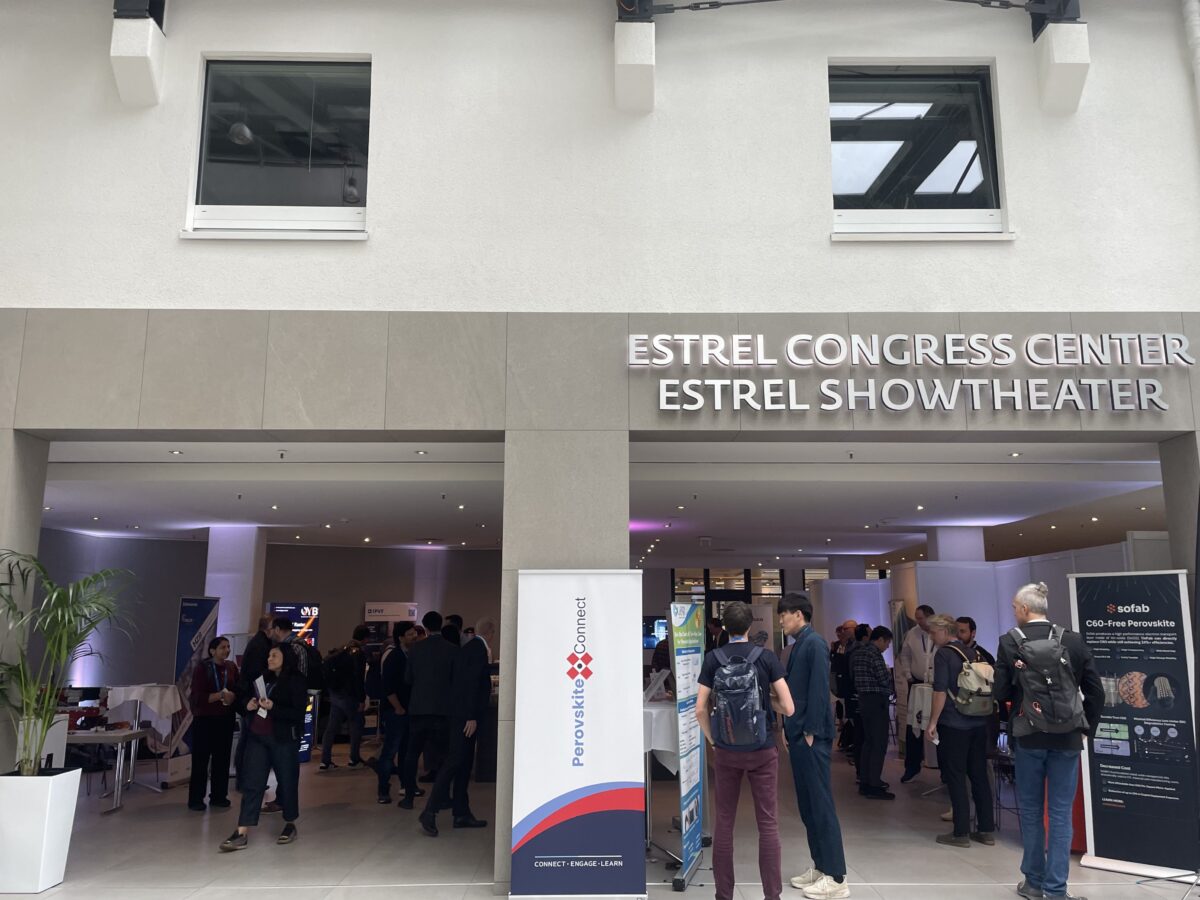
Industry and researchers discussed scalability, sustainability and routes to commercialization at the first global perovskite fair in Berlin, with organizers already planning a second edition for October 2026.
With the development of perovskites progressing rapidly, it was time for the technology to have its own dedicated trade show. Perovskite Connect 2025, organized by TechBlick and Perovskite-Info, was the world’s first trade fair for perovskites and took place from October 21-23 in Berlin. It was held in conjunction with The Future Of Electronics Resized trade fair, showcasing the latest in additive, printed, sustainable, hybrid and 3D electronics.
Perovskite Connect 2025 featured exhibitors from across the industry, in addition to two days of keynote sessions and speakers on the ongoing work required to take perovskites from pilot projects and efficiency records in laboratories to large-scale commercial deployments.
Presentations were given by both industry leaders and research institutions. Attendees said pv magazine Collaboration between both parties is crucial to support the next phase in the evolution of perovskites and several speakers expressed a willingness to share testing procedures and research results to address production bottlenecks. Other specific discussion topics included the sustainability of perovskites, how to understand and address the causes of device instability, and what companies and researchers are doing to address these challenges.
Image: pv magazine
Some leading perovskite companies shared how they are preparing their technology for scalable deployments at the gigawatt level. Among them was Oxford PV, which presented its roadmap until 2035. Ed Crossland, the company’s CTO, shared plans to increase module efficiency from 25% with an annual decline of 2% in 2025 to 30% efficiency in 2030 and 35% in 2035, after which the annual decline should be around 0.5%. He added that the modules already deployed in the field are performing better in terms of degradation than their 2023 predictions.
Elsewhere, Chinese perovskite cell manufacturer Microquanta, with a 52.2% market share, shared how it is optimizing its laminar air dryer (LAD) design for scalable production. The company plans to expand its LAD to larger modules of more than 1 m², while aiming for tandem designs with four terminals with an efficiency of more than 30%.
More than 80 exhibitors were present at both events. Exhibitors in the designated perovskite area included Alpha Precision Systems and Sofab Inks, who recently collaborated on a Perovskite solar cell of 30 x 30 cm and the French research institute IPVF, which is working on one pilot test line of perovskite mini modules of 30 x 60 cm², which will go live early next year.
Although the number of perovskite exhibitors was relatively small compared to Electronics ReShaped, there was great interest in the perovskite products on display and the discussions that took place. As a result, it is likely that the number will be much higher in the future. Event organizers told the story pv magazine the second edition of the event is already scheduled and will take place on October 20-22, 2026, again in Berlin.

Image: pv magazine
Berlin feels like a suitable home base for the conference, especially as some of this edition’s discussions focused on the importance of reinvigorating European solar energy production. Solar energy expert Gunter Erfurt warned that up to €18 billion ($20.9 billion) of annual economic activity in Europe is lost due to imported solar panels. He called for restoring balance to the global solar energy sector by revitalizing the supply chains of Europe and the US.
Erfurt was also among speakers who highlighted perovskite production as an opportunity to strengthen Europe’s solar energy manufacturing base, although others expressed concern that China’s vast resources mean the country is on track to achieve commercialization more quickly. If the world’s other major solar markets are to keep up with China as perovskites develop, it will be critical to maintain the collaborative efforts on display at Perovskite Connect.
This content is copyrighted and may not be reused. If you would like to collaborate with us and reuse some of our content, please contact: editors@pv-magazine.com.
Popular content

