

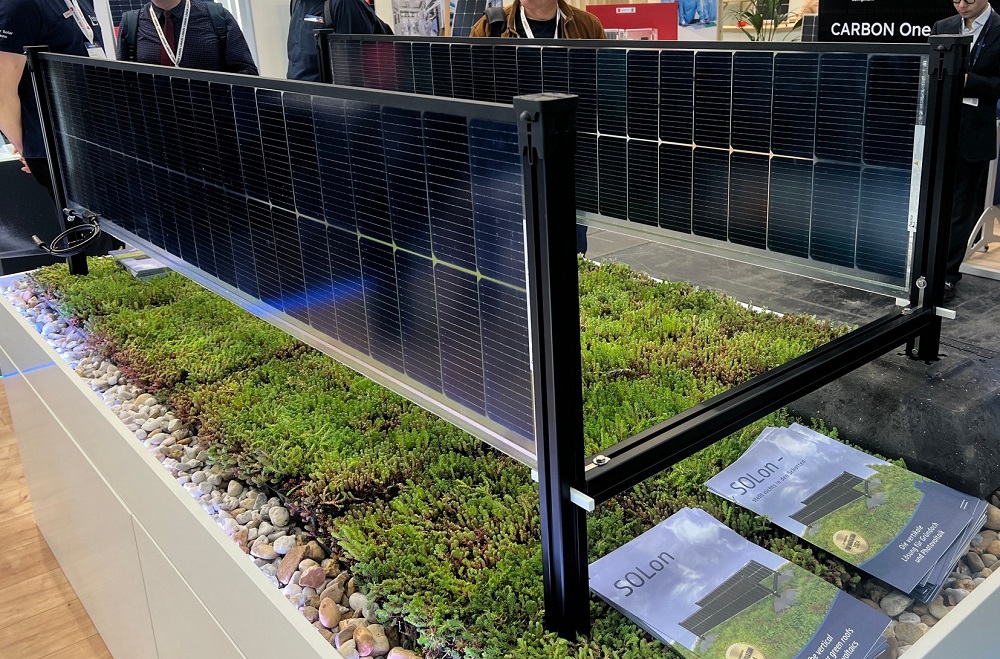
New research from Finland shows how the distance between solar panels plays a key role in determining power and crop yield. The scientists found that crops at a distance of 8 meters received at least 75% of the irradiation, which is expected to have minimal impact compared to a no-shade scenario.
Scientists from the University of Turku in Finland have investigated the impact of solar panel row spacing on power and crop yield in vertical two-sided agrivoltaic projects at high latitudes and found that a spacing of at least 8 meters is necessary to ensure project viability.
In the study “Performance evaluation of high-latitude agrivoltaic systems with vertically mounted bifacial panels”, published in Applied energythe researchers explained that their work addresses a gap in the literature regarding high-latitude APV systems.
“This work is computational, with a focus on energy production and factors affecting the agrivoltaic system, and is needed to motivate further experimental studies,” they stressed. “The purpose of the crop irradiation study was to estimate how to avoid excessive shading of crops in an agrivoltaic system.”
Using PVsyst, the research team modeled an east-west oriented agrivoltaic system consisting of 15 module rows in a landscape configuration, with a ground clearance of 1 m and agricultural land between the rows. A clearance of 0.5 m was left on each side of the panels to account for areas inaccessible to agricultural implements. A driving distance of 5 to 100 meters was simulated. Two additional south-facing systems have been created for benchmarking.
With these simulations, the researchers aimed to assess the degree of shade at high latitudes, evaluate how panel-induced shade affects energy generation and crop yield, and determine how crop type affects albedo.
The analysis showed that for vertical bifacial arrays, the distance between module rows should be between 11.3 m and 13.7 m to maintain 90% of agricultural yield compared to reference fields without PV panels.
“Increasing driving distance has a significant impact on production, which increases rapidly up to 10 meters; above 20 meters, however, gains begin to stagnate,” the researchers noted. “At a distance of 8 meters, the crops received at least 75% of the irradiation, which is expected to have a minimal impact compared to a no-shade scenario.”
In terms of crop selection and its influence on albedo, winter barley produced the highest energy yield, while oats produced the lowest. Shading caused the largest power losses in the east-west configuration, especially when tall objects such as trees were near the array. Sites with south-facing shade were identified as most suitable for vertical bifacial agrivoltaic systems.
A techno-economic analysis based on spot electricity prices further showed that east-west oriented vertical installations are more profitable than their south-facing counterparts, especially as the share of PV in the energy mix increases.
“This is because both energy prices and production of vertical bifacial PV systems show two peaks: one in the morning and one in the evening,” the scientists concluded. “Additionally, prioritizing self-consumption may be the most viable approach, as self-consumed energy has a higher value than energy sold to the grid as there are no additional costs.”
This content is copyrighted and may not be reused. If you would like to collaborate with us and reuse some of our content, please contact: editors@pv-magazine.com.
