

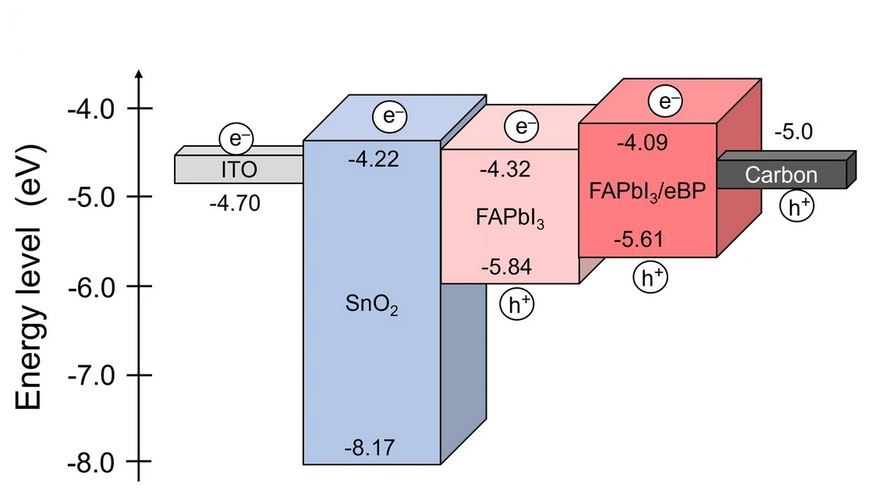
The result is the best efficiency ever measured for a carbon-based PV cell using unconventional hole-transporting materials. The device is built with a transparent holey layer based on electrochemically produced large-area phosphorene flakes, which reportedly enable the required band energy alignment within the cell.
A research group in Australia has designed a perovskite solar cell using a carbon electrode and a hole transport layer (HTL) made from a special type of 2D material known as phosphorene (eBP).
This material consists of a single layer of black phosphorus (BP) and is analogous to graphene. According to the researchers, it has high carrier mobility, ambipolar conduction behavior and an adjustable band gap, making it ideal for applications in perovskite solar cells. “Recently, the concept of using BP derivatives as an interlayer between the perovskite layer and HTL has shown a significant improvement in hole transport due to the reduced injection barrier between the perovskite and HTL, and the favorable band energy alignment in conventional perovskite cells. ” explained.
The research group used a packed bed electrochemical reactor (PBER) to produce high surface area phosphorene flakes for the HTL. “The electrochemical expansion of BP was carried out in a two-electrode PBER, in which a bed of bulk BP was pressed against a boron-doped diamond (BDD) working electrode and separated from a platinum (Pt) counter electrode with a glass fiber. membrane,” the report said.
“The resulting expanded BP was exfoliated into nanosheets (eBP) for just 2 minutes using mild sonication in dimethyl sulfoxide (DMSO) due to the weakened van der Waals interaction between the layers caused by the presence of intercalants.”
Image: Griffith University, 2D Materials and Applications, Common License CC BY 4.0
The academics built the cell with a glass-coated indium tin oxide (ITO) substrate, an electron transport layer (ETL) based on tin oxide (SnO2), a perovskite absorber, an HTL that relies on eBP, and a carbon contact.
In the proposed cell configurations, the eBP flakes aim to improve the interfacial contact between the perovskite absorber and the carbon electrode, while suppressing ion migrations and reducing hysteresis. They also contributed to achieving “suitable” band energy alignments, as well as improved hole selectivity and transport.
Tested under standard lighting conditions, the device achieved a power conversion efficiency of 15.58%, an open-circuit voltage of 1.082 V, a circuit current density of 22.89 mA and a fill factor of 62.85%, which according to the scientists is the highest. values ever recorded for a carbon-based perovskite solar cell using non-conventional hole transport materials.
“More importantly, the unencapsulated c-PSCs with eBP flakes showed excellent stability under various harsh test conditions, including high temperatures and humidity, due to the combined protection of hydrophobic eBP HTL and carbon electrode,” the academics added. “We hypothesize that the well-aligned band energy and hole extraction ability of eBP nanosheets lead to efficient hole transfer from the perovskite layer to the carbon electrode.”
In comparison, a control cell built with a conventional HTL achieved an efficiency of 13.48%, an open-circuit voltage of 1.045 V, a circuit current density of 21.46 mA, and a fill factor of 60.06%.
The new cell design was presented in the study “High surface area phosphorene for stable carbon-based perovskite solar cells,” published in 2D materials and applications. The research group was formed by scientists from Griffith University.
This content is copyrighted and may not be reused. If you would like to collaborate with us and reuse some of our content, please contact: editors@pv-magazine.com.
