

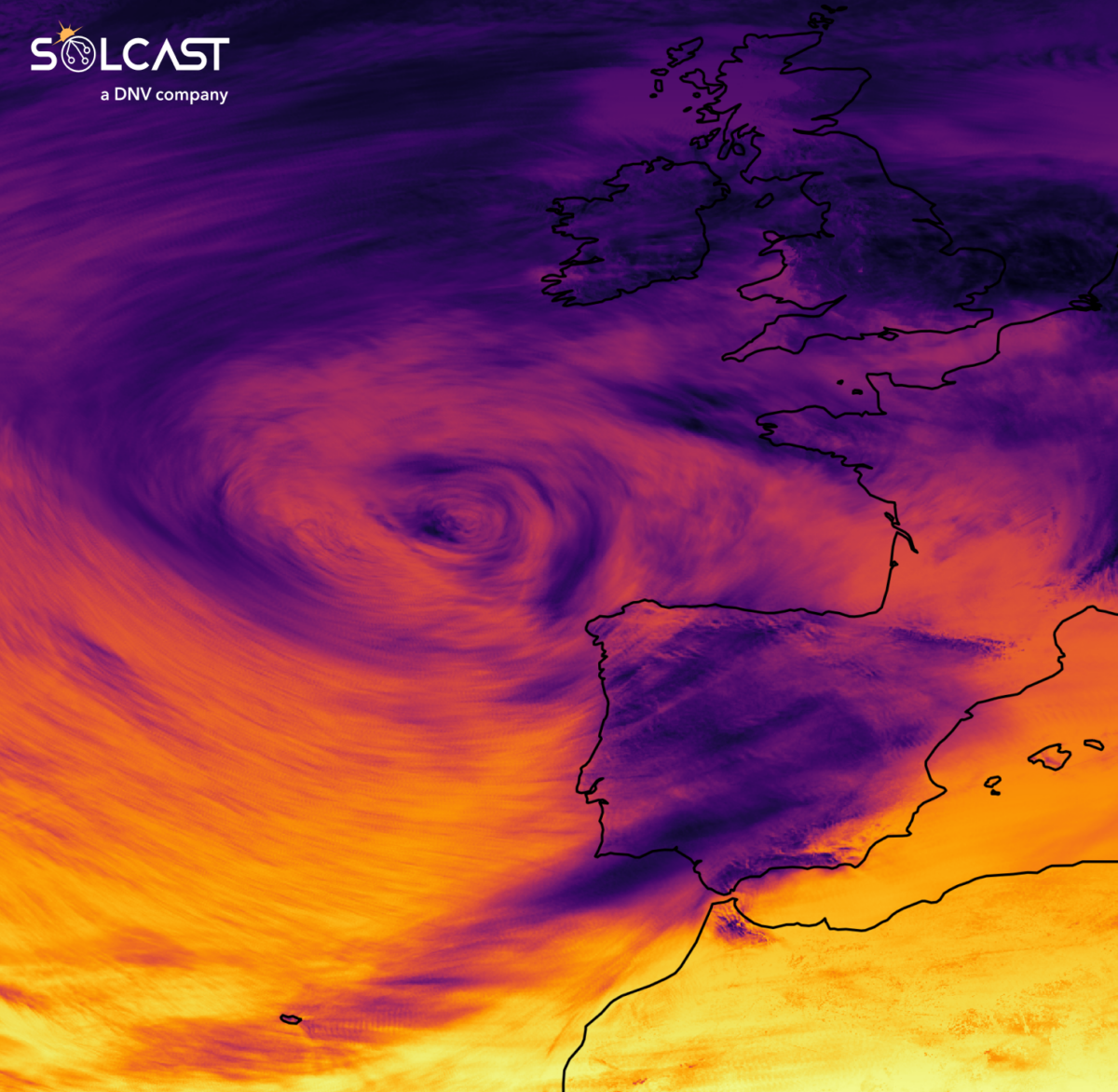
In a new weekly update for pv magazineSolcast, a DNV company, reports that Storm Claudia has significantly reduced daily insolation in the British Isles and the Iberian Peninsula, limiting solar energy generation.
Storm Claudia, which hit western Europe in mid-November, caused damaging winds and widespread power outages across the Iberian Peninsula and the British Isles. Severe weather associated with the Atlantic storm system reduced solar radiation and damaged solar power, causing widespread power outages. While the impact of significant weather events like Storm Claudia is most felt in the lives lost and damage caused, the resilience of sustainable power grids to severe weather is a key factor in the widespread impacts of storms on communities. Renewable energy producers, grid and system operators, and those with residential or large-scale solar energy systems need to be aware of upcoming weather events and how to prepare for them to minimize negative impacts.
Storm Claudia developed as a deep low-pressure system over the North Atlantic Ocean and was identified and named on November 10 before moving east towards Europe. The associated frontal systems brought strong winds and pouring rain to Ireland, England and Wales on the 13th and 14th, while Portugal, Spain and the Canary Islands experienced heavy conditions from the 12th to the 16th. Heavy and widespread cloud cover during this period greatly reduced daily insolation over the British Isles and the Iberian Peninsula, limiting solar energy generation. On November 15, solar radiation estimates from satellite images showed a low GHI due to the dense storm cloud in northwestern Portugal, which cast a broad shadow over key solar areas.
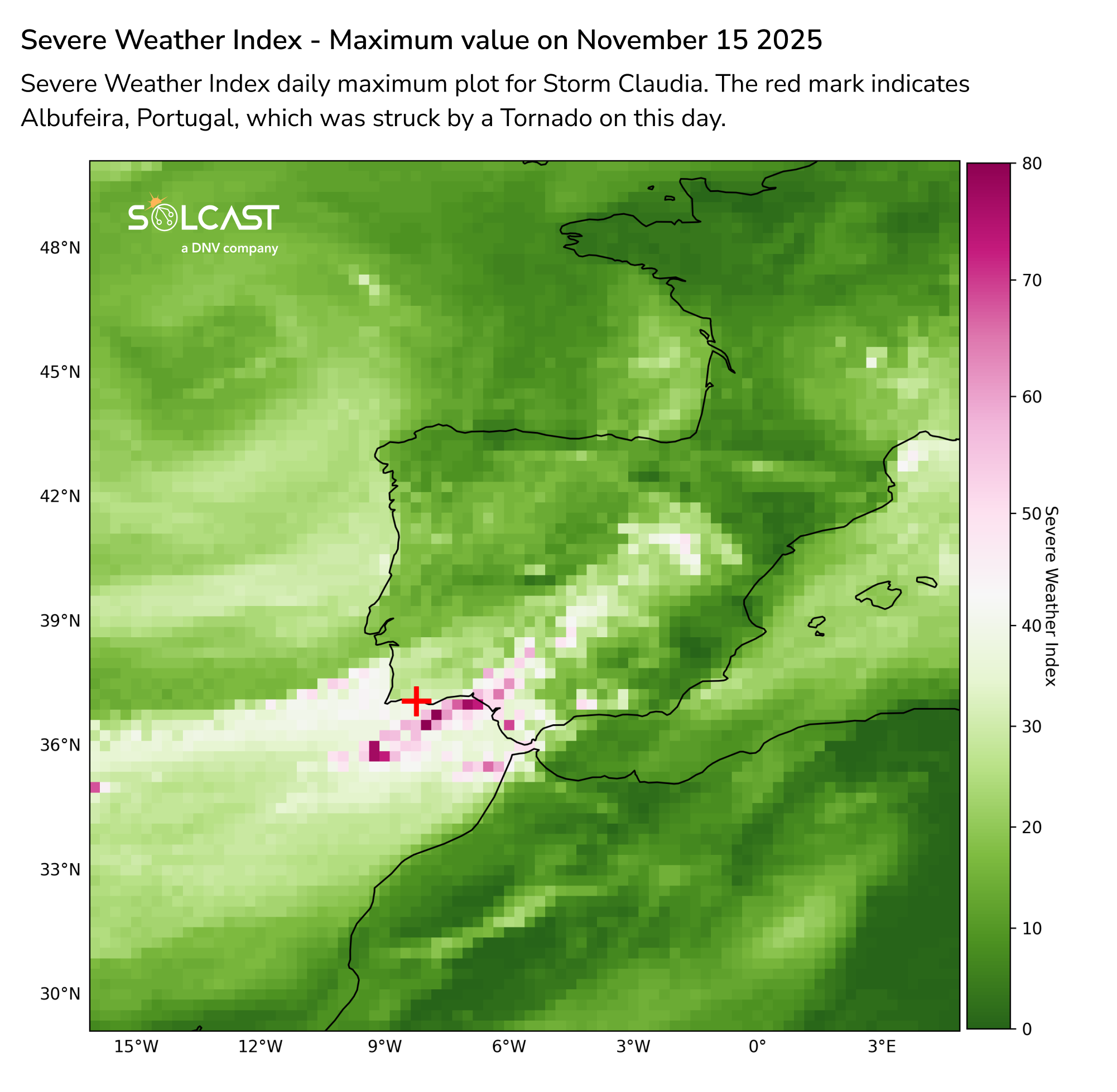
The storm caused major physical and infrastructure damage. In Portugal, the city of Albufeira was hit by a tornado on November 15, causing one death at a campsite and several injuries at a nearby hotel. Across the region, thousands of households suffered power outages as trees, whose roots were destabilized by saturated soil, fell onto power lines. According to reports, more than 20,000 customers were without power in Portugal alone, with additional outages in Ireland, England, France and Spain.
Despite the significant personal toll and costs of these damages, managing power supplies in the lead-up to these events is critical to limiting the extent of negative impacts. Increasing residential storage capacity and the proliferation of hybrid solar-plus-storage installations provide an opportunity to reduce energy consumption by storing energy in advance of severe weather events. Forecasting severe weather conditions allows battery owners and operators of all sizes to implement conservative battery strategies and deliver power.
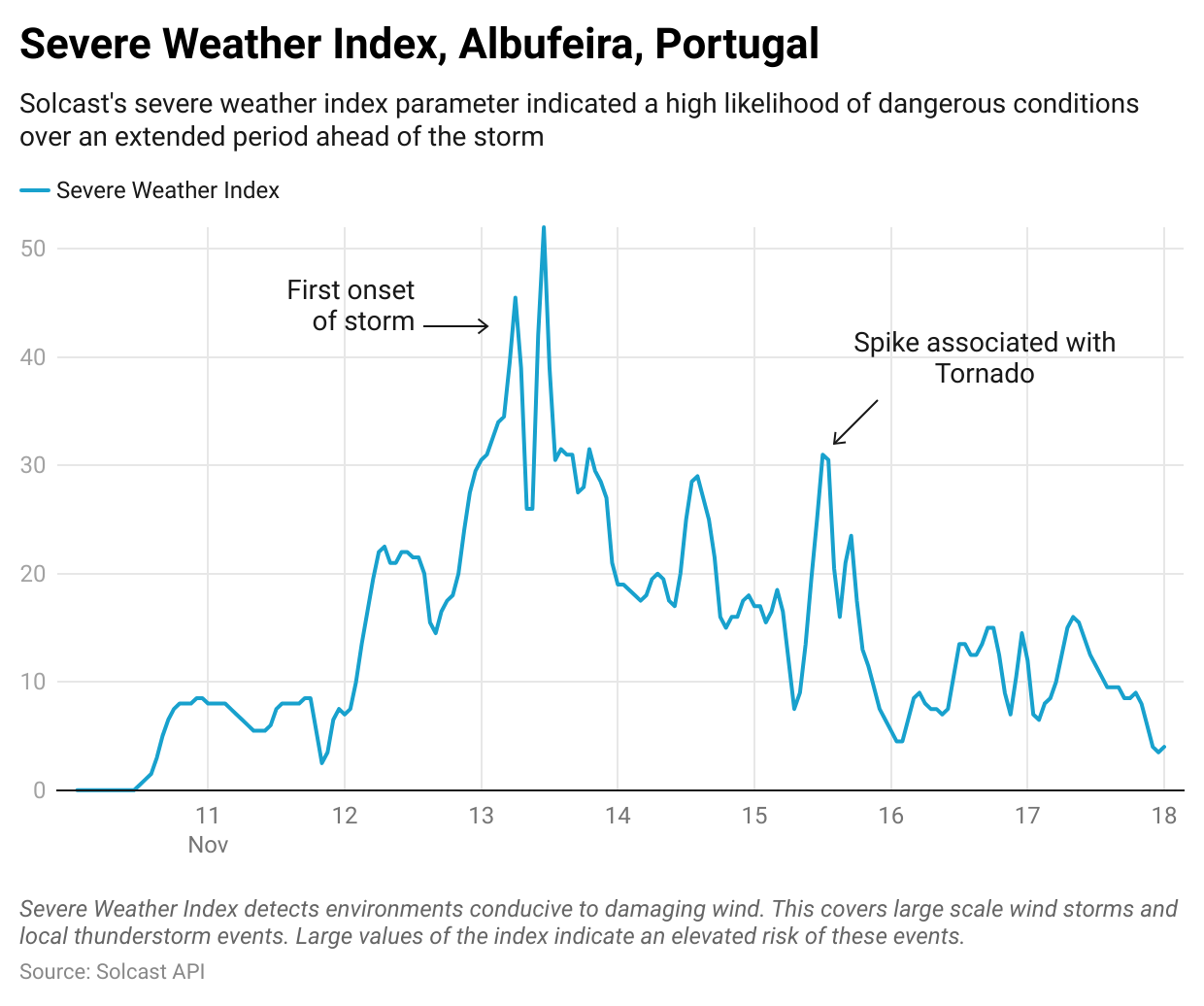
The above data shows the maximum of the severe weather index for November 15, and a time series of severe weather index for Albufeira in the days leading up to the tornado. During Storm Claudia, this index showed persistently high values in the affected areas, including Albufeira, indicating an increased risk of dangerous weather. The extended period of a high severe weather index indicated early on that damaging winds were likely. This, combined with a radiation forecast for the region, could be used to predict a long-term period of reduced solar generation.
Solcast produces these figures by tracking clouds and aerosols worldwide at a resolution of 1-2 km, using proprietary satellite data AI/ML algorithms. This data is used to drive irradiance models, allowing Solcast to calculate high-resolution irradiance, with a typical deviation of less than 2%, as well as cloud tracking predictions. This data is used by more than 350 companies that manage more than 300 GW of solar energy worldwide.
The views and opinions expressed in this article are those of the author and do not necessarily reflect those of the author pv magazine.
This content is copyrighted and may not be reused. If you would like to collaborate with us and reuse some of our content, please contact: editors@pv-magazine.com.
Popular content

