

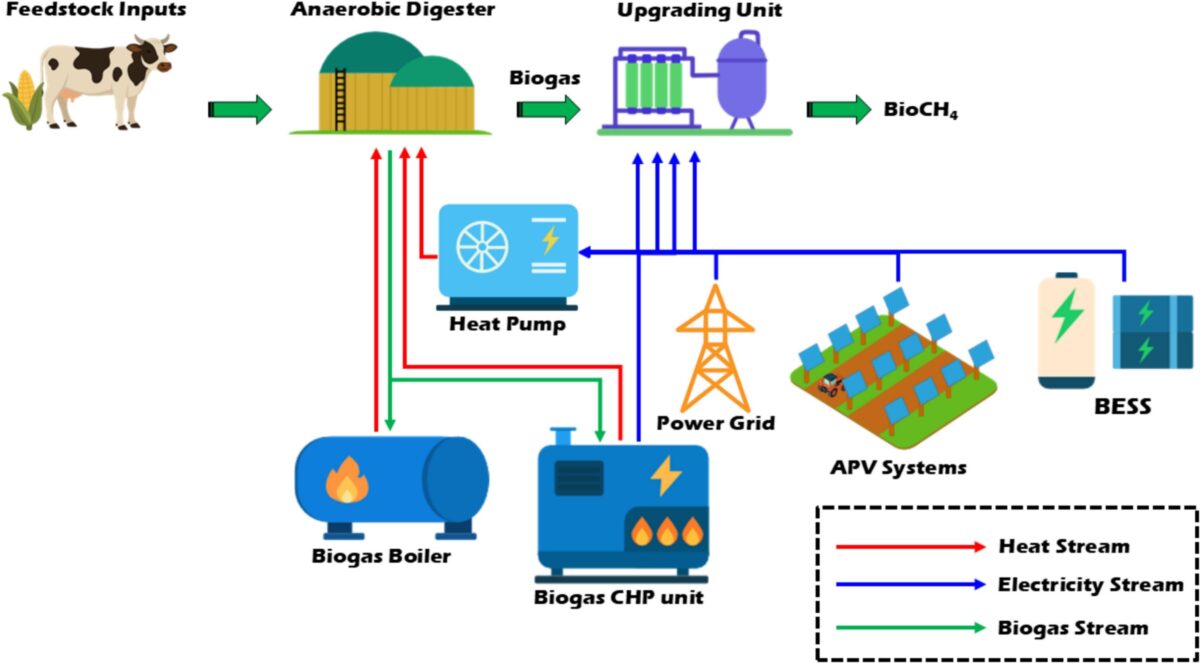
Researchers in Italy simulated and optimized an agricultural-driven anaerobic digestion plant for biomethane production in eight scenarios, using vertically mounted panels with single-axis trackers in some cases and dual-axis trackers in others.
A group of scientists led by Italy’s Catholic University of the Sacred Heart has carried out a techno-economic optimization of an agricultural-driven anaerobic digestion (AD) plant for biomethane production.
A multi-objective genetic algorithm (MOGA) combined with a technique for order preference by similarity to ideal solution (TOPSIS) ranking methodology was developed to simultaneously optimize economic performance and land use.
“This study presents the first optimization framework that integrates bifacial agrivoltaic (APV) systems with anaerobic digesters specifically designed for biomethane production,” said corresponding author Amirhossein Nik Zad. pv magazine. “To our knowledge, no previous study has combined a multi-objective genetic algorithm with the TOPSIS ranking methodology in this APV biomethanation context.”
Central to the optimization is a mesophilic AD plant in Piacenza, Italy, which requires a constant temperature of 37 C. 4.75 tons of raw materials are consumed per hour and 6,789 Nm³/day of biogas is produced, of which approximately 3,680 Nm³ is biomethane (BioCH4). The total annual electricity demand is 1,011.8 MWh, with a peak demand of 119 kW. The plant has a heat demand of 1,340 MWh, with a peak in January of 179 kW.
“We analyzed eight scenarios, grouped into three primary scenarios (grid-tied bifacial APV systems) and five alternative scenarios: off-grid APVs, grid-only (without APV) and conventional (combined heat-and-power only) configurations,” explains Nik Zad. “For the three primary scenarios, our framework simultaneously optimizes economic performance and land use. For the alternative scenarios, an analytical techno-economic evaluation was carried out to compare their performance with the optimized solutions.”
Image: Università Cattolica del Sacro Cuore, Energy Conversion and Management, CC BY 4.0
Scenario 1 included an APV system, a mains connection and a boiler. In Scenario 2, the boiler was replaced by a groundwater heat pump (GWHP), while Scenario 3 replaced it with a combined heat and power unit (CHP). Scenario 4 used only a CHP; Scenario 5 combined a grid connection with a GWHP; and Scenario 6 linked a mains connection to a boiler. Scenario 7 included an APV system with a battery energy storage system (BESS) and a boiler, while Scenario 8 combined an APV system with a BESS and a GWHP.
In all scenarios with an APV system, the solar panels were installed vertically and single or dual axis tracking was used. When a CHP unit was used, it consumed 24.05% of the biogas produced.
“The most striking finding was the dramatic economic superiority of heat pump electrification over biogas combustion strategies. Groundwater heat pump configurations achieved up to 8.7 times higher net present value (NPV) compared to biogas boilers or CHP alternatives within our primary (optimized) scenarios,” said Nik Zad. “This happens because the electrification of thermal demand preserves biogas for upgrading to biomethane, which has a significantly higher market value than electricity in Italy, approximately 5.5 times the purchase price of electricity.”
The research group also found that the optimized on-grid APV configuration, which combines 1-axis tracking with GWHP (Scenario 2), achieves superior economic performance with an NPV of €2.88 million ($3.35 million), outperforming the conventional CHP baseline by 4.1 times (Scenario 4).
“Another interesting result was the consistent dominance of 1-axis tracking systems over both 2-axis and vertical configurations in all scenarios,” Nik Zad concluded. “Although 2-axis systems capture more energy, the additional capital and operating costs offset these gains. The 1-axis configuration consistently provided the optimal balance between energy yield and cost-effectiveness, indicating that it represents a mature technology ready for standardization and large-scale deployment in integrated agri-energy systems.”
The academics presented their research work in “Techno-economic optimization of agriculturally driven anaerobic digestion plant for biomethane production”, published in Energy conversion and management. Scientists from Italy’s Catholic University of the Sacred Heart and Sweden’s Mälardalen University participated in the study.
This content is copyrighted and may not be reused. If you would like to collaborate with us and reuse some of our content, please contact: editors@pv-magazine.com.
Popular content

