

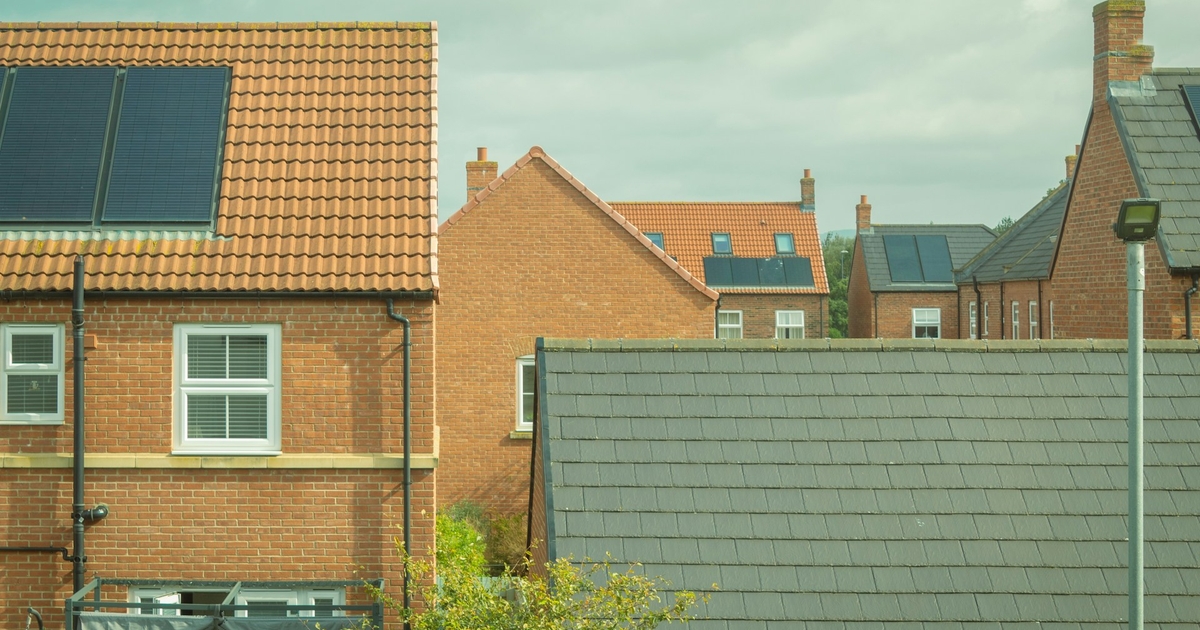
This month the British government will publish its Future Homes Standard, a piece of legislation that sets requirements for new-build homes in England.
Including a mandate to include measures to improve carbon emissions from homes, especially rooftop solar, as well as insulation and heat pumps, has been a demand from the solar industry for some time.
That was the case in June 2025 confirmed by the government that almost all new-build homes must have solar PV installed on the roofwhich in most cases covers at least 40% of the floor area of the property.
Recent headlines have suggested that the government is backtracking on the requirements of the Future Homes Standard (FSH). According to reports, it has been confirmed that the installation of battery energy storage will not be enforced under the legislation.
The government never said that domestic battery energy storage would be included in the FSH.
According to a report in the Guardian, Published on January 2, ministers have bowed to pressure from housebuilders and are unlikely to stipulate that battery energy storage be installed in the home as standard alongside other sustainable technologies.
Homebuilders lobbied against the inclusion of batteries, which would come at an upfront cost to the developer.
The government, in addition to its pledge to unleash a solar revolution on rooftops, has pledged to build 1.5 million new homes over the course of its term in office. It was this that, until June, the government seemed to delay in its commitment to an FSH that required the absorption of solar energy.
In a move described as ‘common sense’ by energy secretary Ed Miliband, FSH will see building regulations explicitly promote solar energy for the first time. While the addition of battery storage would have been a further victory (or even common sense), there was never any suggestion that the January legislation would mandate the installation of batteries in new-build homes.
Speaking to Solar Power Portal, Chris Hewett, CEO of Solar Energy UK, the trade association representing the solar and energy storage industries in Britain, explained: “If the Future Homes Standard were to be established now, I have no doubt that it would effectively mandate the installation of a battery system.
“The truth is that the standard has been in development since 2019, when the battery market was very different, in terms of availability, cost and capacity. Adding the technology would not have been considered at the time.
“Doing that now would require more rounds of consultation and delay the implementation of the regime for longer. That would be in no one’s interest as the FHS virtually requires solar power – a huge policy win for the sector that we should all celebrate.”
Benefits of battery storage
Despite the apparent reluctance of property developers, consumers benefiting from rooftop PV installations need little more encouragement than the further savings offered by energy storage alongside their solar panels to install the technology themselves.
Hewett summarized this: “A battery storage system for home use is fantastic – especially when combined with solar power. It allows the energy generated to be stored so that it can be consumed or sold when the price is highest. Conversely, it also allows electricity to be imported cheaply overnight, providing a vital benefit even in the dark days of winter.”
Figures from the Microgeneration Certification Scheme (MCS), which certifies domestic renewable energy installations, show that in In November, the number of certified solar panel installations in 2025 was 203,125 – the previous annual record from 2011.
MCS also noted that the number of certified battery storage installations at the end of September had increased by 122% compared to the comparable period in 2024, with the total number of installations now standing at 59,000.
The organization has called for the inclusion of battery storage in the FSH and published a report in September 2024 calling the FSH’s omission of the technology a ‘significant missed opportunity’.
Modeling at the time suggested that households with solar power generation and energy storage technologies would pay around £24 per month in energy bills.
A recent article for Solar energy portal written by Alanna Loder-Symonds, sustainability director at consultancy EQONIC Sustainability, part of battery technology company EQONIC, sets the annual savings for a three-bedroom home with both solar PV and battery energy storage installed between £600 and £1,000with a return on investment over 5 to 12 years.
Mandating the installation of energy storage in all newly built properties would clearly be a step towards achieving the government’s pledge to reduce all domestic energy bills by 2030. Leaving the installation up to the property owner will not prevent its implementation, but it will delay it and limit access for the time being for those with lower incomes.
That said, many technology providers offer payment options that mitigate the high upfront costs.
Supporting the increasing demand for electricity
Wider adoption of energy storage will also benefit the electricity grid. As Hewett said: “On a national scale, they also improve our energy security and play a role in avoiding the costs of strengthening the electricity grid – and can help reduce the need to curtail renewable energy generation. Costs are also falling.”
Per analysis by Carbon BriefIn 2025, electricity demand increased by 4 TWh for the second consecutive year to 322 TWh.
This increase is in line with forecasts by the Climate Change Committee (CCC), which sets the carbon budget needed to achieve legally binding net-zero commitments by 2050, that electricity demand will double by the same year.
The strain this will place on the electricity grid means a major infrastructure upgrade is necessary, but domestic demand growth can be mitigated by using battery energy storage.
The National Energy System Operator’s (NESO) ‘critical drivers’ set out in its Future Energy Pathways to net zero include managing demand growth and reducing energy costs for consumers, something that mandating the installation of household energy storage systems could achieve.
While it is encouraging to see ministers not backtracking on the FSH, the omission of battery storage from the standard is broadly worth highlighting as an area that needs to be addressed.
“We will have to see how homebuilders respond to consumer demand and go beyond the legal minimum to build zero-bill homes, as some are doing now – and how many new solar home buyers retrofit battery systems. So it would make sense for FHS to ensure that all solar homes are ‘battery ready’ so that installations are cheap and easy,” Hewett concluded.
