

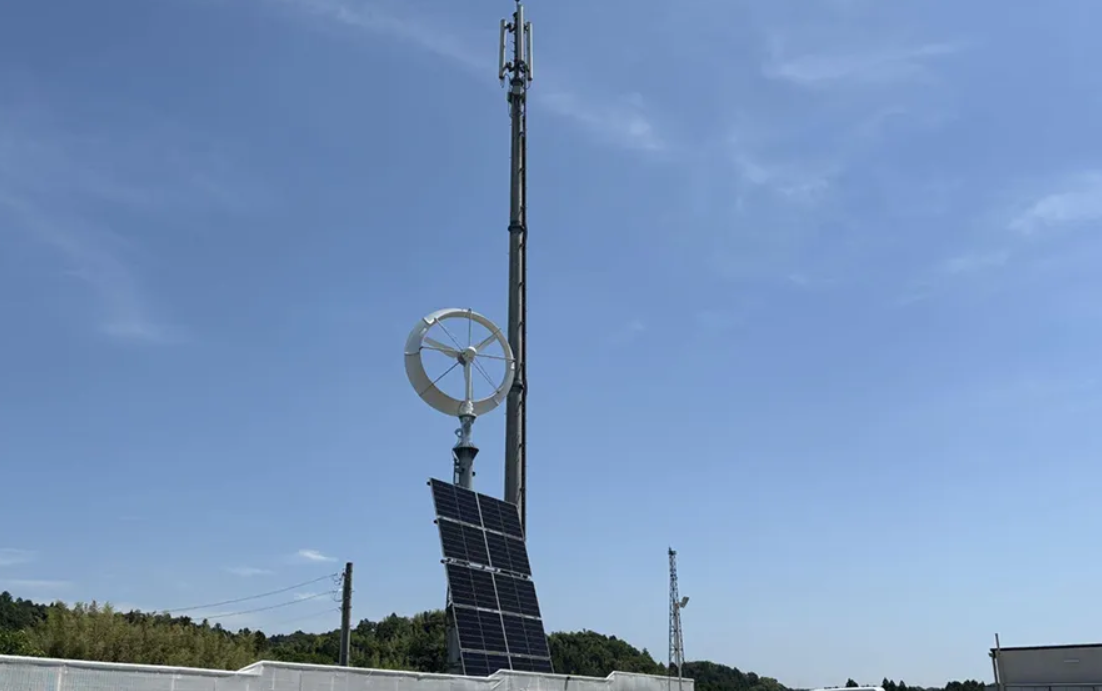
SoftBank Group is testing AI-powered mobile base stations powered by solar panels and a 3 kW wind turbine to reduce energy consumption while maintaining service quality. The system stores excess energy in batteries and can automatically switch to the electricity grid if necessary.
Japanese investment holding company Softbank Group is testing a new type of mobile base station that generates a significant portion of its electricity from solar and wind energy.
The pilot system will be installed at one of the company’s facilities in Ichihara City, Chiba Prefecture. It uses artificial intelligence (AI) to dynamically manage the station’s ‘sleep’ mode, reducing energy consumption during periods of low communications traffic, while maintaining service quality.
The installation combines conventional solar panels with a 3 kW lens wind turbine. The turbine is equipped with a diffuser that efficiently captures and accelerates the wind, allowing high power even at low speeds of approximately 3 m/s. According to SoftBank, the system’s compact design also makes it suitable for deployment on remote islands and mountainous areas.
The power generated by the system is stored in batteries, which power the base station when generation is low. If the battery level drops below a preset threshold, the station automatically switches to the commercial grid to ensure uninterrupted operation.
“By analyzing human flows and communication traffic with AI, we evaluate target cells while maintaining communication quality,” SoftBank said in a statement. “Base station sleep control is performed under the assumption that traffic in the target cell is handled by surrounding stations without causing congestion.”
Previously, stable service during sleep mode required surrounding base stations to be in the same building and oriented in the same direction, with strict conditions to determine the target cells. SoftBank said AI analytics now enables a broader selection of cells without compromising communication quality. The company expects this to expand the number of target cells in sleep mode from about 14,000 to about 24,000.
SoftBank plans to expand testing of the wind and solar base stations in the coming months.
It recently announced a new four-year project focusing on high-energy-density battery technology and high-efficiency solar cells for high-altitude long-duration platform station aircraft (HAPS).
This content is copyrighted and may not be reused. If you would like to collaborate with us and reuse some of our content, please contact: editors@pv-magazine.com.
