

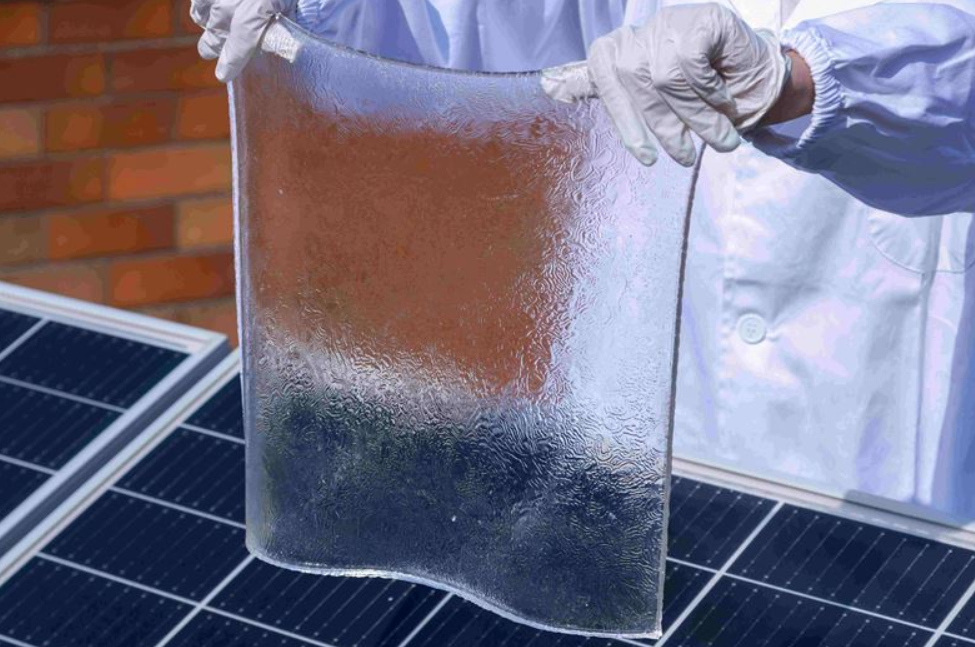
A team of scientists has developed a new hydrogel solar panel coating that can reportedly reduce hotspot temperatures by up to 16.2 C, outperforming conventional hydrogels. According to the research group, the hydrogel also showed superior durability and improved performance by up to 13%.
Researchers from Hong Kong Polytechnic University (PolyU) have developed a new hydrogel coating for solar panels.
The new coating, presented in the study “Improving photovoltaic efficiency and sustainability with advanced hotspot management”, published in the magazine Advanced energy materials, is so-called able to improve heat dissipation in solar panels to cool any hotspots, while also increasing energy generation efficiency.
Yan Jerry, chair professor of Energy and Buildings at PolyU, explains pv magazine of which the hydrogel coating is mainly made polyacrylamide (PAM), a water-absorbing gel, bonded together hydroxyethylcellulose (HEC). “To make it stronger and more durable, we add HEC, which helps hold the gel together,” he explains. “Leaf-patterned cotton threads are placed in the gel to help move the water to the hottest areas, keeping the cooling effect even.”
The outer layer of the hydrogel is a thin, The porous film of polytetrafluoroethylene, also called Teflon, traps dust and controls how quickly water evaporates.
Apply According to the team’s research, the hydrogel coating on solar panels reduced hotspot temperatures by up to 16.2°C, outperforming conventional hydrogels that can reduce such temperatures by up to 10.7°C. This advancement was found to increase cooling capacity to 463.8 W m−2, equivalent to a 13% improvement in power.
Analysis in the research paper indicates that, when applied to rooftop and building-integrated photovoltaic (BIPV) systems, the hydrogel coating could mitigate nearly half of energy losses due to hotspots. The researchers calculated using Hong Kong and Singapore as case studies potential annual power generation increases by 6.5% and 7.0% respectively, with an estimated payback period of 4.5 years and 3.2 years.
“Traditional hydrogels can experience volumetric shrinkage of up to 46% after long-term use, while our innovation significantly reduces cracking and shrinkage, limiting volumetric shrinkage to 34%,” said Liu Junwei, research assistant professor in the Department of Construction Environment and Energy Engineering.
Professor Yan told pv magazine The team now plans to continue researching and improving the hydrogel coating, making it more durable, reducing shrinkage and finding ways to reduce production costs.
“Next steps include running large-scale outdoor tests in different climates to see how well the coating works in real conditions,” said the professor.working closely with industrial partners to improve the production process so that the coating can be produced on a large scale and brought to the global market.”
This content is copyrighted and may not be reused. If you would like to collaborate with us and reuse some of our content, please contact: editors@pv-magazine.com.
