

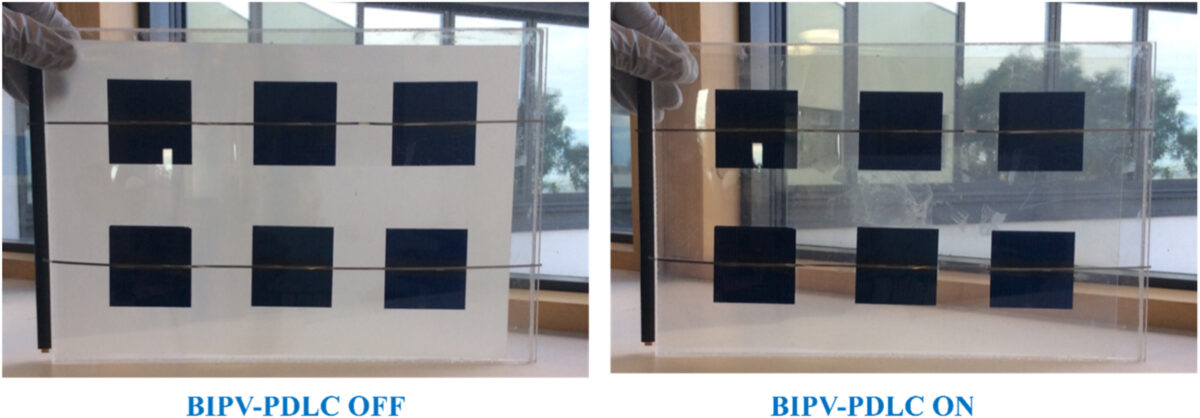
Researchers in the United Kingdom have developed a smart window that combines switchable polymer-dispersed liquid crystals with integrated PV cells, providing controllable transparency and electricity generation. According to the makers, the system combines light, heat and sun protection while maintaining high visual quality and stable performance.
Researchers from the University of Exeter in the United Kingdom have developed a new type of smart window that integrates PV modules with polymer-dispersed liquid crystal (PDLC). PDLC is a smart film composed of droplets of liquid crystals in a polymer matrix that switches from opaque to transparent when an electric field is applied.
“Previous smart window systems attempted to integrate energy generation using conventional PV or tandem structures; however, these approaches often faced performance and stability limitations,” said lead author Aritra Ghosh to pv magazine. “In contrast, the proposed structure functions effectively without such issues, demonstrating stable performance while maintaining desirable thermal and optical properties.”
Ghosh tested two configurations, each in on and off states. In one of them, the PDLC layer is first directed towards the sun (PDLC-BIPV); in the other, the PV layer faces the sun first (BIPV-PDLC). “Both arrangements show very similar heat transfer coefficients (U-values) and solar heat gain coefficients (g-values),” he said. “The biggest difference occurs when the PV layer is on the outside, which slightly changes the overall performance.”
Both systems used glass and acrylic films measuring 0.3 m x 0.21 m x 0.004 m. The PV cells and PDLC films were sandwiched between glass and acrylic glass, with the cell or film on top. The PDLC film becomes transparent under 20 V AC and translucent when unplugged. Six 0.43 W PV cells were installed in the window in two parallel arrays of three cells each.
“An indoor sun simulator provided continuous lighting of 1,000 W/m²,” Ghosh explains. “We measured the temperatures of the PV cells, the test cell, external and internal acrylic surfaces, and the ambient indoor air using T-type thermocouples connected to a Picco data logger. The MP160 IV tracer collected IV data using a 4-wire connection. Data was recorded every five minutes to minimize mismatch errors between the two acquisition systems.”
In the ON state (BIPV–PDLC ON and PDLC–BIPV ON), the system showed 62% solar transmission and 18% reflection, with a haze of 15%. The solar skin protection factor (SSPF) reached 78% and the solar material protection factor (SMPF) was 43%. Visual performance remained high, with a correlated color temperature (CCT) of 5,983 K and a color rendering index (CRI) of 97. The solar heat gain coefficient was 0.54 and the thermal transmittance (U-value) was 5.2 W/m²K. Higher light transmission in the ON state also resulted in higher PV cell temperatures.
In the OFF state (BIPV–PDLC OFF and PDLC–BIPV OFF), solar transmittance decreased to 42%, reflectance to 17%, and haze to 71%. SSPF improved to 90% and SMPF to 71%. CCT decreased to 5,273 K, CRI to 91, g-value to 0.43 and U-value to 4.7 W/m²K.
The results suggest that combining PDLC with integrated PV modules could provide a viable path for multifunctional building facades. By providing switchable transparency, effective shading and electricity generation in one window unit, the system could improve occupant comfort, reduce energy consumption and increase building sustainability.
The new system was presented in “Thermal-optical-electrical performance of combined photovoltaic-polymer dispersed liquid crystal for switchable BIPV smart window”, published in the Journal of Construction Technology. Ghosh and his team say further research will investigate large-scale prototypes and long-term performance under real-world conditions.
This content is copyrighted and may not be reused. If you would like to collaborate with us and reuse some of our content, please contact: editors@pv-magazine.com.
