

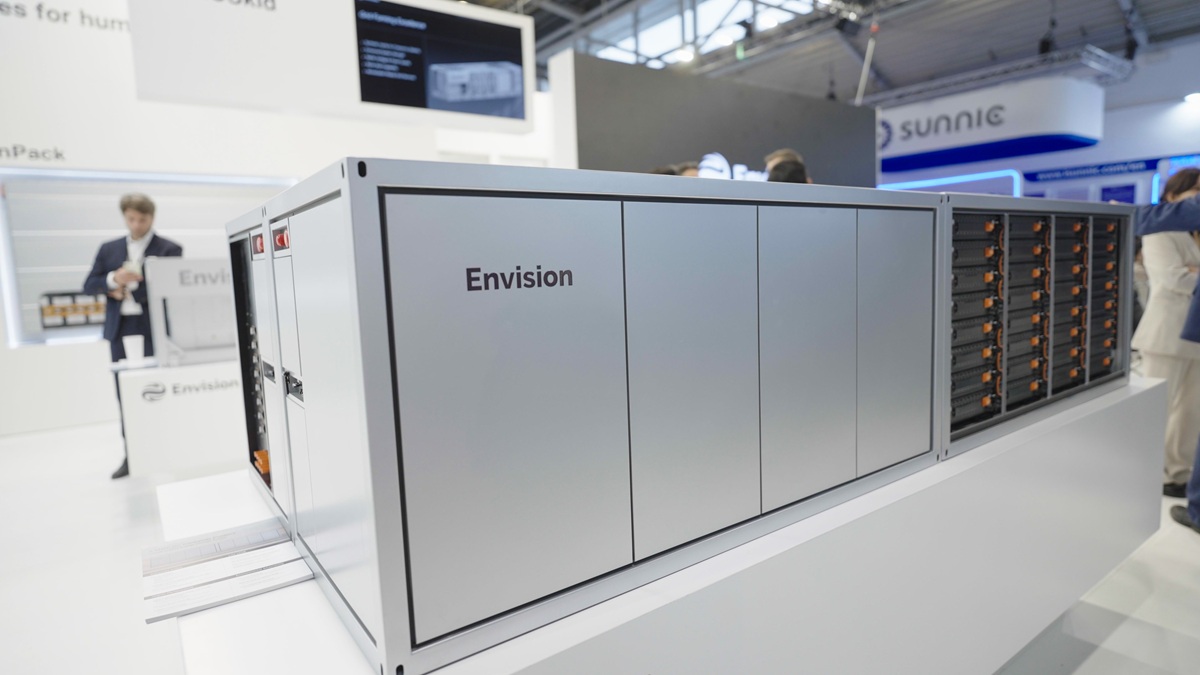
Envision Energy has unveiled what it describes as a fully integrated energy storage solution that combines hardware, software and market-facing capabilities, arguing that deep vertical integration is essential for the next phase of battery deployment as energy systems evolve towards an AI-powered energy system.
The company says its approach goes beyond battery system sales, instead offering an end-to-end platform that includes cell innovation, power conversion, system controls, artificial intelligence and electricity trading, directly connecting physical assets to real-time intelligence and market decision making.
The company’s storage portfolio includes battery cell technology, power conversion systems (PCS), medium-voltage substations, energy management systems and a top-tier software platform designed to support both operations and market participation. According to Envision, this architecture makes it possible to integrate AI not only at the supervisory level, but also directly into the physical operation of storage assets.
“We don’t just offer a product, we offer the entire solution,” said Kevin Huang, Envision SVP & President of Energy Storage Product Line. pv magazine at the World Forum Energy Summit (WFES) held in Abu Dhabi, UAE, in early January. “From the cells to the software and the route to the market: it is one ecosystem.”
Central to Envision’s strategy is what it calls “physical AI,” a concept that differentiates the company from conventional data-centric artificial intelligence. “Traditional AI largely operates at the application and analytics layer,” says Huang. “Physical AI, on the other hand, is designed to interact directly with the constraints of real-world power systems, including network stability, equipment safety and operational limits.”
“Power systems are governed by physical laws and technical boundaries, which means AI must be tightly integrated with models of electrical behavior and asset performance,” he continued. “According to Envision, this allows AI-driven decisions to be made in real time without compromising safety or reliability.”
This physical AI architecture is supported by Dubhe, Envision’s Energy Foundation Model, unveiled during Abu Dhabi Sustainability Week in January. “Dubhe sits at the core of Envision’s physical AI system, analyzing massive streams of real-world energy data to orchestrate renewable energy generation, storage, networking and demand in real time, shaping what Envision defines as the AI energy system,” Huang added.
Rather than deploying a single overarching AI platform, Envision integrates AI technologies across multiple layers of the storage system. This includes grid support functions such as frequency and voltage response, operational optimization and market participation. The company also highlighted that AI agents are used to support trading strategies, allowing batteries to dynamically respond to price signals in increasingly volatile electricity markets.
One of the company’s key claims relates to the health and safety of company assets.
“By collecting and analyzing large amounts of laboratory and operational data from batteries, PCS units and control systems, we can train models to detect early warning signals of failures well before conventional monitoring systems,” said Kotub Uddin, Chief Technology Officer (CTO) of Envision BESS. pv magazine. “Traditional safety systems, such as gas sensors, typically provide only a few minutes of warning before a critical event. Our physical, AI-based systems can identify subtle electrical signals days in advance, enabling proactive maintenance rather than emergency shutdowns.”
“If you can predict a failure early enough, you don’t have to close the factory abruptly,” Uddin explains. “You can plan maintenance, replace components and prevent both safety incidents and lost uptime.”
The company pointed to an internal analysis showing that voltage irregularities associated with dendrite growth in battery cells can be detected through AI models trained on large data sets. While Envision emphasized that these systems are still in development, the company said predictive sensing is already being used to improve operational reliability.
Envision also highlighted its safety record, noting that it has not experienced any major fire incidents in its energy storage batteries. The company attributes this in part to its ability to capture and analyze data across the entire system.
Beyond security and performance, Envision sees AI as a way to fundamentally change the economics of storage. As energy markets mature and margins tighten, optimization becomes increasingly important. According to the company, AI can help asset owners generate additional value by improving price forecasts, reducing operational constraints and enabling more flexible trading strategies.
“The volatility of electricity prices, driven by the growing share of variable renewable energy generation, is a key opportunity for storage,” Uddin said. “Our AI trading tools continuously learn from past market behavior and refine strategies based on results rather than relying solely on static optimization rules.”
“Everyone has planners and optimizers,” says Uddin. “What AI adds is learning. It can look back on a transaction, ask why it wasn’t optimal and improve the next decision.”
This learning ability, Envision said, is becoming increasingly important as merchants seek fewer operational limitations from storage assets. By better predicting degradation and performance impact, AI can support warranty structures that enable more aggressive cycles without compromising the long-term health of assets.
While large network-scale storage projects remain the dominant segment in terms of capacity, Envision sees great potential for AI-enabled, networked storage in commercial and industrial (C&I) applications. Behind-the-meter systems enable a higher degree of control, making them particularly suitable for AI-driven rasterization rather than static, pre-configured behavior.
For example, in C&I projects, AI agents are not only focused on optimization. They continuously infer the characteristics of the power grid to which they are connected, such as power grid strength, inertia and effective short-circuit level, and adapt the network-forming behavior in real time.
“This goes beyond setting grid-forming parameters during construction or commissioning,” says Uddin. “The system continually asks a much more fundamental question: which network am I currently connected to and how should I behave?”
“Behind the meter you can place AI directly in the control loop,” he also said. “That’s where the benefits become very tangible.”
Envision reported that it already has solar-plus-storage projects in China and is developing similar systems in markets such as Chile, Egypt, Spain and Turkey. While many current battery installations will remain standalone, the company expects that most future installations will be co-located with renewable energy generation.
Envision also plans to deploy its AI-based storage solutions globally, including in Europe and North America. The company acknowledged that AI is quickly becoming a standard feature in the industry, but argued that its differentiation lies in developing AI models internally and applying them end-to-end across the system.
Rather than viewing AI adoption as a zero-sum competition, Envision expects widespread adoption across the industry. However, it believes that companies that can generate large data sets, integrate hardware and software, and develop proprietary AI models will have a structural advantage.
“We don’t just use AI; we develop it,” Huang concluded, “And what we build goes beyond storage – it is the foundation of a sustainable energy system.”
This content is copyrighted and may not be reused. If you would like to collaborate with us and reuse some of our content, please contact: editors@pv-magazine.com.
