

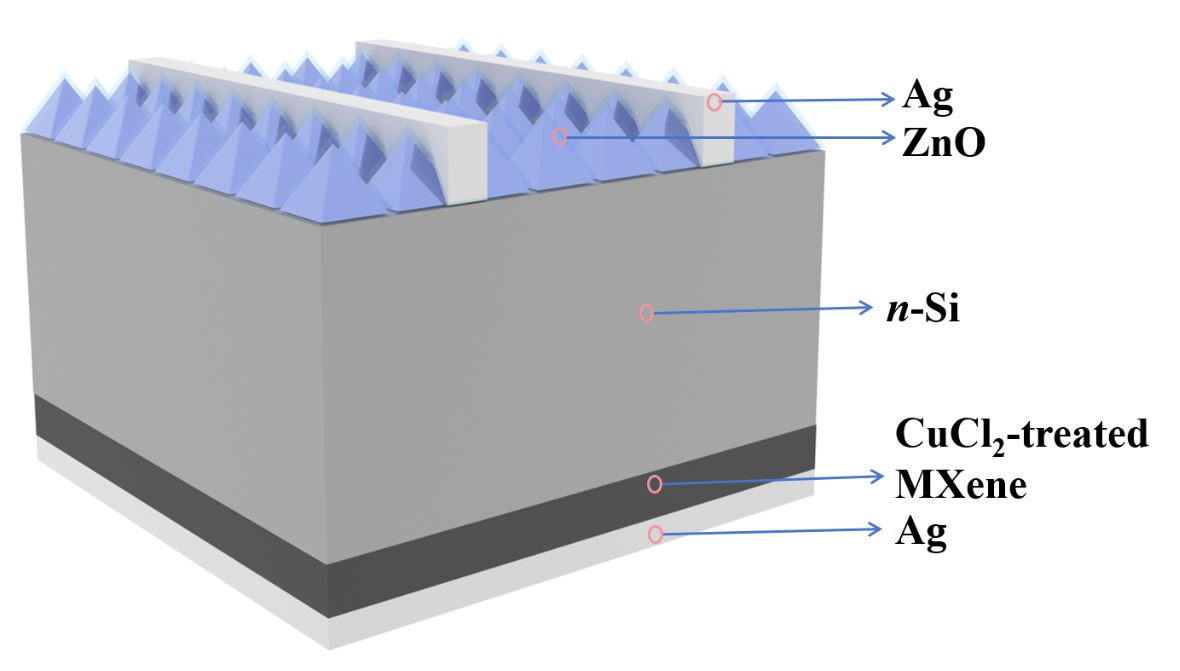
A research group, including scientists from Chinese module maker Longi, has developed an undoped monocrystalline heterojunction cell that uses the promising MXene compound for the hole transport layer. The experimental device achieved an efficiency of 12.2% and was able to maintain approximately 86% of its original efficiency after 105 days of exposure to the ambient environment.
A group of scientists led by China’s Lanzhou University and Chinese solar module manufacturer Longi have designed an undoped heterojunction silicon solar cell based on a hole transport layer, based on a functionalized two-dimensional titanium carbide known as Ti3C2Tx or MXeen.
MXeen compounds take their name from their graphene-like morphology and are made via selective etching of certain atomic layers from a bulk crystal known as MAX. Recently, MXene materials have shown promise for use in PV technology due to their unique optoelectronic properties, such as their high charge carrier mobility, excellent metal conductivity, and high optical transmission.
Furthermore, these compounds have a more tunable work function (WF) than the metal oxides and carbon materials commonly used to minimize parasitic absorption of shortwave light in heterojunction cells. “MXene has a more adaptable WF due to its abundant surface-terminating groups and is more stable than PEDOT:PSS-related organic materials,” says the corresponding author of the study. Junshuai Litold pv magazine.
The researchers defined the solar cell as a ‘back heterojunction’ device because it was fabricated by using the Ti3C2Tx on the
back side of an n-type monocrystalline silicon wafer with a thickness of 200 μm. They then treated the compound with copper chloride (CuCl2).
“The 60 μl CuCl2 ethanol solution (10 mg ml 1) was spin-coated onto the MXene film and then annealed at 60 C for 10 minutes,” the scientists explained. “Due to the surface dipole effect, the electronic structure of MXene can be regulated by enriching the specific surface endpoints, resulting in the shift of the Fermi level and the redistribution of the electrons, which then leads to the WF change.”
The experimental cell was built with a silver (Ag) electrode, a zinc oxide (ZnO) electron transport layer (ETL), a silicon absorber, the Mxene hole transport layer (HTL) and another Ag contact. “The Ag electrode with a WF of 4.26 eV is compatible with the ZnO layer for efficient electron collection. In addition, the ZnO layer plays an anti-reflective role,” the scientists specified. “When contacting the
MXene layer, the electrons in n-Si flow into MXene due to the difference in the Fermi levels between them.
Tested under standard lighting conditions, the device showed an energy conversion efficiency of 12.2%, an open-circuit voltage of 0.615 V, a short-circuit current density of 30.75 mA/cm2 and a fill factor of 64.57%. “There is plenty of room for improvement,” Li said, referring to these figures. “Improving the interfacial contact between n-Si and MXene is a critical component for exploration.”
It was also found that the cell retained approximately 86% of its initial efficiency after 105 days of exposure to the ambient environment.
The new cell concept was presented in the study “Construction of back-heterojunction crystalline silicon solar cells using Fermi-level modified MXene by CuCl2”, published in the Power Sources Journal. “Our work represents a valuable effort to develop new solar cells that can have a high performance-to-cost ratio,” Li concluded.
This content is copyrighted and may not be reused. If you would like to collaborate with us and reuse some of our content, please contact: editors@pv-magazine.com.
