

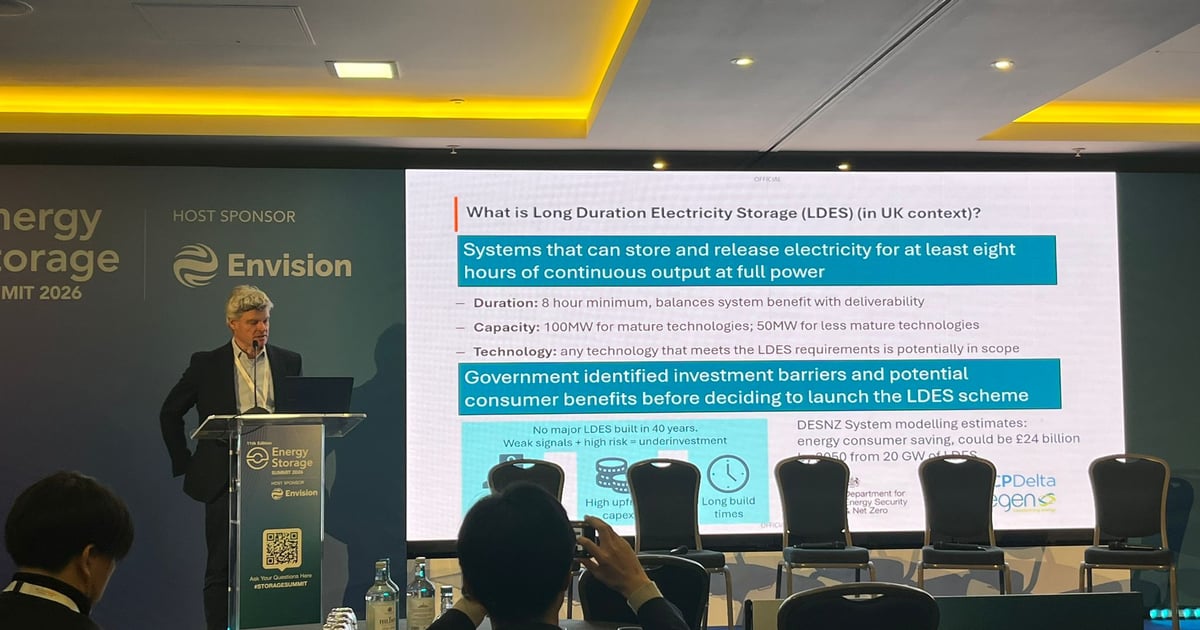
Ofgem’s cap-and-floor support scheme for long-term energy storage (LDES) is not innovation funding, the regulator stressed today.
Senior policy advisor at Ofgem, Mark Horley, noted this during a presentation at the Energy Storage Summit today the UK scheme is the first in Europe to offer investment support specifically for LDES.
Notably in defining the scheme and how it will work, Horley was keen to emphasize that the scheme is not a grant but an investment aid, “not here to develop early stage technologies; there are other schemes for that”.
“It’s here to ensure that there is a meaningful scale of flexibility assets that work over longer durations.”
Ofgem defines LDES as any technology capable of operating at full rated capacity for 8 hours and more, a threshold chosen to “strike the right balance” between system benefit and deliverability.
This technology neutrality is the source of some tension within the sector. When discussing the plan Ofgem toyed with the idea of not including lithium-ion BESS. After a significant setback, it changed that approach, and indeed the vast majority of the 77 projects currently assessed for the scheme are Li-ion BESS.
Zenobe is is currently taking legal action against Ofgem for this decision, claiming that the design of the scheme “risks distorting competition” by pitting subsidized LDES projects against unsubsidized lithium-ion BESS projects.
Horley (who made no reference to these tensions) said the scheme was introduced because it was “unlikely that the trader-based market would provide the level of LDES we need”.
The need refers to the capacity that the government has established in the Clean Power 2030 plan.
Ofgem based the mechanism, which Horley said is intended to “underwrite risk”, on a similar scheme it implemented to boost investment in electricity interconnectors, which face similar financial barriers to deployment.
One of the key lessons from the interconnection scheme that Ofgem applied for LDES was that the ‘cap’ element is soft. This means that even if revenues exceed a certain threshold, the operator gets to keep 30% and pays the rest back to the regulator. Horley said this encourages operators to continue optimizing, rather than curtailing, so as not to exceed the limit.
