

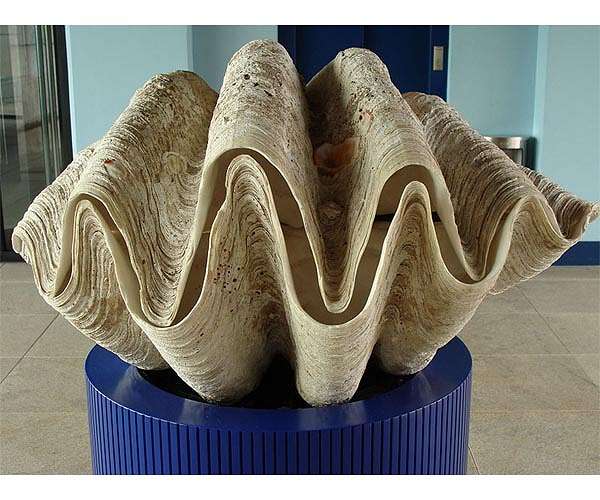
Giant clams could provide the answers to making solar energy more efficient
Designers of solar panels and biorefineries could learn a thing or two from iridescent giant clams that live near tropical coral reefs, according to a new Yale-led study.
This is because giant clams have precise geometries – dynamic, vertical columns of photosynthetic receptors covered by a thin, light-scattering layer – making them perhaps the most efficient solar energy systems on Earth.
“It’s counterintuitive to a lot of people because clams work in bright sunlight, but they’re actually very dark inside,” says Alison Sweeney, associate professor of physics and ecology and evolutionary biology at Yale’s Faculty of Arts and Sciences. Sciences. “The truth is that mussels are more efficient at converting solar energy than any existing solar panel technology.”
In the new study, published in the journal PRX: Energy, a research team led by Sweeney presents an analytical model for determining the maximum efficiency of photosynthetic systems based on the geometry, motion and light-scattering properties of giant clams. It is the latest in a series of studies from Sweeney’s lab that highlight biological mechanisms from the natural world that could inspire new sustainable materials and designs.
In this case, the researchers looked specifically at the impressive solar energy potential of iridescent giant clams in the shallow waters of Palau in the western Pacific Ocean.
The mussels are photosymbiotic, with vertical cylinders of single-celled algae growing on their surfaces. The algae absorb sunlight – after the light is scattered by a layer of cells called iridocytes.
Both the geometry of the algae and the light scattering of the iridocytes are important, the researchers say. By arranging the algae in vertical columns – making them parallel to the incoming light – the algae can absorb sunlight in the most efficient way. This is because the sunlight has been filtered and scattered by the layer of iridocytes, and the light then wraps evenly around each vertical algal cylinder.
Based on the geometry of the giant shells, Sweeney and her colleagues developed a model to calculate quantum efficiency: the ability to convert photons into electrons. The researchers also took into account fluctuations in sunlight, based on a typical day in the tropics with a sunrise, afternoon sun intensity and sunset. The quantum efficiency was 42%.
But then the researchers added a new wrinkle: the way giant clams stretch in response to changes in sunlight. “Clams love to move and groove all day long,” Sweeney said. “This stretching moves the vertical columns further apart, essentially making them shorter and wider.”
With this new information, the quantum efficiency of the mussel model has increased to 67%. By comparison, Sweeney said, the quantum efficiency of a green leaf system in a tropical environment is only about 14%.
An intriguing comparison would be northern spruce forests, according to the study. The researchers said the spruce forests, surrounded by alternating layers of fog and clouds, share similar geometries and light-scattering mechanisms with giant clams, but on a much larger scale. And their quantum efficiency is virtually identical.
“One lesson from this is how important it is to take biodiversity into account, broadly speaking,” Sweeney said. “My colleagues and I continue to brainstorm about where else on Earth this level of solar efficiency could happen. It’s also important to recognize that we can only study biodiversity in places where it is maintained.”
She added: “We owe a great debt to the Palauans, who place crucial cultural value on their mussels and reefs and work to keep them in pristine health.”
Such examples can provide inspiration and insights for more efficient sustainable energy technology.
“You could imagine a new generation of solar panels that grow algae, or cheap plastic solar panels made of stretchy material,” Sweeney said.
The study’s first author is Amanda Holt, a principal investigator in Sweeney’s lab. The study’s co-author is Lincoln Rehm, a Palauan-American and former graduate student at Drexel University and researcher at the Palau International Coral Reef Center, who now works at the National Oceanography and Atmospheric Administration.
The research was funded by a Packard Foundation grant and the National Science Foundation.
Research report:Simple mechanism for optimal light use efficiency of photosynthesis Inspired by giant clams
