
Close Menu
  • News
  • Industry
  • Solar Panels
  • Commercial
  • Residential
  • Finance
  • Technology
  • Carbon Credit
  • More
    • Policy
    • Energy Storage
    • Utility
    • Cummunity
What's Hot

Dutch solar owners asked to switch off during peak periods to ease the distribution crisis

June 7, 2026

The hydrogen flow: Toyota demonstrates its racing prototype on liquid hydrogen

June 7, 2026

Era of electrification exposing Australia’s weakest link

June 6, 2026
Facebook X (Twitter) Instagram
Solar Energy News
Sunday, June 7
  • News
  • Industry
  • Solar Panels
  • Commercial
  • Residential
  • Finance
  • Technology
  • Carbon Credit
  • More
    • Policy
    • Energy Storage
    • Utility
    • Cummunity
Solar Energy News
Home - Policy - Senators propose returning 5% safe harbor to utility-scale solar projects
Policy

Senators propose returning 5% safe harbor to utility-scale solar projects

solarenergyBy solarenergyFebruary 25, 2026No Comments2 Mins Read
Facebook Twitter Pinterest LinkedIn Tumblr Email
Share
Facebook Twitter LinkedIn Pinterest Email

In August 2025, the Treasury Department and the Internal Revenue Service (IRS) released new guidance regarding safely accommodating solar projects for the investment tax credit (ITC). Safe Harboring allows companies to make a good faith effort to start a solar energy project to secure applicable tax credits that year.

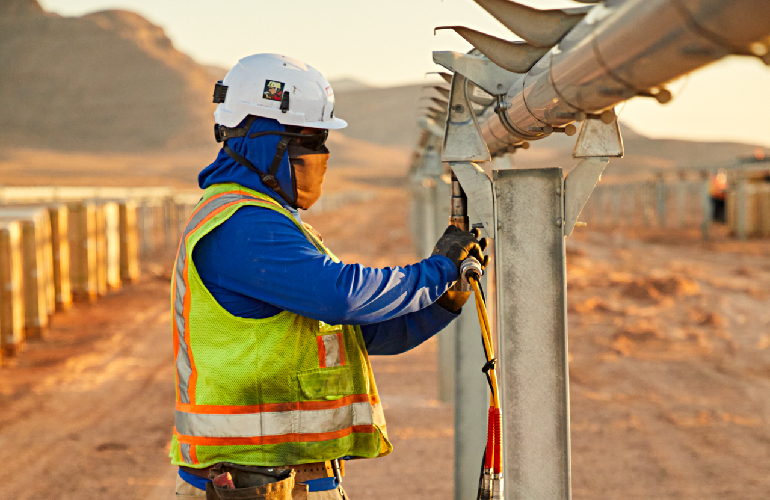
Credit: McCarthy Building Companies

While utility-scale solar projects could once take advantage of the “5% safe harbor” rule, which only required the project developer to cover 5% of the project cost by a certain date, the federal government changed this to a “physical work test.” For projects larger than 1.5 MW, racks must be installed at a location at least before July 4, 2026 to qualify for the ITC.

The physical work requirement does not include “preparatory activities” such as leveling the land, conducting studies or clearing a site. The IRS also requires that projects using the physical work test “maintain a continuous construction program,” where “the physical work performed is of a significant nature.”

Projects smaller than 1.5 MW can still use the 5% safe harbor. All projects still have four years to enter service under the continuity safe harbor.

This was an abrupt rule change, said US Democrat Sens. Catherine Cortez Masto (Nevada), Chuck Schumer (New York) and Ron Wyden (Oregon). The trio filed a resolution this month under the Congressional Review Act to overturn the IRS’s physical work testing rule because it “makes it harder for wind and solar companies to claim critical tax benefits” and “raises the cost of building America’s clean energy infrastructure, harming the United States’ ability to meet increased electricity demand and leading to higher energy prices for working families.”

See also  DOE's free software helps protect solar projects from cyberattacks

“This eleventh-hour change to the IRS guidelines is nothing more than a blatant attempt to disqualify projects needed to build out our nation’s clean energy infrastructure,” Cortez Masto said. “For years, wind and solar companies have been planning their investments in our nation’s energy grid, ready to meet our rising energy demands, create good-paying jobs and invest in our future. The Republican tax bill and this last-minute administration guidance will increase energy prices and dampen investment, and Congress must act.”

Senate Joint Resolution 107 was read twice and referred to the Finance Committee.

Source link

harbor projects propose Returning safe senators solar utilityscale
Share. Facebook Twitter Pinterest LinkedIn Tumblr Email
solarenergy
  • Website

Related Posts

Dutch solar owners asked to switch off during peak periods to ease the distribution crisis

June 7, 2026

The hydrogen flow: Toyota demonstrates its racing prototype on liquid hydrogen

June 7, 2026

Era of electrification exposing Australia’s weakest link

June 6, 2026
Leave A Reply Cancel Reply

Don't Miss
Technology

All-perovskite tandem solar cell based on tin-lead perovskite achieves an efficiency of 28.8% – SPE

By solarenergyAugust 16, 20240

An international research team has developed an all-perovskite tandem PV device that reportedly exhibits reduced…

Era of electrification exposing Australia’s weakest link

June 6, 2026

Faith and Sustainability – How Religious Organizations Are Embracing Solar Power (2025)

July 11, 2025

If community programs are successful for the community, why not try not to store from the community?

October 7, 2025
Stay In Touch
  • Facebook
  • Twitter
  • Pinterest
  • Instagram
  • YouTube
  • Vimeo
Our Picks

Dutch solar owners asked to switch off during peak periods to ease the distribution crisis

June 7, 2026

The hydrogen flow: Toyota demonstrates its racing prototype on liquid hydrogen

June 7, 2026

Era of electrification exposing Australia’s weakest link

June 6, 2026

‘Come out from behind your screen, our industry is ultimately about people’

June 6, 2026
Our Picks

Dutch solar owners asked to switch off during peak periods to ease the distribution crisis

June 7, 2026

The hydrogen flow: Toyota demonstrates its racing prototype on liquid hydrogen

June 7, 2026

Era of electrification exposing Australia’s weakest link

June 6, 2026
About
About

Stay updated with the latest in solar energy. Discover innovations, trends, policies, and market insights driving the future of sustainable power worldwide.

Subscribe to Updates

Get the latest creative news and updates about Solar industry directly in your inbox!

Facebook X (Twitter) Instagram Pinterest
  • Contact
  • Privacy Policy
  • Terms & Conditions
© 2026 Tsolarenergynews.co - All rights reserved.

Type above and press Enter to search. Press Esc to cancel.