

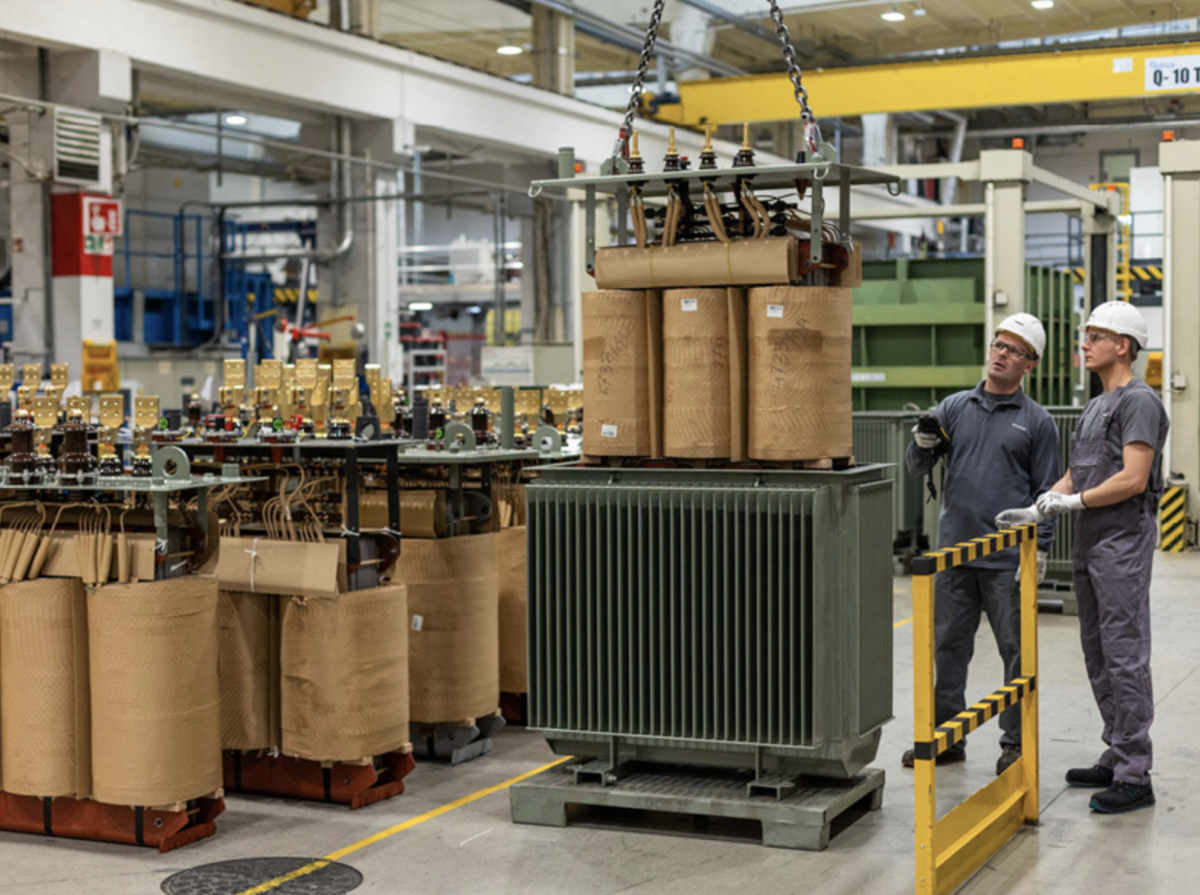
Demand for transformers and other grid connection infrastructure is currently in a “super cycle,” according to Bruno Melles, general manager for transformers at Hitachi Energy.
“The massive electrification of industry and transportation, the integration of renewable energy into the power grid and the explosive growth of AI data centers are forcing us to rethink energy,” Melles said. pv magazine. “That is why Hitachi Energy invests in production capacity, R&D and engineering.”
He said Hitachi Energy has invested $1.5 billion to increase production and footprint of its transformer business, as part of a total investment of $9 billion in expanding manufacturing capacity, R&D, engineering and partnerships across various business segments.
The increased demand is creating a shortage of key components for solar projects that can be connected to regional networks. Data from market intelligence provider BloombergNEF shows that lead times for delivery of large transformers (100 megavolt amps and above) have more than doubled compared to 2019, and transformer prices in the US market have increased by 79%.
While Hitachi Energy and others are investing in additional production capacity, it will take time to bring it online, and many are cautious about estimating long-term demand. This means that supply will likely remain tight in the coming years.
“Demand for networking equipment has been somewhat flat over the past decade. Network equipment factories are underutilized and some have even closed. Now manufacturers are cautious about investing as they see this as another rapid wave,” explains Eva Gonzalez Isla, grid and utilities analyst at BloombergNEF.
Melles confirmed that Hitachi Energy’s investment in new transformer capacity is part of a long-term business plan that does not depend solely on peak demand. “Integrated and holistic longer-term planning is needed for several reasons, including giving technology providers like us insight into the order pipeline, what is needed to invest,” he explains.
He added that plant equipment is a constraint on transformer capacity expansion. “Depending on the complexity and specialization of the required equipment, procurement lead times can vary from two to four years,” explains the director of Hitachi Energy. “This is especially true for high-end manufacturing systems used in the production of large power transformers.”
Gonzalez Isla also noted that transformers often need to be built to custom project designs, and the time to train new engineers in this regard is a limitation in expanding production, as well as securing the supply of the grain-oriented electrical steel that forms the core of a transformer.
Net investment
As grid capacity and connection points become a bigger bottleneck for solar and energy storage projects in many regions, investments are growing. BloombergNEF expects global investment in networks to surpass $500 billion by 2026. Renewable energy industry players are entering the sector to ensure timely grid connections for their own projects, and to take advantage of growing demand. For example, the European project developer Sunotec has acquired a majority stake in the German substation builder Kaufmann Electric.
“It was a real bottleneck to have all these restrictions on getting things onto the grid,” said Bernhard Suchland, CEO of Sunotec. He explained that the company was looking at ways to help accelerate the construction of the network infrastructure, testing and implementing the approach by first taking on the construction of substations in Bulgaria itself, before identifying the opportunity to replicate the model through a strategic partnership with Kaufmann Electric in the German market. Here and elsewhere in Europe, Suchland sees plenty of opportunities as networks work to catch up with new demand.
“There is a huge backlog in Europe and the market is complacent. Nothing has been upgraded as it should be,” says Suchland, noting that data centers and other major electricity consumers need medium and high-voltage transformer substations in addition to PV and BESS projects.
In India, module manufacturer Waaree Energies saw similar market constraints arising from limited network infrastructure, and in September 2025 invested INR 1.92 billion ($21 million) to acquire a 64% stake in Rajasthan-based transformer manufacturer Kotsons, which it has since rebranded as Waaree Transpower. “Transformer shortages have put pressure on India’s renewable energy expansion, delaying project timelines and increasing EPC costs. This acquisition strengthens end-to-end supply from modules to transmission, improves project economics and meets rising global demand with Kotsons’ 4,000 MVA capacity and UL-certified exports to the US and Canada,” said Sunil Rathi, Executive Director at Waaree Group. He added that the transformers would be used for Waaree’s own projects and to capitalize on expectations of growth in the transformer market by 2030.
Step up
In many regions, power grid upgrades that will allow solar to maintain its growth rate have been slow to get off to a good start. “We have seen that even with increased investment, there are significant barriers to meeting the needs of new generation and energy demand on time,” Peter Wall, head of network research at BloombergNEF, said in a December 2025 press release.
As overcoming these supply chain and labor market constraints inevitably takes time, companies are looking for other ways to ensure the timely delivery of grid connection equipment. In Germany, Kaufmann Electric integrates and standardizes the many phases of building a new substation and offers this as a service.
“We apply a fully integrated approach, from permitting to connection planning, cable routing and substation commissioning. This is an end-to-end capability that we can provide to accelerate project realization,” said Sebastian Holzer, Managing Director of Kaufmann Electric.
The company also sees standardization as a route to fast delivery.
“We no longer design transformers for every project. We use a design that fits approximately 80% of our projects. This makes us much more flexible,” says Philipp Gau, grid and substation director at Kaufmann Electric. He added that custom designs also lead to a long planning phase and longer lead times for component manufacturers.
BloombergNEF’s Gonzalez Isla pointed to closer cooperation between network equipment manufacturers and their larger buyers, with framework agreements to better guarantee supply and provide manufacturers with insight into demand. “These agreements work on a target volume basis rather than a project basis. The larger orders and volumes are attractive to their supply chains.”
Melles confirmed that Hitachi Energy uses such agreements and that they help the company make expansion decisions. “We are focusing on new business models, such as framework agreements and capacity reservation contracts, which help us make more efficient investment decisions thanks to the long-term vision they provide,” he said.
This content is copyrighted and may not be reused. If you would like to collaborate with us and reuse some of our content, please contact: editors@pv-magazine.com.
