

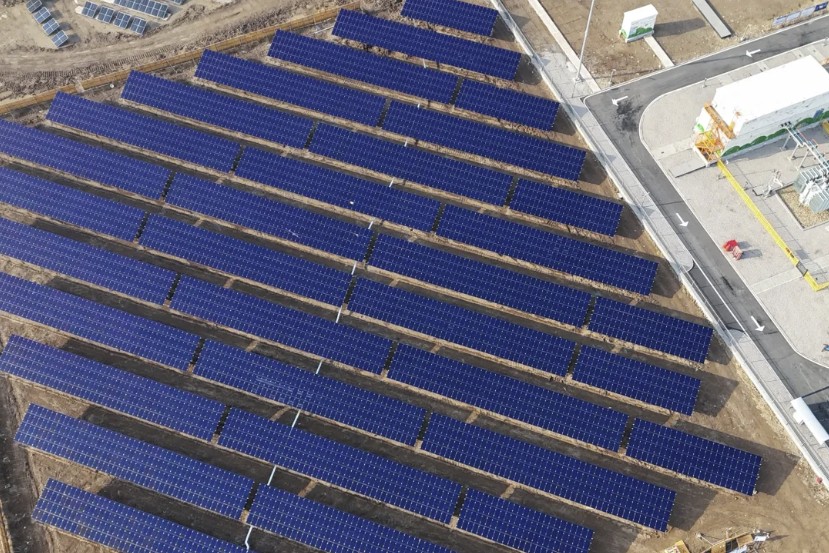
The 1 MW test facility is located in Xuwei New Area, Lianyungang, Jiangsu Province. It is designed to generate long-term field data on large-area perovskite modules in coastal conditions.
A 1 MWp perovskite PV field test plant in Xuwei New Area, Lianyungang, Jiangsu Province, China, was connected to the grid and became fully operational in late February 2026.
The project, formally named the Xuwei New Area Novel Perovskite Distributed PV Demonstration Power Station, was developed and owned by Jiangsu Fangyang New Energy Investment Co., Ltd.the investment platform for sustainable energy Fangyang Group. The facility is located within a national petrochemical industrial base, with electricity generated for on-site industrial consumption.
Unlike conventional distributed PV projects, the installation is primarily intended as an open, long-term outdoor validation platform for perovskite technology. The stated objective is to measure the performance, degradation behavior and operational stability of large-area perovskite modules in the coastal climate of eastern China, which is characterized by high humidity, salt spray and wind-blown dust.
The project is also expected to generate full lifecycle operating data that will be made available to PV manufacturers, research institutes and industry associations. The goal is to address a major barrier to perovskite commercialization: the limited availability of transparent, large-scale field performance data.
The station uses large format double-glazed perovskite modules measuring 1.2 m x 0.6 m, supplied by a Chinese specialist Renshine. According to the project brief, the modules achieve a mass production efficiency of almost 20% and deliver more than 140 W per module. They feature a frameless design, anti-reflective surface treatment and self-cleaning coatings intended to reduce contamination losses and maintenance requirements in industrial environments.
The plant uses string inverters adapted to the operating characteristics of perovskite modules and integrates a monitoring system designed to track generation performance, environmental conditions and equipment status with millisecond-level sampling. A distributed string-level security architecture enables rapid fault isolation and automated alerts.
For the perovskite sector, the importance of the Xuwei plant lies less in efficiency figures than in its potential to generate field evidence. The project could help validate sustainability claims, refine encapsulation and manufacturing processes, and support the future development of standards based on operational data collected in demanding coastal conditions.
At the end of August, Huaneng put into operation a 5 MW perovskite PV demonstration and verification plant at Gonghe Photovoltaic Park in Qinghai Province.
This content is copyrighted and may not be reused. If you would like to collaborate with us and reuse some of our content, please contact: editors@pv-magazine.com.
