
Close Menu
  • News
  • Industry
  • Solar Panels
  • Commercial
  • Residential
  • Finance
  • Technology
  • Carbon Credit
  • More
    • Policy
    • Energy Storage
    • Utility
    • Cummunity
What's Hot

Dutch solar owners asked to switch off during peak periods to ease the distribution crisis

June 7, 2026

The hydrogen flow: Toyota demonstrates its racing prototype on liquid hydrogen

June 7, 2026

Era of electrification exposing Australia’s weakest link

June 6, 2026
Facebook X (Twitter) Instagram
Solar Energy News
Sunday, June 7
  • News
  • Industry
  • Solar Panels
  • Commercial
  • Residential
  • Finance
  • Technology
  • Carbon Credit
  • More
    • Policy
    • Energy Storage
    • Utility
    • Cummunity
Solar Energy News
Home - Technology - Researchers complete Europe’s first PV pollution loss analysis – SPE
Technology

Researchers complete Europe’s first PV pollution loss analysis – SPE

solarenergyBy solarenergyDecember 11, 2024No Comments4 Mins Read
Facebook Twitter Pinterest LinkedIn Tumblr Email
Share
Facebook Twitter LinkedIn Pinterest Email

A European research group has adapted a pollution model for use across the continent, analyzing full and partial rain-cleaning scenarios to calculate energy losses and increases in levelized energy costs (LCOE), marking Europe’s first techno-economic assessment of PV pollution.

December 11, 2024
Lior Kahana

A global team of researchers has completed Europe’s first European techno-economic analysis of PV pollution losses.

The researchers developed pollution maps by interpolating analytical data and calibrating them with ground-measured losses from sensors across Europe. They evaluated the cleaning effect of rain under two scenarios: one where the panels were assumed to be completely cleaned and another where only 10% of the contamination was removed.

“The main objectives of the current research are twofold: first, to map both energy and economic losses in PV systems due to pollution patterns, and second, to share with the community an adapted version of a pollution model that allows cleaning effectiveness can be adjusted. of rainfall, which could be reapplied in additional studies,” the scientists said. “The maps and models not only provide insight into the spatial distribution of pollution, but also provide a valuable resource for stakeholders involved in decision-making processes related to maintenance planning, resource optimization and environmental impact assessments.”

Researchers used the pollution model suggested by Coello and Boyle, who estimated deposition rates from particulate matter (PM) concentrations. The model quantifies these velocities using PM10 and PM2.5 indicators, measuring the mass of airborne particles with diameters up to 10 μm and 2.5 μm, respectively. It applied reanalyzed PM data from the Copernicus Atmosphere Monitoring Service, covering the period 2005-2019.

See also  Pexapark registers more than 1 GWh of European storage PPAs in March – SPE

Researchers recalibrated the model using field measurements from nine European PV locations. They conducted tests at three locations in Denmark, three in Spain, two in France and one in Norway. They recalibrated the model using a PV site near a train station in Switzerland, where significant pollution losses occurred despite regular rainfall, cleaning only 10% of the soil.

“The new model was tested using data from a case study of a system in a rainy location (>1,000 mm year-1) with a uniform rainfall distribution in Switzerland, where losses of up to 10% due to pollution were identified after artificially cleaning,” they said. “The losses due to contamination are derived by comparing the performance ratio (PR) of the system, which represents the ratio between the actual and theoretical power, after and before manual cleaning through an equation.’”

Pollution variability index

Image: German Aerospace Center (DLR), Renewable Energy, CC BY 4.0

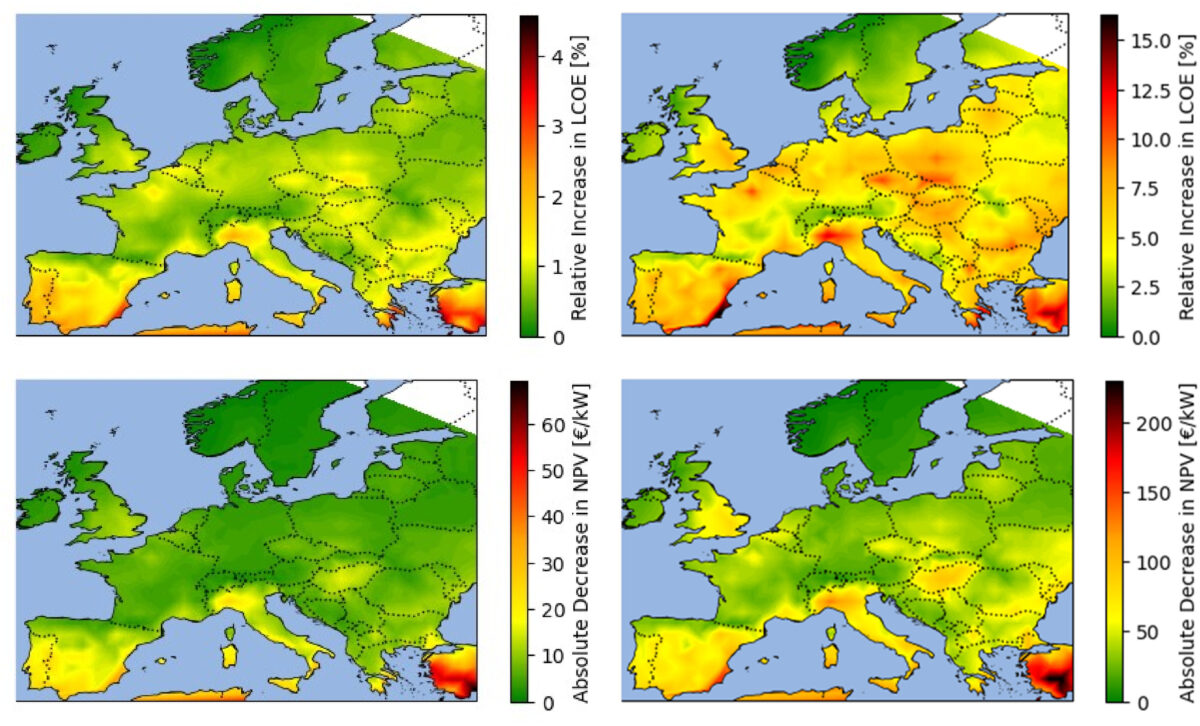
The researchers calibrated the model for both scenarios and applied it across Europe. If it is assumed that rain cleans the panels perfectly, the average annual pollution loss in electricity is 0.9%, with Greece showing the highest loss at 4.3% and Norway the lowest at 0.2%. In the scenario where rain cleans only 10% of the pollution, average losses increase to 5.3%, peaking at 14% in Spain and falling to 1.2% in Norway.

By economic standards, perfect rain cleaning leads to an average 1% increase in LCOE, peaking at 4.6% in Turkey. The average decline in net present value (NPV) is €9.10 ($9.56)/kW, with Turkey experiencing the largest decline at €69.30/kW. When rain removes only 10% of the dirt, the average LCOE increase is 5.8% and in Spain it is 16.3%. The average NPV reduction is €45/kW, with Turkey showing the largest reduction at €230.40/kW.

See also  EU completes €1 billion industrial heat decarbonisation pilot auction – SPE

“The regions with the greatest losses tend to also be those with the highest seasonality due to long and arid summers with typically only a few precipitation events, which in some cases can contribute to the natural cleaning of the solar collectors,” the researchers said.

They presented their results in “Photovoltaic pollution losses in Europe: geographical distribution and cleaning recommendations”, published in Renewable energy. Researchers from the German Aerospace Center (DLR), the Center for Energy, Environment and Technological Research (CIEMAT), the University of Jaén, the Danish European Energy, the Norwegian Institute of Energy Technology (IFE) and the Italian Sapienza University of Rome worked together on the study.

This content is copyrighted and may not be reused. If you would like to collaborate with us and reuse some of our content, please contact: editors@pv-magazine.com.

Popular content

Source link

analysis complete Europes loss pollution researchers SPE
Share. Facebook Twitter Pinterest LinkedIn Tumblr Email
solarenergy
  • Website

Related Posts

Rooftop PV ensures that South Africa has no loss of load for a year

June 2, 2026

Pexapark registers 17 European PPAs for 966 MW in April – SPE

May 27, 2026

Saudi Arabia gets first BESS production facility – SPE

May 27, 2026
Leave A Reply Cancel Reply

Don't Miss
News

The disordered rock salt roadmap aims to boost lithium ion battery energy and reduce critical metals

By solarenergyJanuary 22, 20260

A new scientific review describes how a little-understood class of cathode materials for lithium-ion batteries…

PPAs and capacity milestones in the British market on the roof PV on the roof

May 13, 2025

Winter forest fires choke off solar energy in South America – SPE

August 19, 2024

Brazil opens Consult on National Smart Meter – Implementation – PV Magazine International

October 1, 2025
Stay In Touch
  • Facebook
  • Twitter
  • Pinterest
  • Instagram
  • YouTube
  • Vimeo
Our Picks

Dutch solar owners asked to switch off during peak periods to ease the distribution crisis

June 7, 2026

The hydrogen flow: Toyota demonstrates its racing prototype on liquid hydrogen

June 7, 2026

Era of electrification exposing Australia’s weakest link

June 6, 2026

‘Come out from behind your screen, our industry is ultimately about people’

June 6, 2026
Our Picks

Dutch solar owners asked to switch off during peak periods to ease the distribution crisis

June 7, 2026

The hydrogen flow: Toyota demonstrates its racing prototype on liquid hydrogen

June 7, 2026

Era of electrification exposing Australia’s weakest link

June 6, 2026
About
About

Stay updated with the latest in solar energy. Discover innovations, trends, policies, and market insights driving the future of sustainable power worldwide.

Subscribe to Updates

Get the latest creative news and updates about Solar industry directly in your inbox!

Facebook X (Twitter) Instagram Pinterest
  • Contact
  • Privacy Policy
  • Terms & Conditions
© 2026 Tsolarenergynews.co - All rights reserved.

Type above and press Enter to search. Press Esc to cancel.