

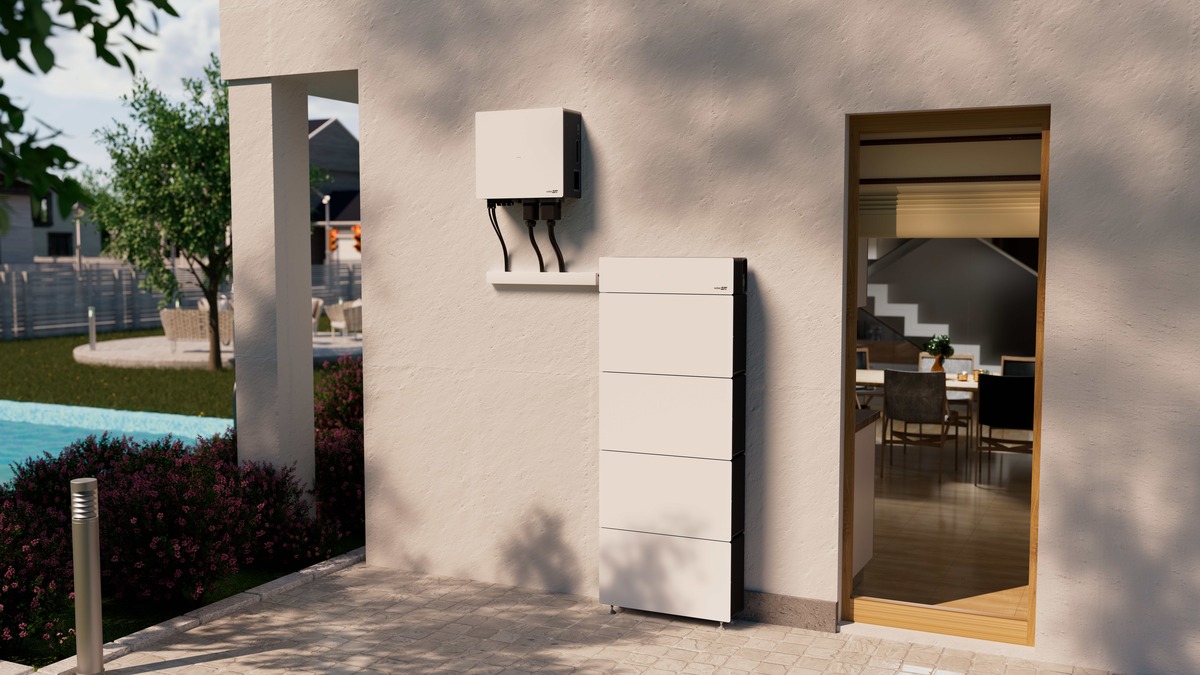
The Nexis solution combines a flexibly configurable hybrid inverter with a modular high-voltage battery that offers a charging capacity of up to 14 kW per stack. The inverter delivers 8–20 kW AC power, supports up to 200% DC oversizing and features an IP65-certified design with integrated backup power.
Israel-based inverter and battery manufacturer SolarEdge has launched Nexisa new residential solution that combines a flexibly configurable hybrid inverter with a modular high-voltage battery.
The Nexis The inverter follows what the manufacturer calls a multi-range concept, designed to simplify logistics for installers: instead of multiple device models, a single unit covers multiple power classes. The rated AC power can be adjusted in six steps from 8 kW to 20 kW.
The maximum continuous current per phase ranges from 12.3 A in the smallest configuration to 29 A in the largest, while the maximum short-circuit current ranges from 14.8 A to 35 A depending on the setting. Up to 200 percent DC oversizing is possible. Four MC4 connectors are available for the photovoltaic system and the battery.
The inverter uses silicon carbide power electronics and is said to be able to deliver high efficiency in both PV and battery operation. According to the manufacturer, the European weighted efficiency ranges from 98.4% to 98.75%.
The inverter has no fan and operates at a noise level of less than 40 dBA. With an IP65 rating, it is suitable for outdoor installation and can operate in temperatures from -40 C to +60 C. It measures 200 mm × 428 mm × 488 mm and weighs 30 kg.
An important feature is the integrated emergency power function. The Nexis inverter can supply up to 20 kW three-phase power at 230 or 400 V, with a maximum of 6.6 kW per phase. According to the manufacturer, the switching time in the event of a power failure is less than 50 milliseconds.
The Nexis The home battery can be used in single- and three-phase systems, but also in AC and DC-coupled applications.
Compared to previous SolarEdge storage systems, charging and discharging capacity has increased significantly to 14 kW per battery stack, compared to approximately 5 kW previously. The manufacturer plans to increase the power to 28 kW in the third quarter of 2026. The higher charging capacity is intended to accommodate afternoon peak loads, reflecting changing market conditions.
The battery has a modular design, with each module offering a capacity of 4.9 kWh. Modules are mounted on wall brackets with quick couplings and stacked module by module. A single stack can reach 20 kWh, and up to 78 kWh is possible in parallel operation.
Each module has its own DC-DC converter with an efficiency of 92%, allowing monitoring and optimization at the module level. Individual modules can be replaced and system capacity can be scaled even after commissioning. Modules operate in the voltage range of 370–480 V in single-phase and 715–950 V in three-phase operation. Higher voltages reduce current and minimize losses in the DC link, the company said.
During part load operation, only the necessary modules are activated. For example, daytime charging in summer can use three 10.5 kW modules, while low loads at night discharge just one module, improving efficiency. According to the manufacturer, this can deliver up to 30% system efficiency at part load.
The battery is IP65 rated and can operate in temperatures from -20 C to 55 C. The battery is also flood resistant and can withstand immersion in up to 37 cm of water for 72 hours. One module weighs 55 kg and the link module weighs 15.8 kg. The system comes with a 10-year warranty.
SolarEdge said it also streamlined installation. The inverter can be commissioned without opening the housing and all communication connections are accessible from outside.
Other innovations include an integrated antenna, eliminating the need for additional wiring. The AC connections use tension clamps, eliminating the need to crimp wire strands. A display indicates the set power class during commissioning, preventing incorrect configurations during subsequent work or system expansions.
For connectivity, SolarEdge emphasizes the integration of heat pumps via the EEBus standard. Collaborations with manufacturers such as Vaillant already exist, and further integrations are planned for Nibe, Bosch, Buderus and Wolf.
The integration is done via the SolarEdge Go app, which allows users to pair devices and visualize performance and consumption data.
This content is copyrighted and may not be reused. If you would like to collaborate with us and reuse some of our content, please contact: editors@pv-magazine.com.
