Researchers in Hong Kong Hong Kong fabricated a prototype of a thermochromic double-sided photovoltaic glazing system that passively regulates solar heat gain while simultaneously harvesting energy from both sides. Experiments and simulations have shown that it significantly reduces cooling loads and indoor temperatures while boosting electricity generation.
Researchers from the City University of Hong Kong have developed a novel thermochromic bifacial photovoltaic (TC-BiPV) glazing system that integrates hydrogel-based thermochromic (TC) layers with bifacial PV modules. This system dynamically regulates solar transmission and simultaneously collects radiation from both sides, while modeling and optimizing building energy consumption to reduce consumption, costs and emissions.
TC technology allows buildings to self-regulate solar radiation by changing their optical properties in response to temperature. Common TC materials include vanadium dioxide (VO₂), perovskites, and hydrogels; However, VO₂ and perovskites face limitations such as high transition temperatures, toxicity, and challenges in large-scale manufacturing.
Hydrogel-based TC glazing is more practical and offers full-spectrum modulation, low cost and scalability, the researchers explained. It transitions from transparent (hydrophilic) to translucent (hydrophobic) as temperature increases, reducing energy consumption and improving visual and thermal comfort. Nevertheless, in its warm state, hydrogel reflects a significant portion of solar radiation, limiting energy consumption.
The bifacial design of the proposed TC-BiPV system addresses this limitation by capturing the solar radiation reflected from the hydrogel in its warm state, effectively reducing energy waste.
The team also highlighted that while PV glazing alone efficiently harvests solar energy, its optical properties cannot be adjusted, while hydrogel-based TC glazing can dynamically modulate solar transmission but fails to capture reflected energy. Integrating both functions into one system is therefore highly desirable for advanced glazing applications. Previous hybrid solutions, such as PV shading or tracking PV modules, relied on manual or mechanical adjustments, increasing operational complexity and costs.
The system consists of a bifacial PV pane (BiPV), an air gap and a hydrogel glass pane from the outside to the inside. The BiPV glass contains PV cells sandwiched between two clear glass plates, while the hydrogel glass encloses a thermochromic hydrogel layer between two glass plates.
Image: Hong Kong City University
Below the transition temperature, the hydrogel is transparent, allowing solar radiation for indoor lighting; above the transition temperature it becomes translucent, reducing solar gain. When warm, the hydrogel reflects light to the back of the BiPV glass, improving electricity generation at the back.
Spectral selectivity ensures that the BiPV glass on the front receives the full solar spectrum, while the irradiance on the back is concentrated within the PV response range, reducing cell temperature and improving efficiency. The hydrogel state responds to outdoor temperature, solar radiation and angle of incidence, linking system performance to orientation and climatic conditions.
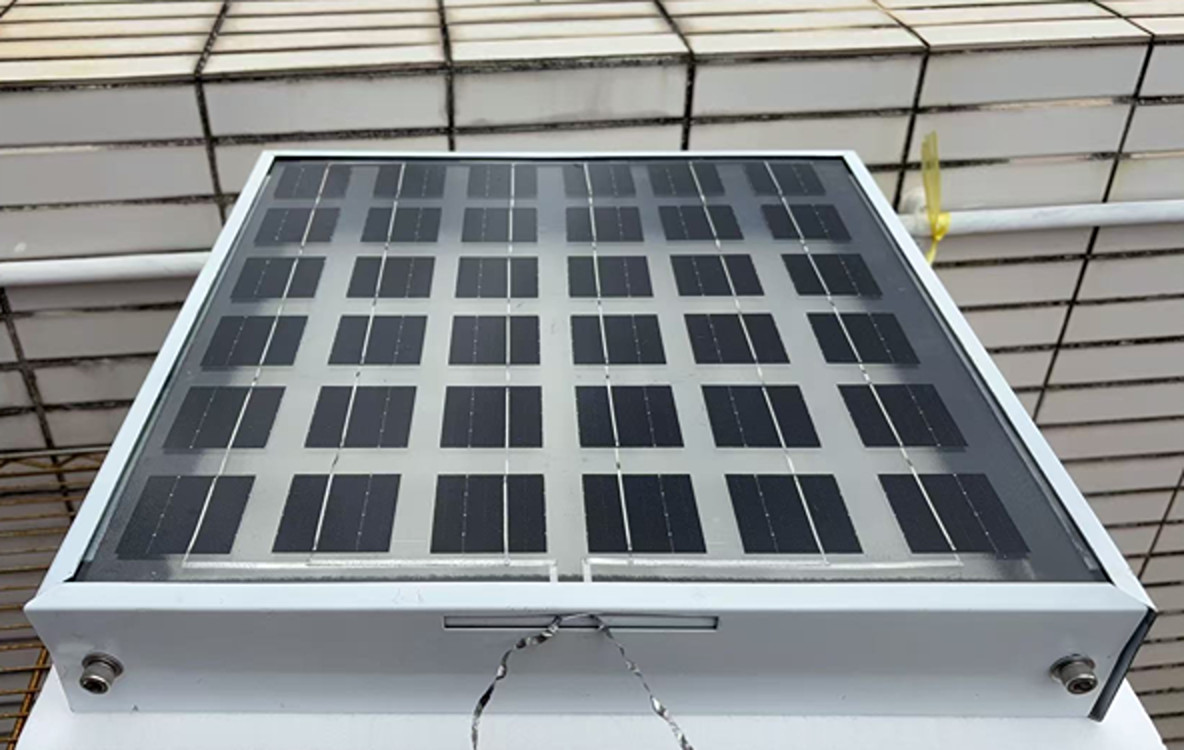
The prototype was fabricated with BiPV cells arranged in a 6×6 matrix with approximately 45% coverage, and a 1 mm thick hydrogel layer sealed between panes of glass. The mounting includes a 5cm air gap for wiring, mounting and independent replacement of hydrogel and PV glass for easier maintenance.
“We have conducted prototype experiments and validated optical-thermal-electrical models show strong combined benefits,” said the study’s lead author, Chin Yan Tso. pv magazine. “For example, we found that on a summer test day, the TC-BiPV glazing reduced direct solar heat gain by approximately 30% compared to thermochromic glazing alone, reducing the air temperature in the test box by up to 4.8 C.”
“We also found that, compared to conventional bifacial PV (BiPV) glazing, TC-BiPV reduced direct solar heat gain by approximately 62.6%, provided temperature reductions in the test box of up to 15.1 C and increased electricity generation by approximately 16.5%,” he continued. “Annual simulations in tropical locations indicate that the bifacial gain of TC-BiPV ranges from 9–18% for skylights and 6–14% for vertical windows, versus 4–5% and 5–7% for BiPV.”
“Our analysis also showed that for skylight installations, TC-BiPV reduces annual indoor heat gain by 27.7% versus BiPV and 38.4% versus TC glazing; for facade windows, the reductions are 9.1% and 40.1%, respectively. Sensitivity analyzes identified PV coverage and hydrogel transition temperature as important design levers,” Tso explained.
“The TC-BiPV approach offers a scalable, passive path to reducing cooling loads while improving on-site PV generation, with practical promise for energy-efficient building envelopes in warm climates,” he concluded.
The system was described in “Experimental and numerical study of a novel thermochromic bifacial photovoltaic glazing system”, published in Construction and Environment.
This content is copyrighted and may not be reused. If you would like to collaborate with us and reuse some of our content, please contact: editors@pv-magazine.com.
Popular content