

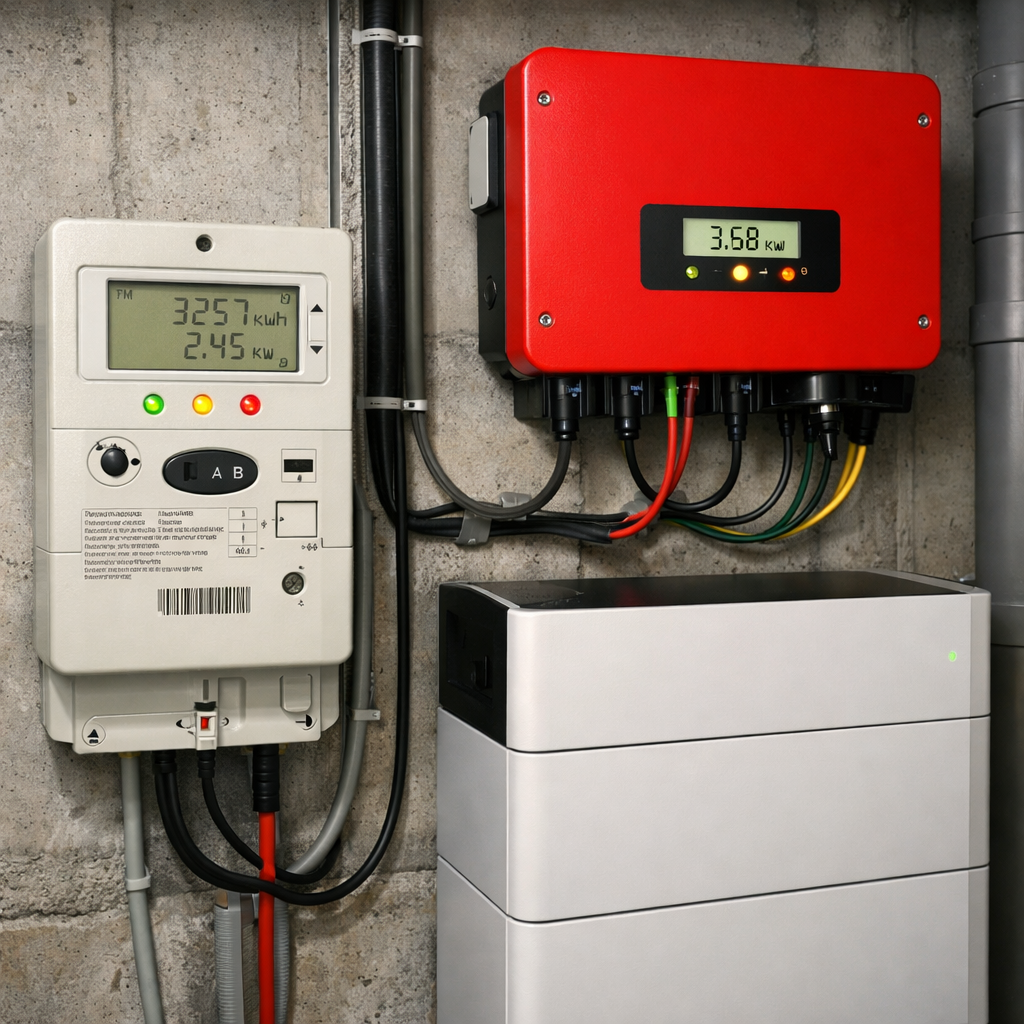
The scientists explained that small and medium-sized businesses are essential for the advanced metering infrastructure (AMI), which enables remote monitoring and connects utilities to customers while supporting a PV-powered green energy transition on rooftops. However, its widespread adoption poses significant cybersecurity risks, including inaccurate billing, energy theft, service disruptions and privacy breaches, making robust security measures essential.
They estimate that there are currently more than 209 million SMs deployed across Europe and say that while these devices provide features such as outage detection, theft detection and power quality monitoring, they also raise concerns about privacy, data interception and system vulnerability.
The group also emphasized that cyber attacks, especially the injection of false data, can manipulate meter readings, compromise system integrity and cause significant financial losses for utilities. By altering usage data, attackers can bypass billing, enable energy theft, or disrupt demand patterns used for network management.
In addition to direct revenue impacts, these attacks can also mislead system administrators, resulting in incorrect operational decisions, such as incorrect load balancing, incorrect demand forecasts or inefficient energy distribution. Over time, such disruptions can affect system performance and reliability.
Currently, hardware-based and software-based approaches are used to detect anomalies in SM data. Hardware solutions require additional equipment, while software-based methods include data-driven, network-based, state estimation-based, and hybrid techniques. However, both solutions face challenges such as scalability issues, inability to detect multiple simultaneous attacks, sensitivity to noise, and dependence on expensive measurement equipment such as Phasor Measurement Units (PMUs).
To address these limitations, the researchers proposed a new attack detection method that uses smart meter data and a robust state estimation framework.
The proposed approach is based on a distribution system state estimator (DSSE), a mathematical tool that processes limited, noisy real-time data from sensors to determine grid conditions, such as voltages and currents, even when measurements are noisy or incomplete. Confidence ellipses are then constructed around the estimated values to capture the uncertainty. Often used to visualize the relationship and variability between two variables, these ellipses provide a statistical bound on expected behavior.
By measuring the distance between real-time data and these boundaries, the method can reportedly identify anomalies, with any value falling outside the corresponding ellipse flagged as suspicious, indicating a potential cyber attack.
According to the research team, this approach simplifies threshold selection, improves detection accuracy, and performs well even under noisy conditions and multi-node attacks. It was validated using two grid models of different sizes, simulating both single-node and multi-node attacks. Attack scenarios include minor manipulations of voltage values, which are realistic to avoid detection.
The method was then compared with traditional techniques such as the chi-square test and the Largest Normalized Residual (LNR) test, with the results showing that while traditional methods are sensitive to noise and require careful threshold tuning, the proposed approach maintains high detection accuracy and reduces false detections, especially in noisy environments.
“It should be noted that the proposed approach has higher computational complexity and requires more processing power to achieve,” the academics said. “However, this method provides more precise detection of power theft, a problem that imposes enormous costs on both society and end users, who collectively bear the financial burden of stolen energy until its termination.”
