

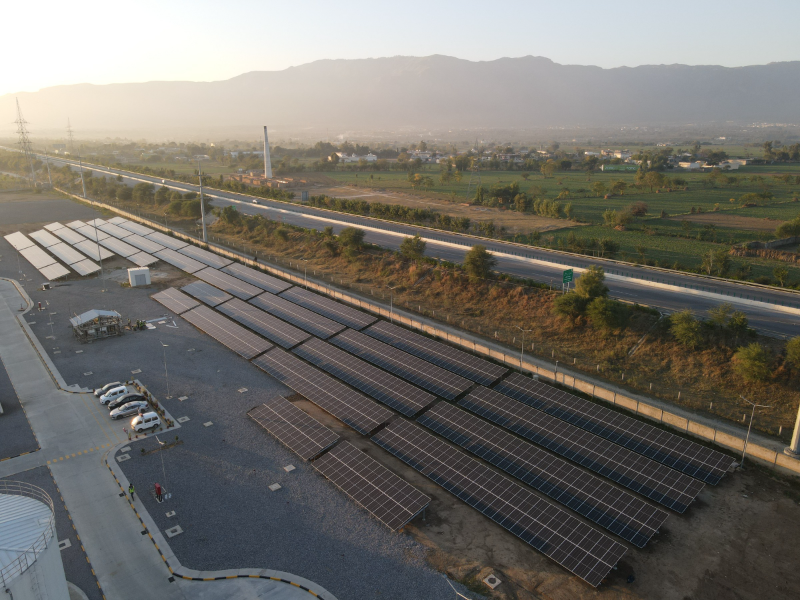
High energy prices are becoming a strong driver for commercial and industrial (C&I) solar projects in Pakistan. Omar Malik, CEO of Pakistani C&I solar developer Shams Power, speaks with pv magazine about market trends and challenges.
C&I power consumers are increasingly using solar panels in Pakistan due to high energy prices and rates.
“The average industrial consumer currently pays a rate of $0.12/kWh,” said Omar Malik, CEO of Pakistani solar developer Shams Power. pv magazine. “But this is only half the story, as they also have to pay a $0.10 tax on every kilowatt hour they take from the grid. The government depends on five to six sectors for most of its indirect tax collection, of which electricity is one of the largest.”
High self-consumption means lower electricity costs and lower taxes. According to the country’s current regulations, the sale of excess power to the electricity grid under net metering is only allowed for generators with a size of up to 1 MW.
The government also only exempts import duties on solar panels. “The exemption for solar inverters has been abolished recently,” Malik said. “But this has had no consequences for market development.”
Pakistan’s National Electric Power Regulatory Authority (NEPRA) has issued 1,596 net metering permits across the country with a cumulative capacity of 221.05 MW in the 2022-2023 financial year, according to official statistics from the Associated Press of Pakistan.
Malik said the market is also growing in terms of panel imports.
“In 2022, 2.8 GW of solar panels were imported into Pakistan. About 5 GW in 2023, despite import controls, and this year the forecast is up to 12 GW,” he said.
Financing problems
One of the major hurdles in Pakistan’s C&I segment is access to finance.
“Banks and lenders in Pakistan continue to view solar as an asset that is depreciating very quickly,” explains Malik, noting that the volatility of the Pakistani rupee is still an issue compared to India, where access to finance is easier is. “The Indian currency is stable enough for international investors.”
Despite these challenges, Shams Power was able to raise $20 million in debt from local banks, backed by a guarantee from an international lender, GuarantCo.
“To achieve this, we need to involve the bank in the project financing phase,” explains Malik. “Or we can even do this after a year or two of operation, when we have some defined cash flows and we can show how these assets are performing and get the portfolio refinanced.”
Many Pakistani companies that export denim and textiles to the US and European markets are facing pressure from their buyers to support their supply chains with clean energy.
“In fact, there is some pressure to switch to renewable energy sources, but it is not coming from the government,” says Malik.
Storage segment
The C&I segment does not yet offer a major business case for battery storage.
“Batteries are still not economically viable in terms of grid parity, due to high tariffs and taxes on importing batteries and storage technologies,” said Irteza Ubaid, Chief Operating Officer of Shams Power. pv magazine. “With the current electricity price system you can only make a profit if there is a power outage. Or when peak rates hit, you can start using batteries. However, the levelized storage cost of C&I Tier-1 batteries today is still close to $0.35/kWh. We are still unable to provide customers with an economic advantage in setting up storage as they can purchase grid power for less than $0.30. They really aren’t interested – unless they have a continuous production process and can’t afford any interruptions.”
Shams Power is currently building 5 MWh of storage projects in Pakistan.
“We have educated our customers and convinced them that we should not only look at the cost per kWh, but also at additional benefits such as the quality of the power and the environmental benefits,” says Ubaid.
Import duties continue to be levied on batteries, meaning the upfront costs remain higher than in other, more mature renewable energy markets.
Shams Power has a track record of deploying more than 40 MW of C&I solar power for major customers such as Coca-Cola, Mondelez, AkzoNobel, Metro, Packages, Shifa Hospital, Hyundai and Sanofi. It has a pipeline of over 200 MW with major multinationals and local companies across Pakistan.
This content is copyrighted and may not be reused. If you would like to collaborate with us and reuse some of our content, please contact: editors@pv-magazine.com.
