

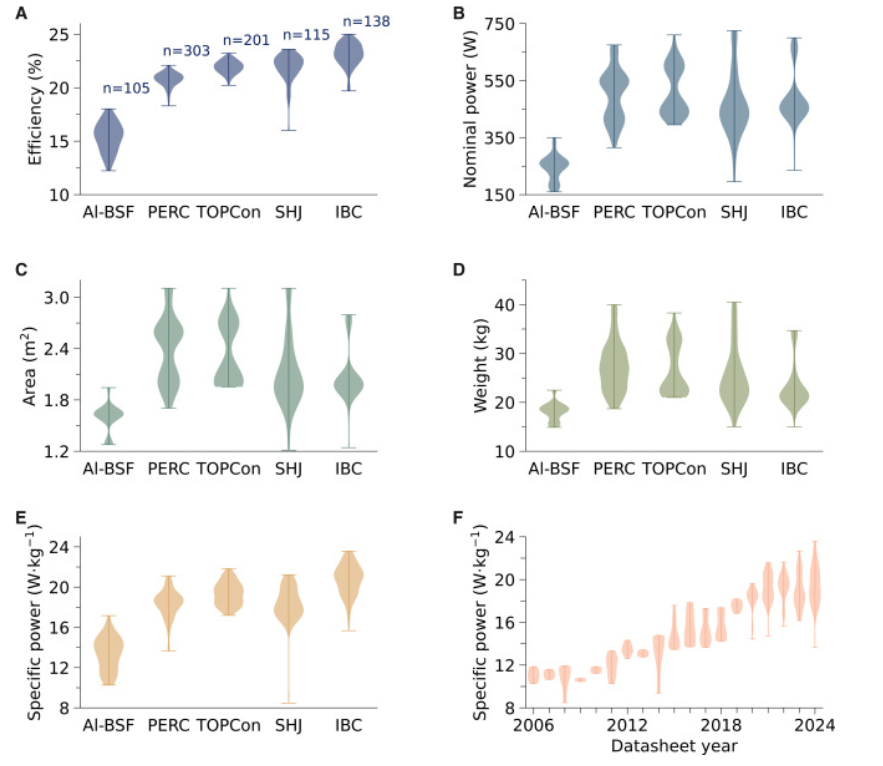
An international study found that the specific power of commercial silicon solar panels has increased from 8.5 W/kg in the early 2000s to 23.6 W/kg today, thanks to advances in module design, bifaciality and temperature management. The researchers emphasized that glass and frame dominate the module weight, and that consideration of operating conditions such as nominal cell temperature and back lighting is essential for accurate PV system design.
An international research team discovered this the specific power of commercial silicon solar panels increased from about 8.5 W/kg in the early 2000s to 23.6 W/kg today.
The specific power of a PV module measures how much electrical power the module produces per unit weight. This metric can also be expressed in W/m2 and helps compare the efficiency of different solar panels, regardless of their size or weight. It is especially important in space applications or portable solar panels, where weight is more important than surface area.
“The PV community is aware of the changes in module design that have taken place in recent years,” said study co-author Bruno Vicari Stefani. pv magazine. “Our work provides an extensive body of evidence illustrating these changes. It underlines the move towards application-specific module designs rather than ‘one-size-fits-all’ solutions.”
“The conventional view on the use of silicon panels is shifting,” said co-author Matthew Wright. “Silicon is no longer seen as a bulky module confined to a roof. Advances in silicon module design have enabled a range of new applications, such as the high specific power designs used in aerospace.”
The research team explained that the effective specific power of a PV module varies depending on operating conditions, including nominal operating cell temperature (NOCT) and lighting. NOCT is a standardized measure of the temperature a solar cell reaches under typical field operating conditions, rather than under ideal laboratory conditions. In concrete terms, this is defined as the temperature of the cells of a module in open circuit conditions when the module is exposed to an irradiation of 800 W/m², an ambient air temperature of 20 C and a wind speed of 1 m/s.
Specific power was calculated with or without bifacial gains, which were modeled assuming a back-to-front irradiance ratio of 10% and manufacturer-provided bifaciality factors. This analysis showed that bifacial gains increase the effective specific power of PERC, TOPCon, heterojunction (HJT), and interdigitated back-contact (IBC) modules, narrowing the gap between the best-performing technologies. HJT modules were found to respond best to combined temperature and lighting at the rear.
The scientist highlighted that considering both temperature effects and back-light illumination can reduce performance differences between technologies, enabling more accurate predictions of energy output relative to module mass while informing the design of sustainable PV systems.
The researchers also reported that glass continues to dominate the weight of photovoltaic modules in current manufacturing practices, contributing between 54% and 86%, with bifacial modules generally being heavier due to the double-glazed designs. They emphasized that module weights can scale in both surface area and glass thickness, noting that larger or thicker glass modules can reach 26-39 kg. According to their findings, monofacial modules typically use a single 3.2 mm glass sheet, while bifacial modules use dual 2.0 mm layers. They also emphasized that thicker glass improves durability but makes handling and transportation difficult, especially in rooftop installations.
Their analysis also found that aluminum frames account for 6%–19% of module weight, while encapsulants account for 2%–15%. Other components, including cells, junction boxes, backplates and connections, collectively contribute 8% to 16% of the total weight. The researchers noted that while thinner glass or lighter frames can improve specific power, such adjustments can compromise mechanical reliability. Overall, they concluded that glass and frame are the most important factors determining module weight, efficiency and handling issues.
Their findings are available in the article “Increasing specific power and the emergence of new markets for crystalline silicon photovoltaics”, published in Cell reports natural sciences. The research group included scientists from the University of South New Wales (UNSW) and the Newcastle Energy Center in Australia, the Federal University of Santa Catarina (UFSC) in Brazil, the US Department of Energy’s National Laboratory of the Rockies and the University of Oxford in the United Kingdom.
This content is copyrighted and may not be reused. If you would like to collaborate with us and reuse some of our content, please contact: editors@pv-magazine.com.
