

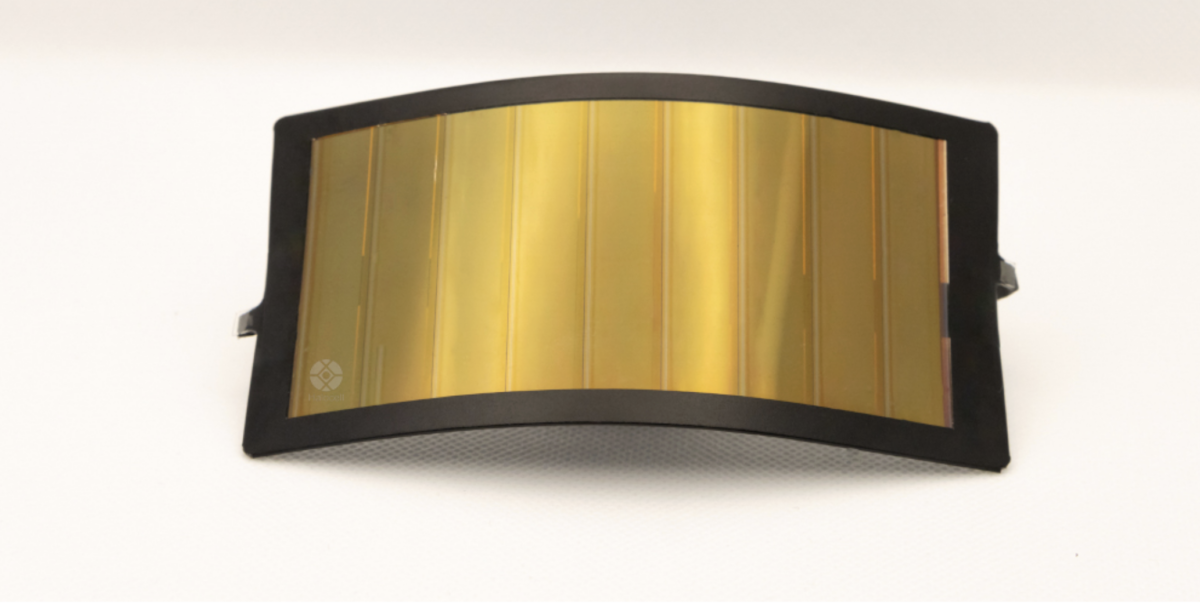
An ongoing collaboration between Australia’s Halocell Energy and US-based Sofab Inks shows that perovskite modules incorporating Sofab’s Tinfab electron transport layer retain approximately 100% of their normalized efficiency after 1,300 hours under accelerated combined light and moisture-heat tests.
Australian solar cell developer Halocell Energy and US startup Sofab Inks have found that perovskite devices incorporating Sofab’s new metal oxide nanoparticle inks exhibit high levels of durability.
Halocell and Sofab Inks announced a strategic partnership to accelerate innovation in perovskite PV technology in mid-2025, coinciding with the launch of Halocell’s Ambient Module series. The partnership will see Sofab Inks supply Halocell with its nanoparticle inks, while Halocell also continues to formulate and produce its own proprietary perovskite inks.
Jack Manzella, COO and co-founder of Sofab Inks, shared pv magazine that the University of Louisville spin-off has worked with Halocell’s engineering team since the partnership began to qualify and validate the material in Halocell’s devices.
Modules with Sofab Inks’ Tinfab electron transport layer have demonstrated normalized efficiency of approximately 100% after 1,300 hours under accelerated combined light and moisture-heat tests of 1,000 lux lighting, 85% relative humidity and 65 C. Control devices using commercially available charge transport layers decreased by approximately 20% normalized efficiency under the same test conditions.
“Stability remains a critical barrier to the commercialization of perovskite solar cells, so this is a meaningful step forward,” Manzella said. pv magazine. “Halocell is one of the few perovskite companies actively selling modules today and the additional stability benefits of our materials strengthen their commercial offering.”
Manzella explained that Sofab’s nanoparticle inks are designed to replace fullerene-based materials such as C60 as the electron transport layer, especially in PIN architectures and tandem applications. “They perform the same function, but offer improved thermal and environmental stability, are compatible with scalable manufacturing techniques such as slot-die coating and are based on cheaper, plentiful materials, making them better suited for commercial-scale production,” he said.
Halocell has now started shipping modules using Sofab’s Tinfab electron transport layer to partners for evaluation, with the current focus on applications in IoT devices, wireless sensors and small indoor electronics.
“Halocell plans to expand its offering into land and drone applications and we are excited to grow with them,” Manzella added.Looking ahead, we are focusing on joint development efforts aimed at scaling up to larger area modules and production volumes.”
In January, Halocell signed a Memorandum of Understanding with Queensland advanced materials company Lava Blue to collaborate on scalable, Australian-made specialty chemicals used in printing perovskite solar panels.
Last October, Sofab Inks announced that the tin oxide electron transport layer material was used in a 22.2% efficient 30 x 30 cm mini perovskite solar module.
This content is copyrighted and may not be reused. If you would like to collaborate with us and reuse some of our content, please contact: editors@pv-magazine.com.
