

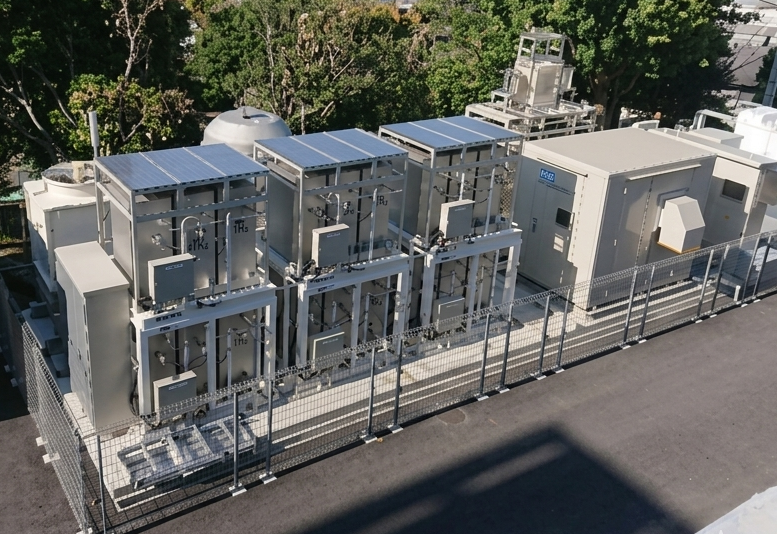
Taisei Corporation has demonstrated in a test facility in Yokohama that a building can run entirely on solar energy by combining PV generation with a hybrid storage system that integrates batteries and low-pressure hydrogen. An EMS-compatible setup with lithium-ion batteries and PEM electrolysis balanced short- and long-term energy supply and demand, enabling sustainable operation year-round, according to the company.
Japanese industrial and construction conglomerate Taisei Corporation has demonstrated that a building can run entirely on solar energy by combining photovoltaic generation with a hybrid energy storage system that integrates batteries and low-pressure hydrogen.
The pilot project was developed at the company’s Zero Energy Building (ZEB) testing facility in Totsuka Ward, in the central-west part of Yokohama City, Kanagawa Prefecture, Japan.
The system is based on an energy management system (EMS) developed by Taisei, which coordinates lithium-ion batteries for short-term storage and a low-pressure hydrogen storage system for long-term seasonal energy shifting.
The EMS continuously balances supply and demand by directing excess PV energy to the building’s immediate consumption, battery charging or an electrolyzer for hydrogen production. When solar energy generation is insufficient, the stored energy is returned to the building, either from the batteries or by converting hydrogen into electricity via fuel cells. The storage system consisted of two 450 kWh lithium-ion batteries, a 5.0 Nm3/h proton exchange membrane (PEM) electrolyzer, a 2,000 Nm3 hydrogen tank and a 5 kW fuel cell.
The company said the effectiveness of this approach was confirmed by real-world use from winter 2023. During a representative sunny day in June 2024, with 12.1 hours of sunlight, the system generated 444 kWh of electricity. Of this, 57 kWh was consumed directly by the building, while 155 kWh was stored in batteries and later partially discharged to meet nighttime demand. The remaining 232 kWh was used for the production and storage of hydrogen for longer-term use.
In contrast, on a winter day in February 2025 with shorter daylight hours, the system generated 297 kWh of solar energy. Electricity demand in the evening and early morning was met by hydrogen stored in previous seasons, with fuel cells supplying 168 kWh to the building.
“The application of our EMS has demonstrated that in both the short and long term, the balance between supply and demand can be reliably achieved, as planned, by coordinating battery storage and low-pressure hydrogen storage in response to real-time energy demand and generation conditions,” the company said in a statement, without providing further technical details.
Looking ahead, Taisei plans to further improve the efficiency of both its EMS and hybrid storage systems. The company aims to provide a fully optimized framework for year-round use of renewable energy in buildings.
In addition to this project, Taisei is actively participating in demonstration projects for hydrogen production, storage, transportation and use as part of its broader commitment to decarbonizing Japan’s energy system. It is currently involved in hydrogen supply chain trials that connect renewable electricity with hydrogen production and storage for construction and regional energy use.
This content is copyrighted and may not be reused. If you would like to collaborate with us and reuse some of our content, please contact: editors@pv-magazine.com.
