

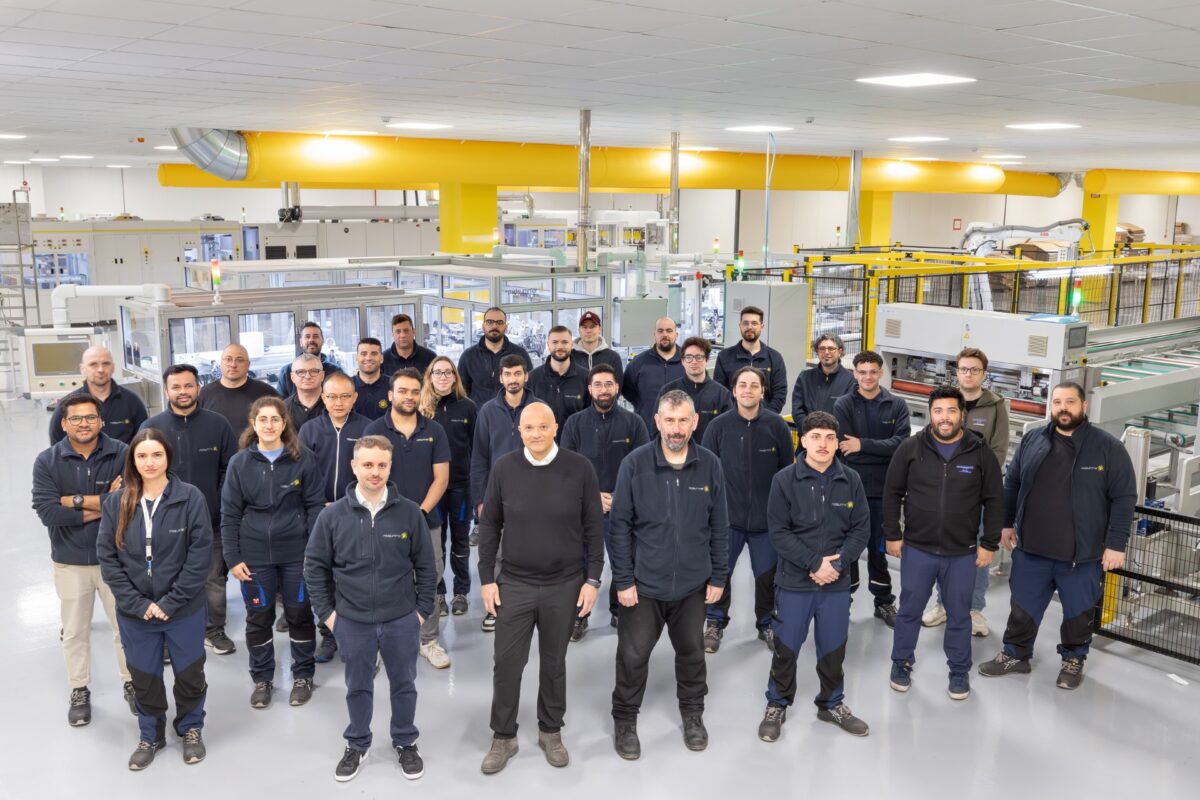
The Swedish thin-film solar energy specialist is producing 50 MW of modules at its factory in Bari, using its proprietary DUO cell production system. The company says it sources all materials from the EU and other countries in the Global North.
Behind every solar panel there is a production story that is shaped by technical choices, investment strategies and market demand. In a new pv magazine series that spotlights PV manufacturing facilities around the world, we explore how these factors come together on the factory floor. Here we focus on Midsummer’s branch in Bari, Italy.
Midsummer, a thin-film solar energy specialist headquartered in Sweden, started considering an Italian operation as early as 2021. The company appointed Jarno Montella to lead the project and acquired a 3,880 m² building, which became operational as a factory in 2024. The total investment in the facility was €50 million ($59 million), including a €16.5 million grant from the Italian National Investment Agency.
“Our Italian factory has a production capacity of up to 50 MW of copper, indium, gallium and selenide (CIGS) solar cells and modules per year,” said Peter Karaszi, head of communications at Midsummer. pv magazine. “The factory is fully vertically integrated across the entire value chain – from raw materials to finished products – without being dependent on imports from China or Russia. All materials are sourced from the EU and other Western countries, making it the only large-scale EU facility with such independence.”
The factory produces two products: the Midsummer SLIM and Midsummer BOLD modules, both 2 mm thick. The SLIM module is designed for standing seam metal roofs and is available in widths of 0.36 m or 0.52 m, with lengths ranging from 0.86 m to 5.9 m. The BOLD module is intended for low-bearing structures including bitumen, PVC, TPO and metal roofs. It is available in widths of 1 m or 1.3 m and lengths from 1.7 m to 6 m. Depending on the model, the output power varies between 114.5 W/m² and 127 W/m².
“From our Italian facility, we supply solar panels to countries in the EU and the US, where shipments must meet specific electrical testing requirements, supported by specialized equipment installed in our factory,” said Karaszi. “We also serve the South American markets, especially Colombia, where our parent company in Sweden is working with Saab to build a new factory. Until that facility becomes operational, we will continue to supply the Colombian market with modules produced in Italy.”
The factory in Bari is organized into two production lines: one for solar cells and the other for modules. The solar cell line is based on ten of the company’s DUO machines and proprietary sputtering tools developed by Midsummer. Manufactured in Sweden, DUO is a turnkey system with an annual CIGS production capacity of 5 MW. Metal substrates measuring 156 mm x 156 mm are fed into the system and passed through 25 process chambers in a continuous vacuum chain. The process reaches a production rate of one solar cell every 20 seconds, which enables production of millions of cells per year.
The module line connects and laminates the cells produced by the DUO machines to form thin, lightweight, flexible solar panels. “Overall, the layout supports a streamlined production flow from cell deposition to final module assembly, enabling large-scale, flexible solar energy production,” concludes Karaszi.
In addition to the factory in Bari, Midsummer operates a smaller annual production line of 5 MW at its headquarters in Stockholm. The company is also building a 200 MW factory in Flen, southeastern Sweden. Commissioning is expected to begin later this year, with full operation planned for 2028. “Our research and development (R&D) team is focused on further improving the performance of solar cells and developing new materials for modules in different colors,” said Karaszi.
Previous articles in pv magazineThe new series on solar manufacturing facilities around the world included United Solar’s polysilicon plant in Oman and Belga Solar’s module manufacturing facility in Belgium.
This content is copyrighted and may not be reused. If you would like to collaborate with us and reuse some of our content, please contact: editors@pv-magazine.com.
