

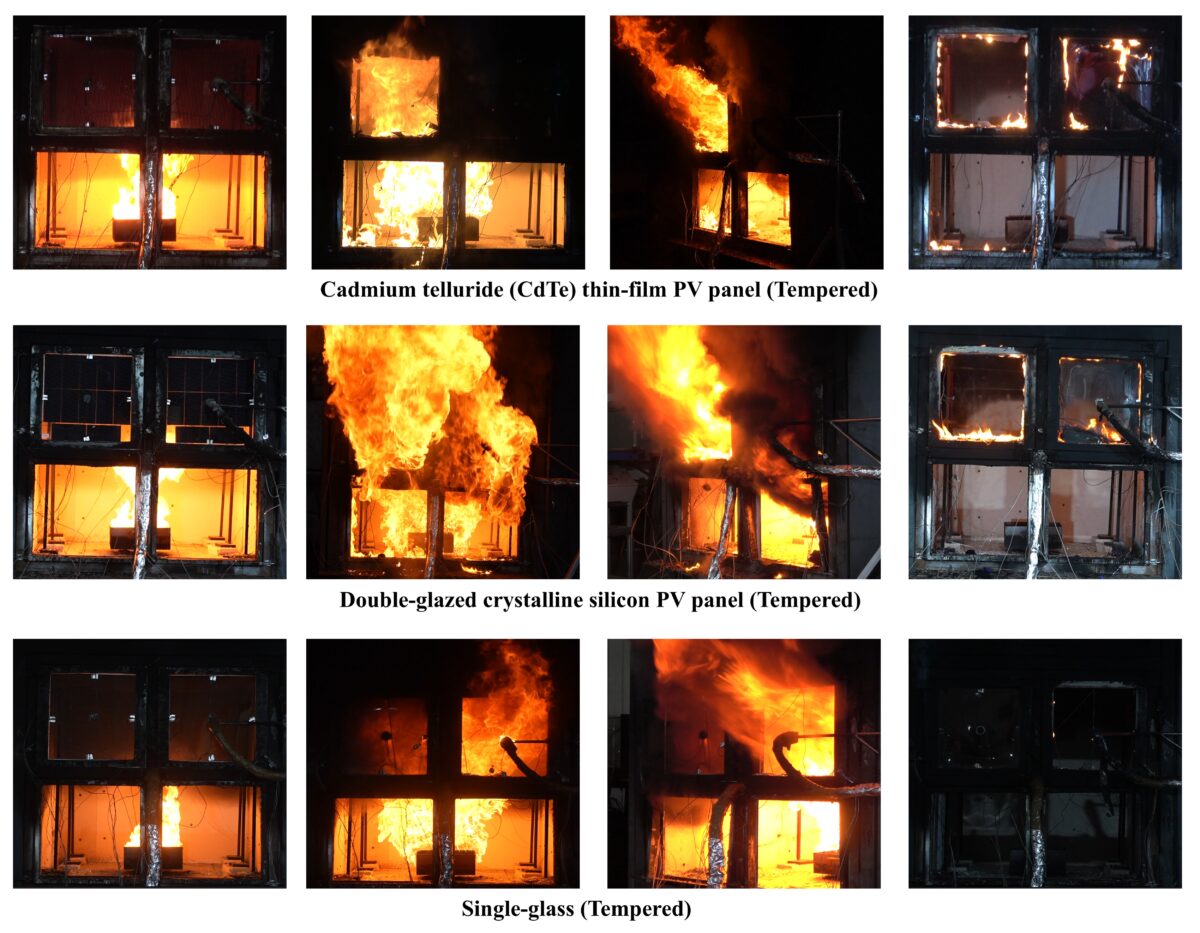
A group of scientists in China have built a specialized compartment to test the thermal rupture and deposition of BIPV facades under enclosure fire conditions. They examined three different types of BIPV modules and found that tempered glass PV panels exhibit superior thermal and mechanical resistance to breakage.
A research team led by scientists from the University of Science and Technology of China has conducted a large-scale experimental study on the thermal performance of a building-integrated PV (BIPV) facade under enclosure fire conditions. An enclosure fire is a fire that burns in an enclosed space, such as a room, where walls and openings control heat build-up, air flow and fire behavior.
“The large-scale experimental setup was designed to study the thermal fracture and effects of the BIPV facade in an enclosure fire,” said first author Chengming Xiao. pv magazine. “Three representative types of PV curtain modules were selected for the experiments: cadmium telluride (CdTe) thin-film, double-glass and single-glass crystalline silicon modules. For comparative experiments, traditional glass was used,”
“Our study provides systematic large-scale experimental evidence on the behavior of BIPV facade fires, quantifies the critical rupture characteristics and temperature differences for different types of PV panels, and reveals the feedback effects of BIPV facade precipitation on the dynamics of compartment fires,” added co-author Yu Wang. “The findings provide important implications for the fire safety assessment and design of BIPV facades.”
For their tests, the researchers built an experimental compartment with dimensions of 1.4 m x 1.4 m x 1.8 m, made of stainless steel. It was lined with 8 cm thick ceramic fiber boards to provide insulation. A stainless steel frame was placed on the open side, where two PV panels measuring 60 cm by 60 cm would be attached.
In the lower part of the compartment there were two openings of the same size to allow natural ventilation. The frame covered the outer 30mm, creating a heated area of 540mm x 540mm, while a 10mm ceramic fiber at the edges reduced heat conduction and prevented strain on the frame.
In this setup, the team examined eight facade configurations. These include thin-film CdTe double-glazed modules with either fully annealed glass or a combination of annealed outer and toughened inner glass; double-glazed crystalline silicon modules with fully annealed or fully tempered glass; and single-glass crystalline silicon modules with a flammable EVA/TPT backplate, again in both annealed and tempered versions. For basic comparison, two non-PV cases were also tested: single-layer annealed glass and single-layer tempered glass.
“The results show that the fire performance of BIPV facades is strongly determined by the coupled effects of glass type and the presence of flammable encapsulation materials,” Xiao said. “Tempered glass PV panels exhibit superior thermal and mechanical resistance to fracture, and falling flammable encapsulation materials can ignite lower or surrounding combustibles, further promoting fire spread.”
Furthermore, the researchers add, the strength and type of PV panels also influence the fire dynamics in a compartment, which influences both fire development and flame emission behavior. “The new openings caused by the failure of PV panels changed the stable ventilation conditions and caused the emission of flames, accelerating the growth of heat release and heat flow,” they also noted.
Their findings are presented in “Large-scale experimental research into the thermal performance of a photovoltaic facade integrated into a building during a fire in an enclosed space”, published in the Journal of Construction Technology. In addition to the University of Science and Technology of China, researchers from Italy’s University of Trieste contributed to the study.
This content is copyrighted and may not be reused. If you would like to collaborate with us and reuse some of our content, please contact: editors@pv-magazine.com.
