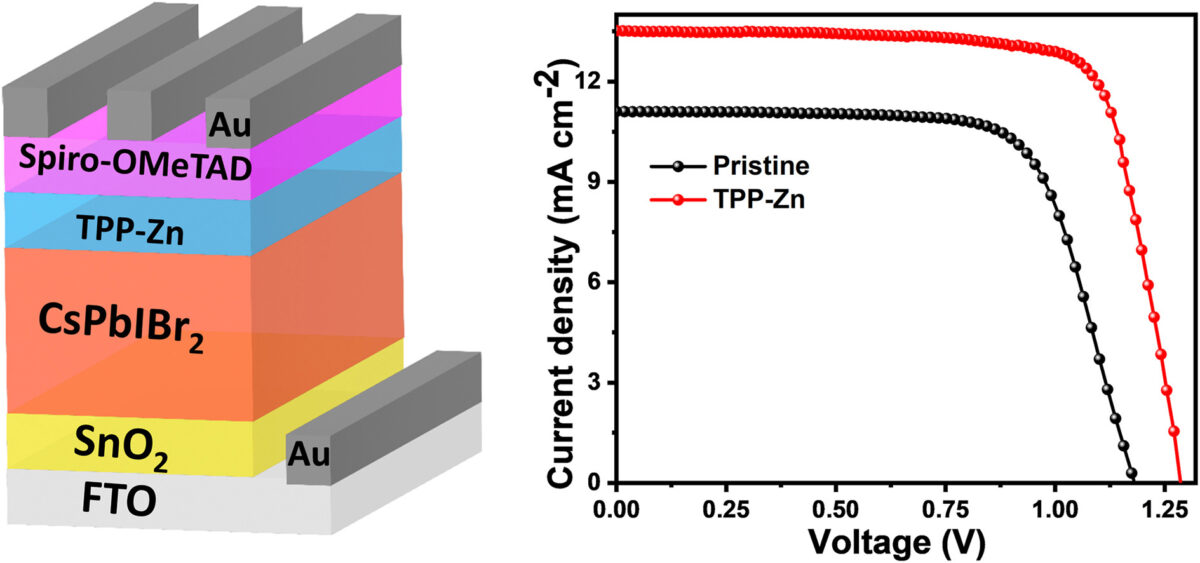
An international research team has proposed a perovskite solar cell architecture with a thin tetraphenyl-porphine-zinc interface to increase surface potential, passivate defect states and improve charge transport. The strategy leads to improved device efficiency and operational stability, enabling energy conversion efficiency of more than 13%.
An international group of researchers has proposed a new device design that improves the surface potential of cesium lead iodide bromide (CsPbIBr₂) perovskite solar cells by depositing a thin layer of tetraphenylporphine zinc (TPP-Zn) on the active layer.
Regular CsPbIBr₂ devices are known for their superior operational stability compared to many other inorganic perovskite compositions, due to their robust crystal lattice, reduced sensitivity to moisture and improved thermal resilience. However, their practical application is still limited by relatively low energy conversion efficiencies, mainly linked to interfacial charge recombination and limited charge extraction.
“The novelty of this work lies in the introduction of a TPP-Zn interfacial layer to effectively modulate the surface potential and passivate trap states in fully inorganic CsPbIBr2 perovskite solar cells with a wide band gap,” said corresponding author M. Bilal Faheem. pv magazine.
“Unlike conventional passivation strategies, the coordination interaction between TPP-Zn and undercoordinated metal cations enables simultaneous suppression of surface defects and enhancement of charge carrier dynamics, leading to improved device efficiency and stability,” he also explained. “In addition, the experimental results were validated through an analog simulation device design using SCAPS-1D against the photovoltaic parameters and thermal stability of perovskite solar cell devices.”
To fabricate the device, the researchers first cleaned fluorine-doped tin oxide (FTO) glass substrates and deposited a dilute tin(IV) oxide (SnO₂) electron transport layer (ETL) via spin coating, followed by annealing at 100 C for 20 minutes and 150 C for 40 minutes. Then, the CsPbIBr2 perovskite absorbent was prepared by dissolving equimolar amounts (1.2 M) of cesium iodide (CsI) and lead bromide (PbBr2) in dimethyl sulfoxide (DMSO). The solution was spin-coated onto the SnO2 layer at 1500 rpm for 20 s and 3500 rpm for 60 s, followed by annealing at 200 °C for 10 min.
Image: King Fahd University of Petroleum and Minerals (KFUPM), Materials Reports: Energy, CC BY 4.0
In the surface passivation step, a TPP-Zn solution in toluene was spin-coated onto the wet perovskite film at 5,500 rpm for 30 s, followed by annealing at 180 °C for 10 min. Then, a hole transport layer (HTL) of Spiro-OMeTAD was spin-coated on top. Finally, a 100 nm thick gold (Au) electrode was deposited via thermal evaporation, yielding devices with active areas of 0.16 cm² and 1.02 cm². The final device architecture was FTO/SnO₂/CsPbIBr₂/TPP-Zn/Spiro-OMeTAD/Au.
The researchers used several methods to characterize the devices. X-ray diffraction (XRD) and ultraviolet-visible (UV-Vis) spectroscopy were used to study the crystal structure, crystallinity, light absorption and band gap. At the same time, photoluminescence (PL) and time-resolved photoluminescence (TRPL) were used to analyze charge recombination and carrier lifetime.
Scanning electron microscopy (SEM), atomic force microscopy (AFM), Kelvin probe force microscopy (KPFM) and X-ray photoelectron spectroscopy (XPS) were then used to investigate the morphology, surface potential and passivation of defects. The device performance was tested using current density voltage (JV), incident photon current efficiency (IPCE), Mott-Schottky, space charge limited current (SCLC), electrochemical impedance spectroscopy (EIS) and contact angle measurements.
The optimized CsPbIBr₂ PSC device was found to deliver a peak power conversion efficiency of over 13.47%, along with an open-circuit voltage of 1.29 V, a fill factor of 82.3%, and a short-circuit current density of 12.69 mA cm² for a device area of 0.16 cm². For the larger active area of 1.02 cm², the device maintains an efficiency of 11.29%. This simple but effective approach offers a promising route to the development of stable and high-performance inorganic perovskite solar cells.
“The most surprising result was the significant improvement in both efficiency and charge transport achieved with a simple, ultra-thin TPP-Zn layer,” said Faheem. “Specifically, the device demonstrated that effective passivation at the molecular level can significantly reduce recombination losses in wide bandgap inorganic perovskite-based PV devices.”
The device was described in “Superficial wide bandgap all-inorganic perovskite solar cells achieve a fill factor of more than 82%”, published in Materials reports: Energy. Scientists from Saudi Arabia’s King Fahd University of Petroleum and Minerals (KFUPM), Syracuse University in New York, Turkey’s Ankara Yıldırım Beyazıt University, Chinese City University of Hong Kong and Pakistan’s Narowal University participated in the study.
This content is copyrighted and may not be reused. If you would like to collaborate with us and reuse some of our content, please contact: editors@pv-magazine.com.
Popular content