
Close Menu
  • News
  • Industry
  • Solar Panels
  • Commercial
  • Residential
  • Finance
  • Technology
  • Carbon Credit
  • More
    • Policy
    • Energy Storage
    • Utility
    • Cummunity
What's Hot

Report: US data center development slows in first quarter

July 30, 2026

Türkiye will add 2.1 GW of solar energy in the first half of the year

July 30, 2026

The Trinity Energy project takes the Florida Costco distribution center off-grid

July 29, 2026
Facebook X (Twitter) Instagram
Solar Energy News
Saturday, August 1
  • News
  • Industry
  • Solar Panels
  • Commercial
  • Residential
  • Finance
  • Technology
  • Carbon Credit
  • More
    • Policy
    • Energy Storage
    • Utility
    • Cummunity
Solar Energy News
Home - Technology - Australian researchers develop a vapor-based production process for lead-free perovskite solar panels – SPE
Technology

Australian researchers develop a vapor-based production process for lead-free perovskite solar panels – SPE

solarenergyBy solarenergyMay 1, 2026No Comments2 Mins Read
Facebook Twitter Pinterest LinkedIn Tumblr Email
Share
Facebook Twitter LinkedIn Pinterest Email

Researchers from the University of Queensland have developed a scalable, lead-free manufacturing process for perovskite solar cells that achieves record indoor light efficiency while avoiding toxic materials and enabling flexible applications for consumer electronics.

May 1, 2026
Ev Foley

By pv magazine Australia

Researchers from the University of Queensland have developed a safe and scalable vapor-based manufacturing process for manufacturing high-quality lead-free perovskite material with fewer performance-limiting defects.

Indoor perovskite solar cells operate under low-intensity artificial lighting, such as light-emitting diodes (LEDs) and fluorescent lamps, but most rely on lead-based hazardous materials.

The new manufacturing method eliminates the need for toxins pipe and other hazardous solvents.

UQ Chemical Engineer and co-research leader Miaoqiang Lyu said the technology his team developed eliminates these materials while still delivering high efficiency.

“By completely removing these solvents, the process is much more suitable for scalable production,” Lyu said.

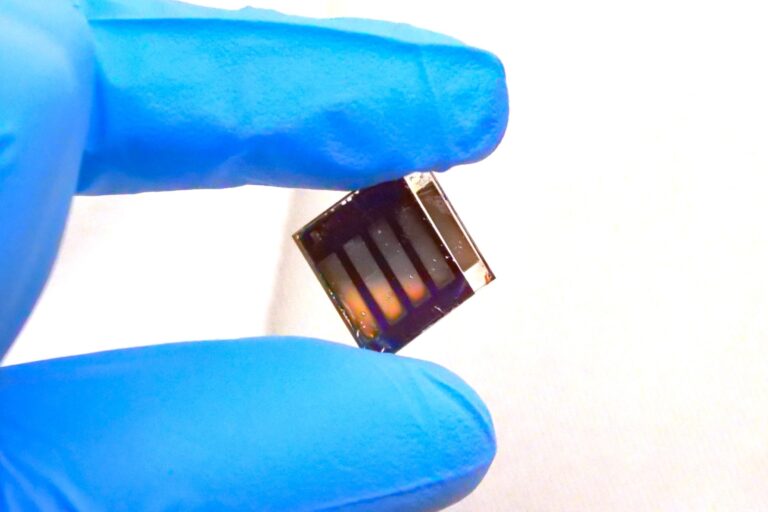
Halide perovskites are an emerging technology that could replace silicon.Image: The University of Queensland

Efficiency

Lyu said halide perovskites are an emerging technology that could replace silicon, offering much higher efficiency and commercial potential.

“Indoor solar cells are not new in themselves, but the energy conversion efficiency of commercial silicon-based technology is only about 10%,” he said.

Using the new method, the panels achieved an efficiency of 16.36% – the highest reported for this type of indoor lead-free perovskite solar cell, made using an industry-compatible evaporation method.

Commercial use

Panels manufactured using the UQ process are thin, scalable and can be made on flexible plastic and in a variety of shapes, making them easy to integrate into a range of products.

They provide an alternative to coin cell and button batteries for low-power electronics such as environmental sensors, wearables, medical and health monitoring devices, and small consumer electronics.

See also  Lithuania launches 800 MWH Energy Storage Tender - PV Magazine International

Battery-powered electronic shelf labels being trialled by supermarkets are also a possible early application of the technology.

“People will likely see perovskite interior panels and integrated consumer electronics on the market in the coming years,” Lyu said.

Further testing

“I think the key here is encapsulation, to protect the material from oxygen and moisture,” Lyu said.

The research was published in ACS Energy Letters.

This content is copyrighted and may not be reused. If you would like to collaborate with us and reuse some of our content, please contact: editors@pv-magazine.com.

Popular content

Source link

Australian develop leadfree panels perovskite process production researchers solar SPE vaporbased
Share. Facebook Twitter Pinterest LinkedIn Tumblr Email
solarenergy
  • Website

Related Posts

Türkiye will add 2.1 GW of solar energy in the first half of the year

July 30, 2026

Taiwan introduces new solar regulations for large buildings

July 29, 2026

British Solar Renewables wins call for 29 MW solar power plant

July 28, 2026
Leave A Reply Cancel Reply

Don't Miss
Policy

Brazil Solar Curtillment reaches 20% as a renewable Strain schedule infrastructure – PV Magazine International

By solarenergySeptember 13, 20250

Brief restrictions in Brazil In the first half of 2025, investments can be made and…

Hydro-Québec launches subsidy for residential and commercial solar energy – SPE

April 3, 2026

Construction begins on massive solar project on roof of new JFK Airport terminal

September 24, 2024

American startup claims doubled energy per hectare with terrain-following solar panels

June 20, 2024
Stay In Touch
  • Facebook
  • Twitter
  • Pinterest
  • Instagram
  • YouTube
  • Vimeo
Our Picks

Report: US data center development slows in first quarter

July 30, 2026

Türkiye will add 2.1 GW of solar energy in the first half of the year

July 30, 2026

The Trinity Energy project takes the Florida Costco distribution center off-grid

July 29, 2026

FCC prohibits the import of new foreign inverters

July 29, 2026
Our Picks

Report: US data center development slows in first quarter

July 30, 2026

Türkiye will add 2.1 GW of solar energy in the first half of the year

July 30, 2026

The Trinity Energy project takes the Florida Costco distribution center off-grid

July 29, 2026
About
About

Stay updated with the latest in solar energy. Discover innovations, trends, policies, and market insights driving the future of sustainable power worldwide.

Subscribe to Updates

Get the latest creative news and updates about Solar industry directly in your inbox!

Facebook X (Twitter) Instagram Pinterest
  • Contact
  • Privacy Policy
  • Terms & Conditions
© 2026 Tsolarenergynews.co - All rights reserved.

Type above and press Enter to search. Press Esc to cancel.