

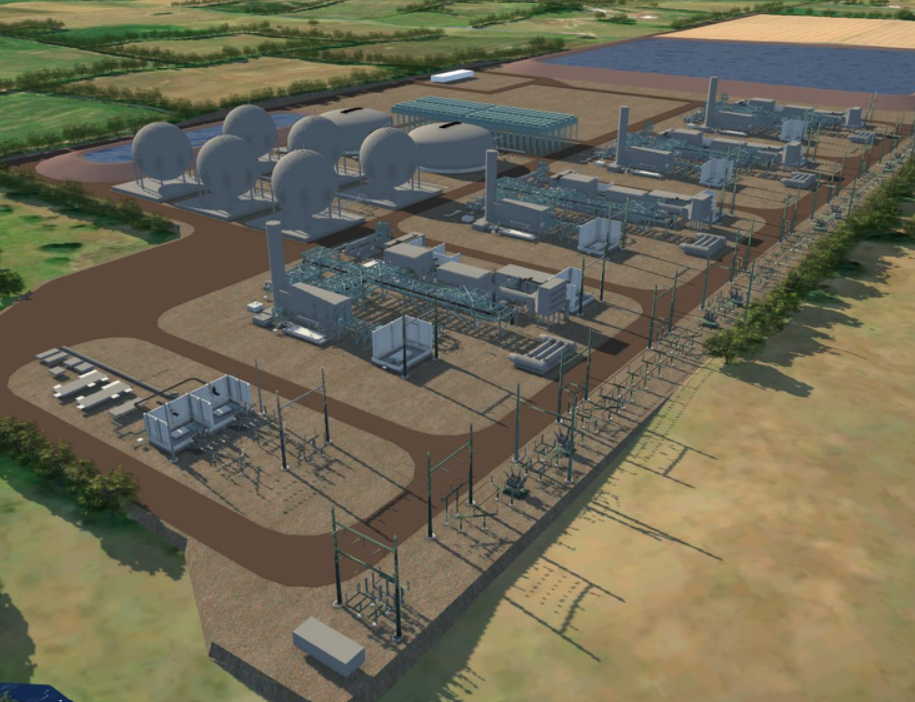
The first 4 GWh phase of the Canadian developer’s Quinte Energy Storage Center is expected to be operational in early 2030, with subsequent phases targeting 8 GWh to 16 GWh.
By ESS news
Hydrostor is developing a large-scale advanced energy storage project (A-CAES) in Greater Napanee, Ontario – “right in Hydrostor’s backyard” – as the Canadian company’s CEO and co-founder Curtis VanWalleghem said after the project announcement.
The planned Quinte Energy Storage Center will deploy Hydrostor’s A-CAES long-term energy storage (LDES) technology for a 50-year lifespan. The company expects the project to be operational in “early 2030.”
Two sites in Lennox and Addington County, Ontario are being assessed in parallel for the development, which will be strategically located near a transformer and power plant.
The first phase of development will target a capacity of 500 MW/4 GWh, enough power for up to 500,000 households for eight hours. Additional phases will target 1 GW/8GWh and 2 GW/16 GWh.
“This project will make a critical contribution to the reliability and resiliency of the electric grid, advancing the province’s energy goals and bringing a major infrastructure project with significant jobs and investment to Ontario,” Van Walleghem said.
Ontario’s electricity market operator IESO has warned that the region could see as much as a 65% increase in electricity demand by 2050. With forecasts calling for a capacity shortfall of 12 to 15 GW by 2035, Hydrostor claims that large-scale renewable, grid-balancing projects like the Quinte Energy Storage Center can help fully integrate other forms of clean energy generation. It is claimed that the A-CAES facility will be a “pillar for the reliability of Ontario’s electricity supply.”
Project construction is expected to begin around 2029 following the contract award in the first quarter of 2027, according to a project timeline on Hydrostor’s website.
It is expected to contribute more than CAD1.4 billion ($1.0 billion) to Canada’s GDP and has received financing from the Canada Growth Fund, which provided a $50 million convertible development loan to finance a portion of the development costs for Hydrostor’s projects in Canada.
The facility will begin its permitting process to secure municipal, provincial and federal permits and approvals. It is being developed in collaboration with the indigenous community, the Mohawks of the Bay of Quinte, who will be an equal partner.
The Toronto, Ontario-headquartered company is in the late stages of developing several other projects around the world based on its A-CAES technology, including the 4 GWh Willow Rock project in California, which should come online in 2030, and the 1.6 GWh Silver city project in New South Wales, Australia.
Hydrostor claims its technology differs from the conventional CAES approach, which typically recovers less than 50% of the input energy. Hydrostor integrates a thermal storage system that captures and stores the heat generated during compression, then reuses it during discharge rather than releasing it as waste.
The A-CAES also addresses another limitation of regular CAES: variable power caused by changes in subsurface air pressure. Hydrostor uses water from an above-ground reservoir to maintain constant pressure in the cave, and water condensed during compression is captured and reused.
Hydrostor says its approach means its projects can be implemented in a wider range of underground locations because, unlike traditional CAES, it does not rely on salt caverns to withstand pressure fluctuations.
This content is copyrighted and may not be reused. If you would like to collaborate with us and reuse some of our content, please contact: editors@pv-magazine.com.
