

From the magazine
Solar glass is not intended to break on its own, but that is happening more and more often. Since about 2021, scientists, operators and testing labs have been seeing glass breakage on solar panels with no apparent cause, such as shock or extreme weather. This new mode of failure has been researched to some extent, but as the scientific name suggests, ‘spontaneous glass breaks’ still occur without warning.
Spontaneous glass breakage in glass-glass modules is, according to Kiwa PVEL, the most important reliability problem facing modules today. “We are aware that this is happening in multiple countries, with multiple types of modules, mounted on multiple tracker/racking solutions,” the lab wrote in its 2025 PV scorecard.
Tristan Erion-Lorico, vice president of sales and marketing at Kiwa PVEL, said the phenomenon is directly related to the industry’s cost-cutting efforts.
“Overall, we made the glass, frames and encapsulant thinner and went to a more aggressive assembly,” Erion-Lorico said. pv magazine. “That probably all works on paper, where the ‘perfect module’ should be reliable over its expected lifespan. However, we have eroded the safety margins and now microscopic defects along the glass edges or surface, misplaced silicone or frame adhesive, edge pinching, pressure from the rails, etc. can result in module breakage.”
In the second quarter of 2025, Kiwa PVEL’s mechanical stress sequence tests recorded an all-time high, with approximately one-third of the modules’ glass breaking. In the last quarter of the year, results improved slightly, with about a quarter of samples failing. But these are still unprecedented results in decades of commercial module production.
“Although our test does not produce the same fracture pattern as modules that spontaneously fracture in the field, it is a good indication of the mechanical durability of modules,” said Erion-Lorico. “A module that fails after static mechanical load (SML) or dynamic mechanical load (DML) testing is unlikely to last 30 years in the field.”
XXL problem
New PV modules in power plants are now larger than ever. With glass on both sides accounting for more than half the weight of a module, it’s not surprising that manufacturers found room to cut costs by reducing its thickness. While previous generations of PV modules had 3.2 mm glass, today’s modules typically have a glass thickness of approximately 2.0 mm.
“The shift to thinner glass is entirely customer driven. Glass manufacturers have had to invest significantly in new equipment to meet this changed demand,” said Pradeep Kheruka, chairman of Borosil and Borosil Renewables, an Indian multinational solar glass manufacturer. “Glass manufacturers can safely handle large, thin glass, but because modules are now larger and heavier than before, they need specialized installation equipment.”
Kheruka added that responsibility for glass breakage is shared among different actors. “High pressure on the front and back glass due to thick solder joints is a factor that module manufacturers must take into account, while issues such as improper kit filling leading to contact between the aluminum frame and the glass, or poorly finished holes in the back plate, can also contribute,” he explains.
Not just tempering
The US National Laboratory of the Rockies (NLR), formerly known as the National Renewable Energy Laboratory (NREL), investigated possible causes of spontaneous glass breakage at the end of 2024. A range of factors were identified, including reduced thermal strengthening in thinner modules, microscopic defects at edges and surfaces, lamination-induced stresses such as edge pinching, increasing module size without corresponding changes to mounting and frames, and contact between the glass and frame or trapped debris.
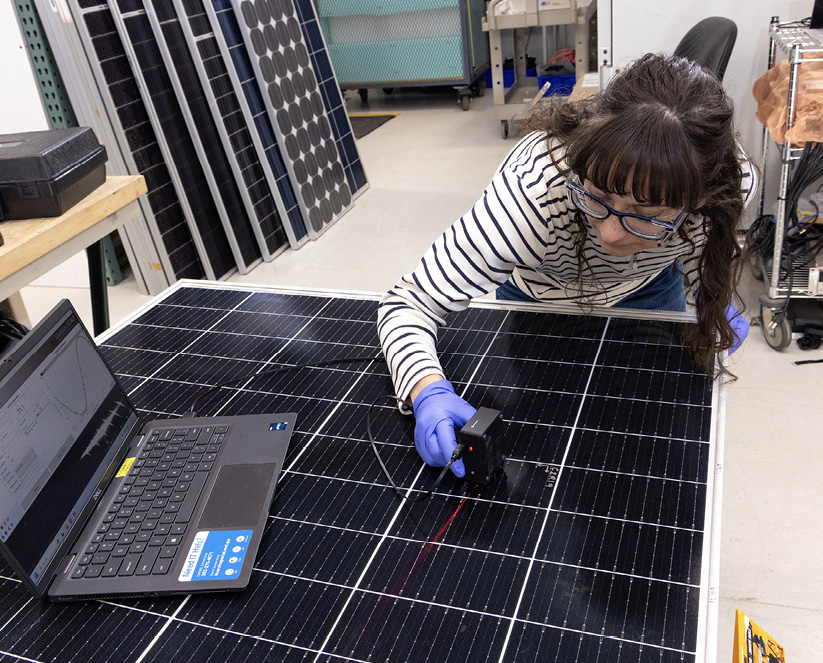
For a recent article from 2026, NLR focused on the first cause and developed a non-destructive method to measure the glass area directly on finished solar panels. Using this new method, researchers collected data from numerous mass-produced panels from commercial fields, where glass spontaneously broke. “We confirm that most 2.0mm glass in PV modules is fully toughened, but it remains weaker than traditional 3.2mm glass. Our results show a clear correlation between lower surface tension and increased susceptibility to spontaneous breakage. This is an important consideration for modules expected to survive more than 30 years in different environments,” explains NLR module reliability researcher Elizabeth Palmiotti.
Palmiotti added that recent research has shown that while 2.0mm glass can meet the threshold for fully tempered glass under certain glass standards, the compressive stress on the surface is generally lower and the compressive layer itself is thinner.
“The thickness of this protective layer scales with the overall thickness. So 2.0mm glass inherently has a thinner protective layer than 3.2mm glass, meaning the same defect can break a thinner glass, but not the thicker glass,” she added, explaining that it becomes more susceptible to defects caused by edge defects, impact and contact with the frame.
Looking for standards
Henry Hieslmair, chief solar engineer at DNV, an independent assurance and risk management provider, said investors are concerned about spontaneous glass breakage. “The general observation is that as safety margins shrink, smaller and more nuanced factors start to play a much larger role,” he said. Farid Samara, senior engineer for solar mounting at DNV, added that when projects with thinner glass and large module sizes come across his desk, he usually needs a much deeper assessment of the module. “Module manufacturers often claim that structural testing should be the responsibility of tracker suppliers, while tracker manufacturers argue the opposite,” he said.
This blame game ultimately points to a deeper problem: a lack of a clear, PV-specific standard for glass.
“There is currently no specific standard for PV glass, which means that glass manufacturers and module manufacturers do not report their glass properties in any meaningful way,” NLR’s Palmiotti noted. “It would be a huge step if the community aligned itself with the definitions for glass surface tension.”
This content is copyrighted and may not be reused. If you would like to collaborate with us and reuse some of our content, please contact: editors@pv-magazine.com.
