

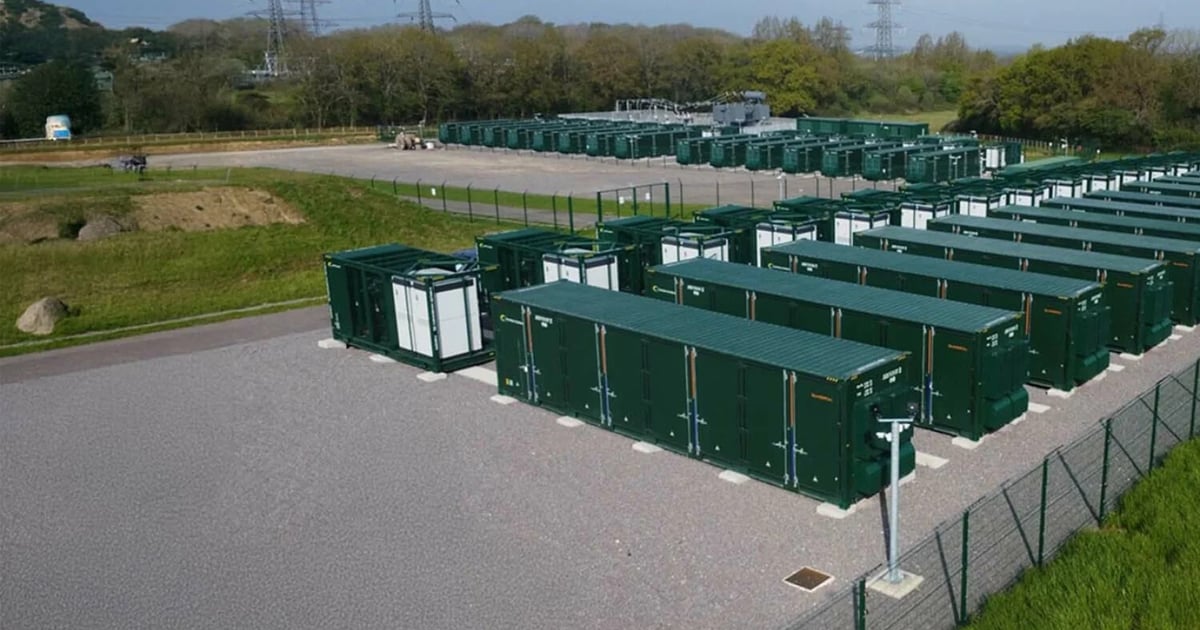
Four out of five planning refusal applications for grid-scale standalone battery energy storage systems (BESS) have been decided in favor of the developer.
Of the 67 appeals for standalone BESS schemes decided by the English Planning Inspectorate, the refusing council lost 53, or 80.8%. Of the denials stating that the project site was on greenfield land, 85% of appeals overturned the council’s decision.
This is the conclusion drawn from data collected and analyzed by GapSense, an AI platform that says it can speed up planning approvals for developers and planning specialists.
The company has read the planning inspector’s decision letters for the appeals it has decided for refused grid-scale BESS projects, which cover cases decided between January 2021 and May 2026. An appeal is only taken when a developer challenges a refusal, so the 81% success rate is among the first refusals and not the proportion of all battery storage refusals.
The green belt no longer justifies a refusal
A previously effective way of refusing projects was to cite greenbelt land as defined in the National Planning Policy Framework (NPPF). According to the NPPF, land in the green belt is considered unsuitable for almost all types of development.
However, a update introduced in 2024 states that the “wider environmental benefits associated with increased production of energy from renewable sources” mean that the usual stance is not being taken for renewable energy generation projects.
Furthermore, the current government has introduced the concept of ‘grey belt’ land, the development of which would not contribute to the problems that the green belt designation is intended to prevent: urban expansion and the connection of individual villages by development.
This has has also been the deciding factor in several calls for planning solar PV installations. Interestingly, GapSense’s findings show that planning inspectors agreed with the council’s designation of green belt land and its findings on damage to landscape character, but despite this alignment, agreeing with developers only 21% of the time, inspectors ultimately still supported approving BESS on green belt land.
Of the thirteen decisions on grid-scale projects using the gray belt argument, ten projects were approved on appeal. In eight of these cases, inspectors found that the location was a gray belt and therefore the BESS was not inappropriate. In a further two cases, the councils conceded this point and withdrew the decisions refusing the green belt.
Furthermore, in two cases the gray belt argument did not hold water and the developer still won its appeal, meaning that only one appeal was actually rejected on the grounds of its location in the green belt.
Need for storage the most decisive factor on appeal
The data shows that the need for energy storage was the most common deciding factor in successful appeals. Grid stability, net zero and an unmet need for storage capacity outweigh moderate damage to landscape and openness, “almost by default,” according to GapSense.
While it is reassuring that the council’s refusal of a project is not necessarily the end of the line, the additional cost and time of the appeals process, when demonstrably unnecessary, jeopardizes development.
For example, in the July 2025 decision on Statera’s 500MW South Oxfordshire BESSwrote the inspector: “The recognized significant weight to be given to the need for the BESS… far outweighs the low level of less than substantial damage that would be caused to the RPG (Registered Park and Garden)… the moderate/minor damage that would be caused to the character of the landscape… and the temporary loss of five hectares of BMV land (best and most versatile agricultural land).”
Also worth noting is that the data shows that, despite fire risk being the central argument of many local objections to BESS development, it was only raised as a main issue in ten appeals and was decisive in only two redundancies. In these rejected projects, the problem was more with the design than with a feature of the technology used.
Solar energy in a similar condition
As mentioned above, a similar situation is unfolding for solar developers, and Solar Media Market Research has found that by 2025 In 2025, 46 projects were rejected at local planning authority (LPA) level, and just under 90% of appeals were won.
One difference, however, is that large-scale solar developers can choose not to engage the LPA by entering the development consent order (DCO) process reserved for Nationally Important Infrastructure Projects (NSIPs).
Because a DCO approval must be granted by the Secretary of Energy, there is currently a high degree of certainty that an NSIP-scale project will be greenlit, making the additional upfront costs of the process more palatable.
In 2020, it was decided that the additional cost and process was an ineffective route for BESS, and the technology was removed from the NSIP designation, regardless of project capacity.
The need to appeal effectively nullifies that decision as the decision ultimately falls to one planning inspector.
GapSense founder Martin Alderson commented: “The surcharge was removed from the NSIP regime in 2020 precisely so it could be processed through local planning more quickly. Instead, councils are spending significant resources rejecting schemes that inspectors continue to treat as critical energy infrastructure – and losing four in five appeals. These projects should be approved the first time, not parked in appeal queues.”
