

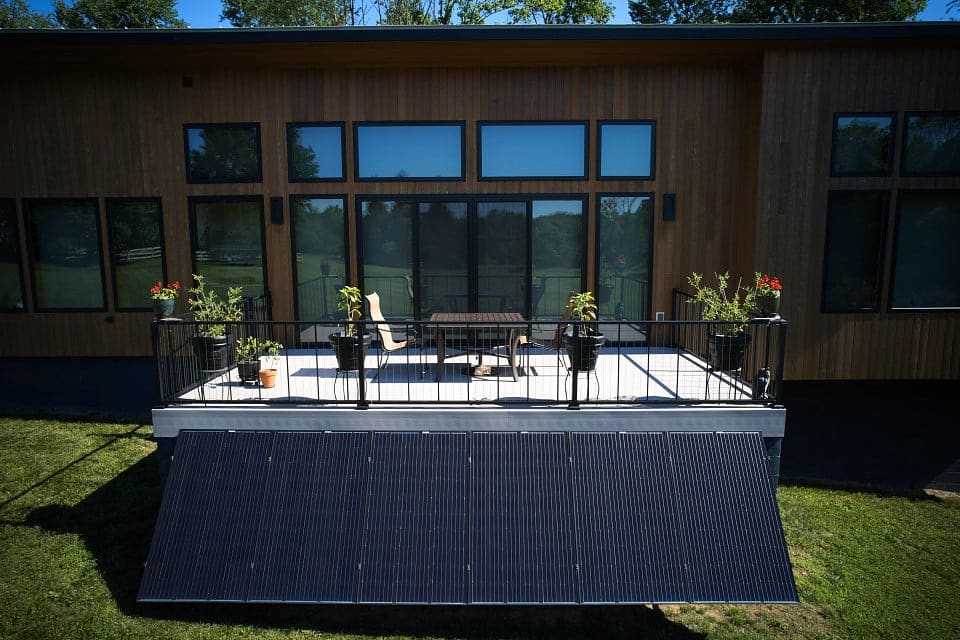
The cost of installing a home solar energy system has rapidly decreased over the past few years, and prices are still on the decline. If you’re considering going solar, the best time to act is during the design phase of your new home. By integrating solar technology into your new home’s construction, you can capitalize on both its environmental and financial benefits, avoiding the need for a more complex and costly retrofit installation later on.
Tips for Owners and Builders Designing a “Solar Ready” New Home
A recent study by the National Renewable Energy Laboratory (NREL) reveals that integrating solar installation during home construction can significantly reduce costs. Whether you’re a builder designing a solar-ready home or a property owner currently in construction, “solar ready” design guidelines exist to simplify the process for everyone involved.
When you design a home that is solar ready, consider the following:
- Roof Steepness and Orientation: Aim for a south-facing roof with an angle between 30 and 45 degrees, which is ideal for solar panel efficiency.
- Layout of Roof Obstructions: Check for roof vents, chimneys, dormers, and other structures that might cast shade on your solar panels, as shade can significantly reduce electricity production.
- Roof Load-Bearing Capacity: Ensure that your roof can support the extra weight of a solar panel system.
- Designated Roof Mounting Points: Incorporating mounting points for your photovoltaic (PV) array during design can save time, cut costs, and minimize the risk of roof damage during solar installation.
Here are critical electrical aspects to address:
- Electrical Conduit Installation: Install an electrical conduit that runs from your main electrical panel to the roof, connecting your solar panels to the electrical system.
- Service Panel and Circuit Breakers: Verify that your main service panel and circuit breakers can accommodate a solar panel array.
- Space for PV Inverters and Equipment: Ensure there is adequate space near the main electrical panel for installing PV inverters and other necessary equipment.
For more detailed information on each of these points, consult the U.S. Department of Energy’s Solar Energy Technologies Office.
How to Design a Solar-Ready Home in North Carolina and Virginia
When designing a solar-powered roof, you should take into account several key factors such as orientation, pitch, space, and shading. For optimal solar panel performance in North Carolina and Virginia, your roof should:
- Orientation: Face south to capture the maximum amount of sunlight.
- Pitch: Have an angle of inclination between 30° and 35°.
- Shading: Have minimal to no obstructions that cast shade over the solar system.
- Space: Provide enough room for the solar panels. For a system capacity ranging from 6-8 kW, you typically need about 400-500 square feet of unobstructed roof space.
Additionally, consider the placement of mechanical obstructions like vents and plumbing. These should be located away from the designated solar area on the roof, not only for efficient energy capture but also for aesthetic reasons.
Why Install Solar During New Home Construction?
If you opt to install a solar system during your home’s construction, you can tailor your home design specifically for solar PV system integration. While it’s not necessary for your solar energy system to dictate every design decision, addressing potential issues during construction can be significantly easier and more cost-effective than modifying them later.
Keep the following design considerations in mind to optimize your solar electricity production:
- Orientation: Ideally, your home should feature a south-facing roof to maximize sunlight exposure throughout the day.
- Shade and Obstructions: The best roofs for solar have little to no shade from trees and are free from structural obstructions such as chimneys or dormers that could cast shadows and hinder your system’s efficiency.
Additionally, while most roof materials are compatible with solar installations, certain types like slate tiles and cedar shingles can pose challenges. These materials are fragile and may require special equipment for solar panel installation, potentially increasing costs.
If you have ample roof space for a large solar panel system, consider opting for an electric furnace instead of a gas one. Although natural gas heating is typically cheaper, an electric furnace powered by your home’s solar PV system could potentially eliminate your utility bills entirely.
Moreover, viewing your new home as an investment, there’s another significant benefit to installing solar: increased property value. Research indicates that homes equipped with solar panels often sell for substantially more than comparable homes without them, sometimes adding tens of thousands of dollars to a property’s market value.

How to Get Started with Solar for Your New Home
Once you decide to integrate solar into your new home, there are essential steps to follow. First and foremost, communicate with your builder that you want your home to be solar-ready. This is crucial whether your home’s design is already set or if you’re still in the early planning stages. Making your builder aware of your solar plans early on will help facilitate the installation process smoothly.
Many homebuilders may offer the option to install solar panels during the construction of your home. If your builder is proficient with solar technology, they might handle the installation themselves. However, in many cases, you might need to engage an external solar installer to set up your PV system. Your builder should provide the installer with all necessary site plans, including specific details about the roof.
Should you need to hire a solar installer, it’s advisable to choose a company experienced in working with new constructions. For those in North Carolina or Virginia, consider reaching out to a solar company like 8MSolar, which can assist you in navigating both the solar installation and new construction processes efficiently.
